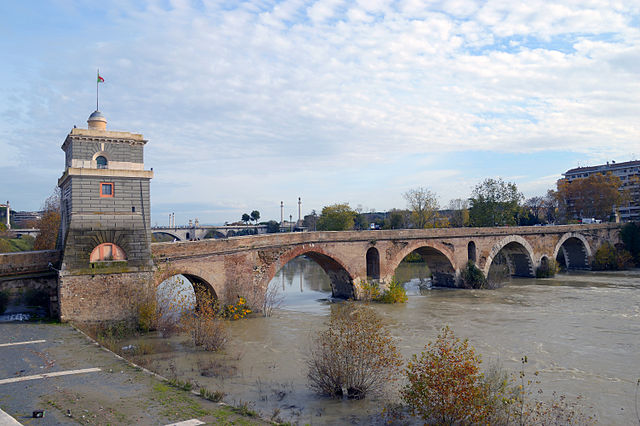
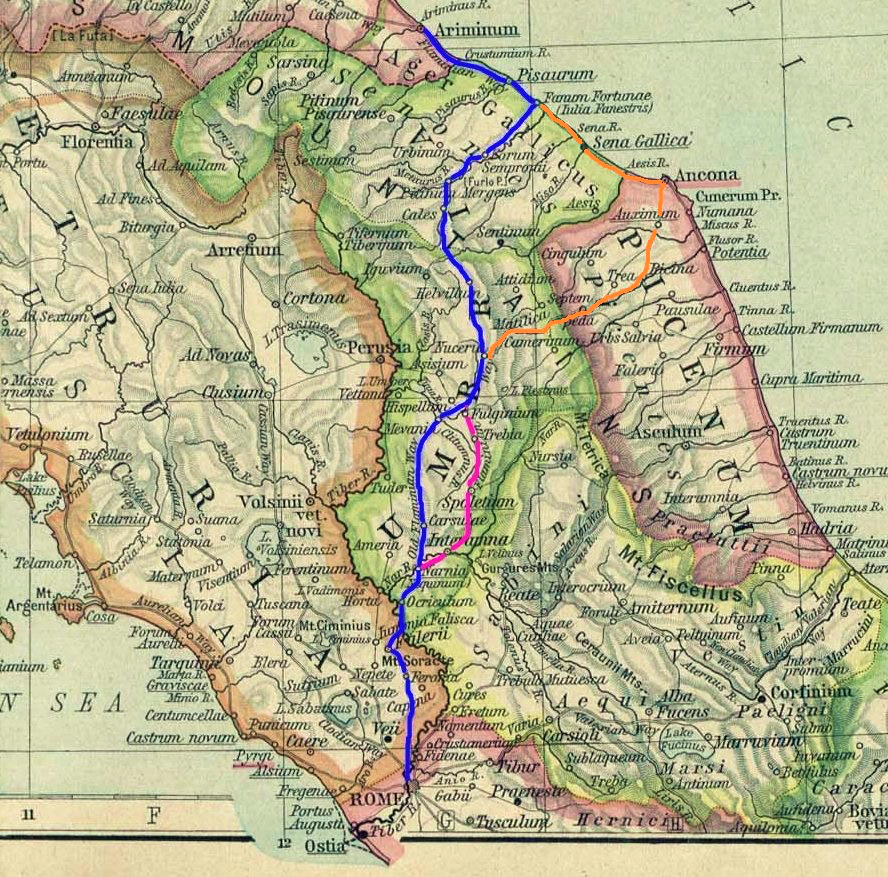
 Main Via Flaminia in blue, later central alternative in pink and ‘branch line’ (Via Septempeda) in orange (CC licence source EH101) ‘All roads lead to Rome‘.
Actually, a fair number do, but it seems the saying wasn’t recorded as being coined by the Romans themselves. Of course, the Romans may well have said it and somebody may have written it down, but that written record, if it existed, has been lost.
The saying derives from medieval Latin. It was first recorded in writing in 1175 by Alain de Lille, a French theologian and poet, whose Liber Parabolarum renders it as ‘mille viae ducunt homines per saecula Romam‘ (a thousand roads lead men forever to Rome). The first documented English use of the proverb occurs more than two hundred years later, in Geoffrey Chaucer’s Astrolabe of 1391, where it appears as ‘right as diverse pathes leden diverse folk the righte way to Rome.‘
Anyway, the Via Flaminia most certainly did lead to Rome right into the city as the Via Lata and became today’s Via del Corso. Today, the Corso, as it’s known colloquially, is a popular place for the passeggiata, the evening stroll for people to be seen and to see others well as being an important shopping street for tourists and locals alike.
The Via Flaminia was first built in 220 BC when Gaius Flaminius was censor, hence the name; it was to be a new road to link Rome with the Adriatic Sea in the north. The starting point was the Porta Fontinalis, a gate in the Servian city walls near present-day Piazza Venezia. The new Via Flaminia cut through the plain between the Tiber and the eastern hills in a straight line. (A typical Roman road, then. 😉 ) The Campus Martius (Field of Mars) was at that time used as a training ground and pasture but numerous tombs must have lined the road in a similar way they did the Appian Way.
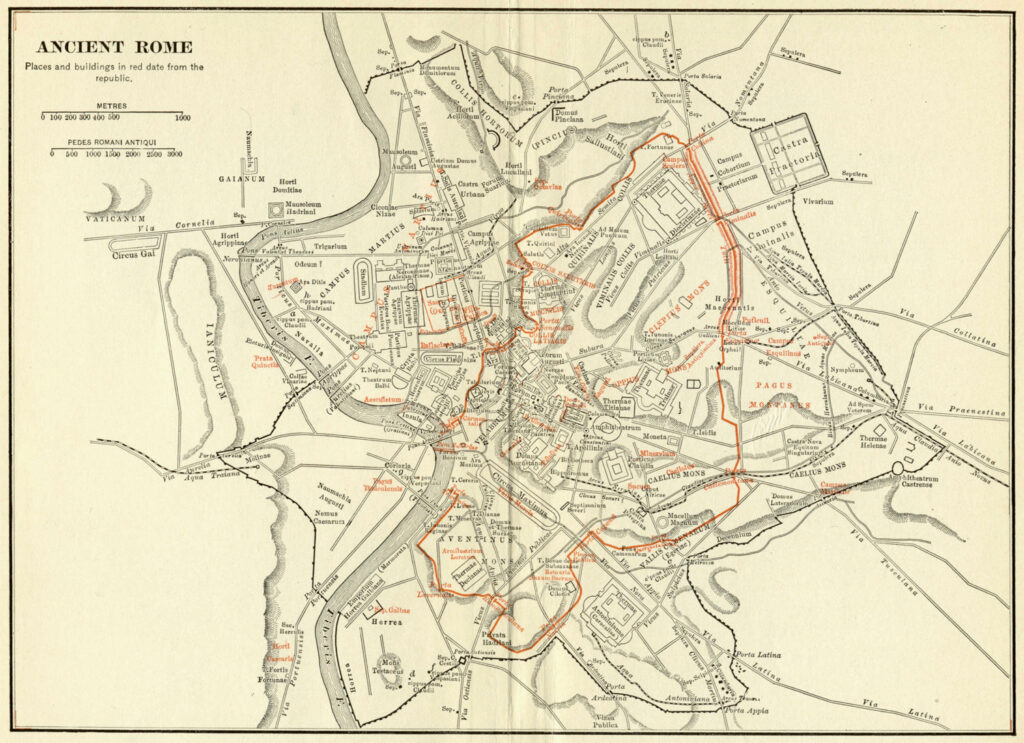 Platner’s map of Rome for The Topography and Monuments of Ancient Rome ,1911. (Public domain) That inveterate builder and improver, Augustus (and probably his henchman Agrippa), instituted a general restoration of the roads of Italy, assigning supervision of different regions to various senators. He reserved the Flaminia for himself and rebuilt all the bridges except the Pons Mulvius (known to us as the Milvian Bridge) by which it crosses the Tiber, 3 kilometres (2 miles) north of Rome (built by Marcus Aemilius Scaurus in 109 BC).
The open area outside the Servian walls became increasingly urbanised during the late Republican and early imperial ages. The city gradually spread towards north and monumental public buildings were built along the road: the most important include Aurelian’s Temple of the Sun, the Ara Pacis, the Ustrinum Domus Augustae, the Ara Providentiae and the Column of Marcus Aurelius. The biggest and tallest of them was the Mausoleum of Augustus.
With the building of the Aurelian Walls (271-75 CE) the whole area was incorporated into the city of Rome, and a new city gate, the Porta Flaminia, was erected at present-day Piazza del Popolo.
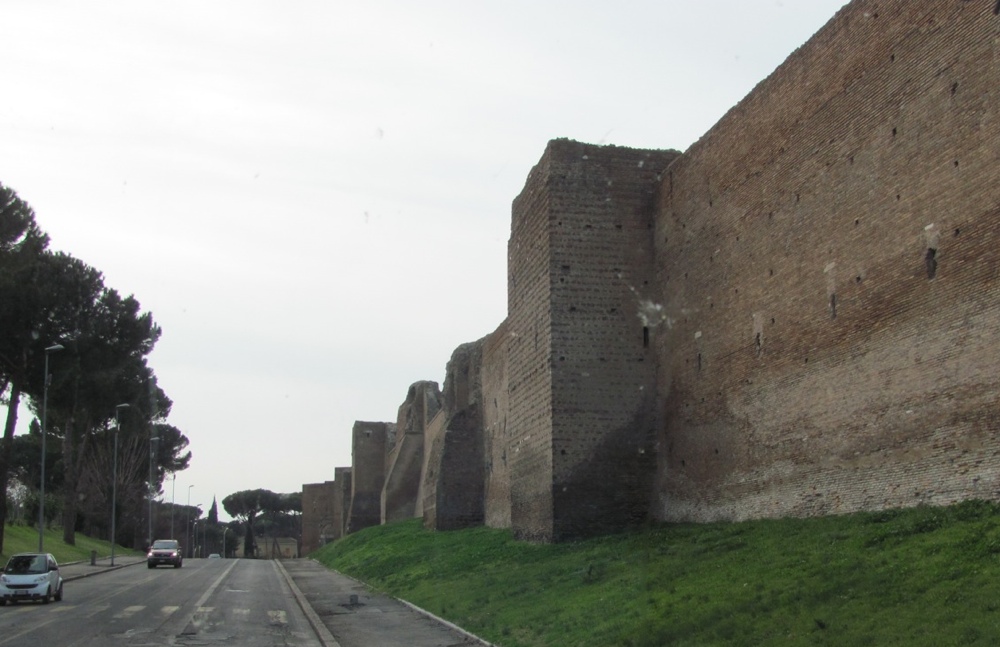 The Aurelian walls in 2012. The cars give an idea of scale! (Author photo) The Via Lata (‘Broad Way’) which connects the Capitoline to the city gate, can be considered the urban stretch of the Via Flaminia. Its name tells us that the street was considered wide, especially in comparison to neighbouring lanes but in narrowed in three places along its length due to triumphal arches; the Arch of Claudius (51-52 CE) (the Aqua Virgo aqueduct crossed the road on top of it), the Arch said to be of Hadrian, later known as the Arco di Portogallo and the Arcus Novus erected by Diocletian in 303-304 CE.
Where did the Flaminia go after it left Rome?
The ancient Roman road led from Rome over the Apennine Mountains to Ariminum (Rimini) on the coast of the Adriatic Sea, and due to the ruggedness of the mountains was the major option the Romans had for travel between Etruria, Latium, Campania, and the Po Valley.
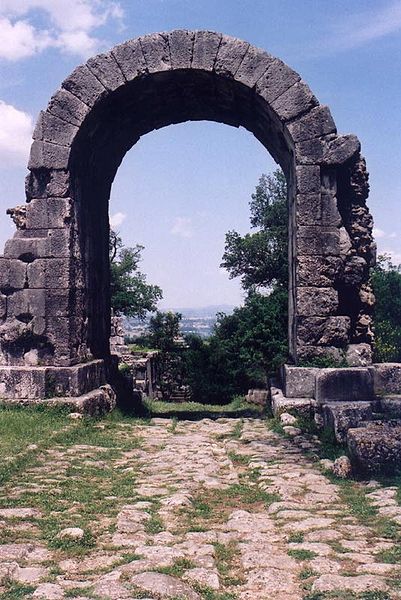 Arch of Trajan and Via Flaminia at Carsulae (CC licence, source: Imcarthur) For my new novel, I was particularly interested in the part of the Via Flaminia between Rome and Ancona on the Adriatic coast. The road runs due north out of Rome, passing slightly east of the site of the Etruscan Falerii (today’s Civita Castellana), crossing the Tiber into Umbria over a bridge where you can still see some traces – the ‘Pile d’Augusto’. From there the Flaminia made its way to Ocriculum (Otricoli) with its fabulous baths complex and Narnia (Narni). (Yes, Narnia! C.S Lewis is supposed to have taken the Roman name as inspiration the setting of his children’s stories…)
Anyway, at Narnia, the road crossed the Nera River by the Ponte d’Augusto, the largest Roman bridge ever built, a splendid four-arched structure to which Martial, no less, mentions. One arch is still standing; another forms part of a modern railway tunnel.
Moving on, the Flaminia proceeded to Casuentum (San Gemini) which passed over two (finely preserved) ancient bridges, through Carsulae (a wonderful undisturbed site) to the Vicus Martis Tudertium (near modern Massa Martana), then Mevania (Bevagna) and Forum Flaminii (S. Giovanni Profiamma).
Later, a more circuitous route from Narnia to Forum Flaminii was adopted, increasing the distance by 12 Roman miles (18 km) and passing by Interamna Nahars (Terni), Spoletium (Spoleto) and Fulginium (Foligno) — from which a branch diverged to Perusia (Perugia). That was the slower option so my characters don’t take it – they go for the original hilly route.
From Forum Flaminii, where the two branches rejoined, the Flaminia went on to Nuceria Camellaria (Nocera Umbra) and my characters travelled along the branch road, the Via Septempeda which ended (or started in their case) at Ancona.
If it ain’t broke, don’t fix it
Today, the route, still called by the same name for much of its distance, is paralleled or overlaid by Strada Statale (SS) 3, also called Strada Regionale (SR) 3 in Lazio and Umbria, and Strada Provinciale (SP) 3 in Marche. Very useful for following on Google Maps and for using satellite view to get an idea of the countryside my characters travel through!
I’m fascinated that the route is practically the same over 2,000 years since the first foundations were laid. During the period of Roman expansion in the 3rd and 2nd centuries BCE, the Flaminia became a main axis for transporting wheat from the Po valley to supply Rome and central Italy. In most of the Roman period, including the end, the Flaminia was the main road leading into the heartland of Italy and like all Roman roads, the way of moving troops quickly and efficiently. Gaius Julius Caesar may have taken advantage of it at the beginning of the civil war, but various Germanic military forces and Byzantine generals found it a vital route hundreds of years later.
A number of major battles werefought on or near the Via Flaminia, for example at Sentinum (near the modern Sassoferrato) and near Tadinum (the modern Gualdo Tadino). Constantine the Great’s famous Battle of the Milvian Bridge occurred along the the Flaminia after his nearby dream of the Chi Rho which led to his conversion – and that of the Roman Empire – to Christianity.
This route, once convenient to Roman citizens and other travellers, is now congested by heavy traffic between northern Italy and the capital in Rome. It remains an important road, but traffic now also reaches Rome by rail and autostrade using dozens of tunnels – shorter, more direct routes under the ridges and passes that their ancestors had to toil over.
Alison Morton is the author of Roma Nova thrillers – INCEPTIO, CARINA (novella), PERFIDITAS, SUCCESSIO, AURELIA, NEXUS (novella), INSURRECTIO and RETALIO, and ROMA NOVA EXTRA, a collection of short stories. Audiobooks are available for four of the series. Double Identity, a contemporary conspiracy, starts a new series of thrillers. JULIA PRIMA, Roma Nova story set in the late 4th century, starts the Foundation stories. The sequel, EXSILIUM, is now out.
Download ‘Welcome to Alison Morton’s Thriller Worlds’, a FREE eBook, as a thank you gift when you sign up to Alison’s monthly email update. As a result, you’ll be among the first to know about news and book progress before everybody else, and take part in giveaways.
If you enjoyed this post, do share it with your friends!
As you’ve seen with the Roma Nova adventures, the whole idea of history taking an alternative path fascinates many people. I was delighted to be invited to join with a group of other authors a little while ago to explore that unique year in English history – 1066. Although there had been mingling of cultures and commerce before, this was the year that Saxon England died and the Norman ascendancy changed the country forever.
Like anybody else interested in history, I knew the general drift of the dramatic stories of courage, shipwreck, blackmail, invasion, self-belief and the romantic allure of ‘the last stand’. Inserting an 11th century Roman into that was a research challenge, but enormous fun. The Mitela of that period, Galla, had a thrilling adventure as well as making a significant intervention in ‘history’.
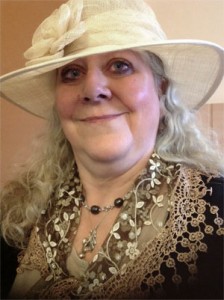 My guest, Helen Hollick knows this period like the back of her hand. So I was intrigued (no, bursting with curiosity to be truthful) about why she had thought up the idea of alternatives to the history we know. My guest, Helen Hollick knows this period like the back of her hand. So I was intrigued (no, bursting with curiosity to be truthful) about why she had thought up the idea of alternatives to the history we know.
So tell us, Helen, why?
Well why not? *laugh*. Seriously, speculative ‘what if’ fiction apart from being highly popular is immensely interesting as a subject of debate between anyone interested in history. What if the Romans had not invaded Britain (as they didn’t invade Ireland or too far into Scotland), what if the White Ship had not sunk – Henry I’s son would not have drowned, would have become the next king, therefore, no civil war between Stephen and Mathilda, no Henry II and no Plantagenets… What If Richard III had won at Bosworth, Katherine of Aragon had borne a healthy son to Henry VIII – the subjects are endless, and one alternative can lead to another. 1066 is a prime example, and 1066onites (is that a viable word?) like nothing more than speculating whatcould have happened if King Harold II had won that day on a battlefield seven or so miles from the coast at Hastings. Harold followers (as I am) also like to place him in a good light – he is an English hero to many, he died nobly, defending his kingdom against foreign invasion by a ruthless tyrant.
Do you think alternative history can be considered as historical fiction?
Oh yes, definitely! (The clue is in the word ‘fiction’). Fiction isn’t real, it’s made-up imagination, so why shouldn’t alternative ideas, scenarios, beginnings and endings with ahistorical feel or connection be regarded as quality fiction – providing it is written well and comes across as believable and plausible. Your own Roma Nova series, Alison, is a very good example. The events and the people are not real, it never happened or existed, Roma Nova is not a real place – but – it could have been. The stories are written so skilfully with meticulous research and exquisite detail that many a Roma Nova reader cannot understand why we cannot find the place on a map! And in a way, is not all historical fiction speculative and even alternative? No one knows for certain the actual facts, after all!
In the anthology 1066 Turned Upside Down, only one of the contributing authors writes in the alternative history genre – me. One other writes science fiction and you and Joanna Courtney managed the whole project. So how did you go about persuading other very well-respected writers of standard historical fiction to join in?
Oh I’m very good at twisting arms… Those of us who write ‘straight’ historical fiction jumped at the chance to change the course of history. In one of Joanna’s stories Harald Hardrada of Norway wins at Stamford Bridge in September 1066 (which could then lead to more debate: Duke William of Normandy had already landed on the south coast – would Hardrada have also fought him? Would he have won or lost? If he lost, the Norman Conquest would still have happened…) In one of my two stories included in the anthology, William’s fleet was defeated at sea by the English Navy (although I confess, this isn’t really speculation, I very firmly believe that this happened.) In a way all of the stories in the collection are ‘alternative’ in that they are all ‘what if’ based, but I specifically wanted you, Alison, aboard as I felt, at the time (a good few years ago now!) that the history of Roma Nova should be expanded. I remember saying to you: “But if Roma Nova was real, and it has survived until the present day its people would have been most concerned about the events of 1066? Surely they would have at least taken note, if not directly intervened?” And I also really wanted to know what Duke William would have thought of women holding the reins of power.
Do you have any plans to explore other ‘what ifs’?
Yes, although organising such things is not as easy as it first looks! I would like to explore the possibility of a follow-up ‘History Turned Upside Down’ instead of concentrating on a single year, have an alternative ‘what if’ for each century: What If Boudicca had won? What if Alfred The Great had lost to the Danes? What If the Black Death had come much later? What If … what if… the possibilities could fill several huge tomes. I’d like to have something in common tucked into each story, maybe a ring or a facial feature for a character, or each story must have a horse, dog or cat in it, or… well, you get the drift! I might get around to organising this project in 2022. Watch this space – applications to join in, welcome!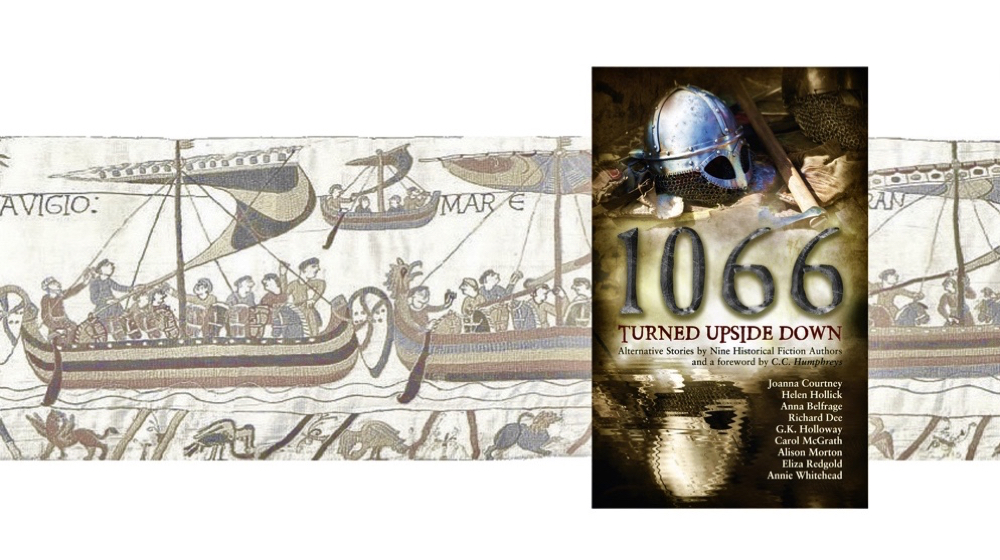
You can buy 1066 Turned Upside Down from these retailers: Amazon Nook Kobo Apple
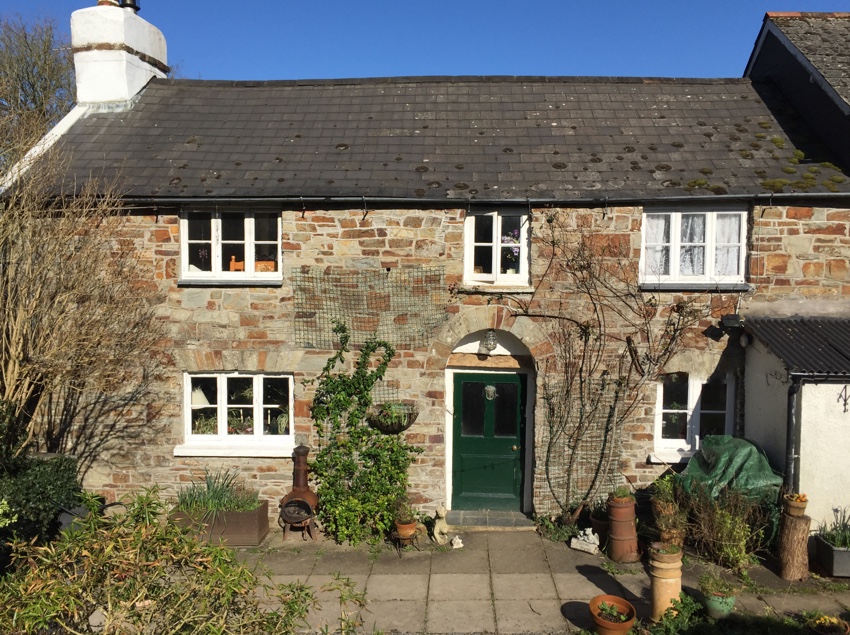
Helen Hollick moved her family from north-east London in 2013 to an eighteenth-century North Devon farm house through being a ‘victim’ on BBC TV’s popular Escape To The Country show. Talk about changing your life’s time-line! She enjoys her new rural life, and has a variety of animals on the farm, including hens, ducks, geese, dogs, cats, goats, Exmoor ponies and her daughter’s string of show jumpers.
Helen became a USA Today Bestseller with her historical novel, The Forever Queen (titled A Hollow Crown in the UK) with the sequel, Harold the King (US: I Am The Chosen King) novels that explore events that led to the Battle of Hastings in 1066. Her Pendragon’s Banner Trilogy is a fifth-century version of the Arthurian legend, and she also writes a pirate-based nautical adventure/fantasy series, The Sea Witch Voyages. She has contributed to two short story anthologies, 1066 Turned Upside Down and Betrayal.
She’s now branching out into the quick read novella, ‘Cosy Mystery’ genre with her new venture, the Jan Christopher Mysteries, set in the 1970s, with the first in the series, A Mirror Murder incorporating her, often hilarious, memories of working for thirteen years as a library assistant. Another divergence from her personal time-line…
Her non-fiction books are Pirates: Truth and Tales and Life of A Smuggler. She also runs Discovering Diamonds, a review blog for historical fiction, a news and events blog for her village and the Community Shop, sometimes assists as ‘secretary for the day’ at her daughter’s regular showjumping shows – and occasionally gets time to write…
Connect with Helen
Website: www.helenhollick.net
Blog: www.ofhistoryandkings.blogspot.com
Twitter: https://twitter.com/HelenHollick @HelenHollick
Amazon Author Page (Universal Link) http://viewauthor.at/HelenHollick
Newsletter Subscription: http://tinyletter.com/HelenHollick
Facebook: www.facebook.com/HelenHollickAuthor
Discovering Diamonds Historical Fiction Review Blog :
https://discoveringdiamonds.blogspot.co.uk/
Alison Morton is the author of Roma Nova thrillers – INCEPTIO, CARINA (novella), PERFIDITAS, SUCCESSIO, AURELIA, NEXUS (novella), INSURRECTIO and RETALIO, and ROMA NOVA EXTRA, a collection of short stories. Audiobooks are available for four of the series. Double Identity, a contemporary conspiracy, starts a new series of thrillers. Double Pursuit, the sequel, is now out!
Download ‘Welcome to Alison Morton’s Thriller Worlds’, a FREE eBook, as a thank you gift when you sign up to Alison’s monthly email newsletter. You’ll also be among the first to know about news and book progress before everybody else, and take part in giveaways.
If you enjoyed this post, do share it with your friends!
Do you ever wish things might have turned out differently in the past, or that we could know all those enticing titbits of hidden history? In all the short story collections I’ve participated in, I’ve always written on this theme.
So in the two previous posts about short stories, we’ve looked at alternative outcomes to 1066, then at multiple aspects of the 1229 year history of Rome (in the West).
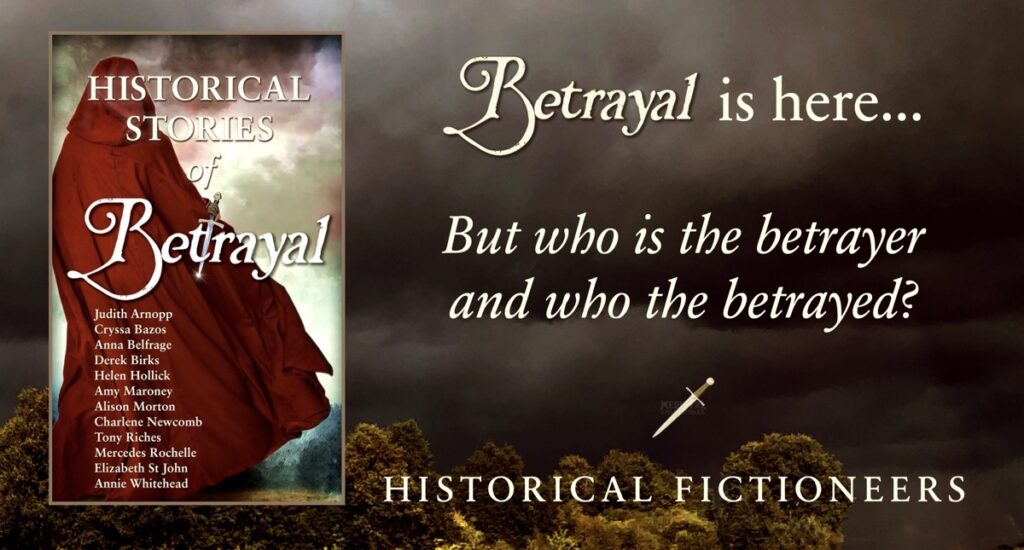
This time, we’re going for a whole stretch of history. Spanning eras from post-Roman Britain to the present day, this collection brings to life legendary moments of deceit as well as imagined episodes of treachery.
In The Idealist, you meet Roma Nova’s much-loved Carina and Conrad again. Carina is in top snappy form as you’d expect but she’s devastated to discover a dark piece of Mitela family history from the 1840s which could rebound into the 21st century and bring ruin and exile for her, her children and family into perpetuity. (So nothing too drastic… 😉 )
I know, writing a dual timeline short story was madness, but you do get 12,000 words from me!
In stories by the other authors, you’ll encounter princes, soldiers, noblewomen, knights, highwaymen, pirates, and ordinary people caught up in extraordinary circumstances. All of these characters have something in common, though – betrayal. Collectively, these stories illustrate the truth that whatever its source – family, foe, lover, comrade – betrayal has devastating consequences.
Based on two continents and in five countries, the Historical Fictioneers include Judith Arnopp, Cryssa Bazos, Anna Belfrage, Derek Birks, Helen Hollick, Amy Maroney, me, Char Newcomb, Tony Riches, Mercedes Rochelle, Elizabeth St John and Annie Whitehead.
And with these colleagues three of the four benefits of writing such collections were fulfilled many times over:
- an opportunity to stretch your writing muscles
- fun to join in a project with writing colleagues (new and old)
- a chance to strut your stuff to their readers and beyond
The fourth, ‘sometimes you make a few bob’ doesn’t apply as we made the decision to offer the collection free of charge on Amazon, Apple, B&N Nook, Kobo and many other ebook retailers. You can go to them all via this link: https://books2read.com/BetrayalAnthology
Here’s an extract from my story set in 1849/the present about Statia Mitela who was much too much of an idealist for her own good. And she never dreamed it could affect her 21st century descendant, Carina.
Outskirts of Rome, Italy, 2nd July 1849
‘Mercury be thanked,’ Statia rasped when she saw the ancient milestone ‘Roma VI.’ And these would be six good Roman miles. She swallowed hard which made her dry throat worse. Despite the broad-brimmed riding hats the four of them wore, the brutal heat of the early July sun beat down, exhausting them all. Statia pulled up her mount under the shade of one of the occasional clumps of pines and patted his shoulder almost absent-mindedly. The poor horse, a hired animal, was as weary as she was. And as dusty from the road.
‘Domina?’ Her leading companion drew up beside her.
‘I need a drink, Valerius,’ she said and swivelled round in her saddle. The other two riders were only a few paces behind. ‘And so do the animals.’
‘The Anio below us would be best and we can rest by the bank.’
They picked their way down to the river where Valerius supervised the two servants watering the horses. After a few moments, he left them to it and sat by Statia on the wool rug she had pulled from her saddle pack.
‘Yes,’ she said as he stared at it. ‘I know. Well and good for the mountains we’ve come through from the Adriatic, but inappropriate for Rome in June. But even though we’re incognito, I don’t want to enter Rome with grass stains or mud on my breeches’ arse.’
Valerius laughed. The first time, Statia noted, since they’d left Roma Nova eleven days ago under the cover of darkness. She hadn’t known what a terrible sailor he was until they’d slipped out of Pula in Istria on the merchant ship. He’d kept a pale, grim, nearly green face until they’d landed safely at Aternum, or Pescara as the Italians called it now.
A former Praetorian centurion, Valerius was used to travelling fast through mountains on ramshackle cold trails. These days, he guarded her home, the Domus Mitelarum, but more than that, he gave her, informally, wise counsel almost as a father would. He’d tried to stop her mission, calling it demented, but had given in with a grunt when she said she would go with or without him. Now they were near Rome, Statia was starting to have her doubts. Perhaps she should have stayed on the farm at Castra Lucilla where she knew what she was doing.
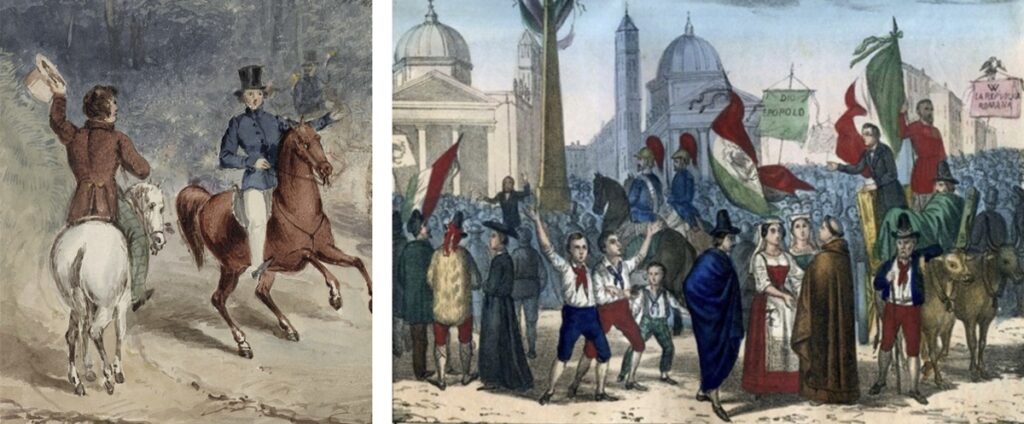
No, she must go on, whatever the cost. She had promised and that was an end on it. She knew the consequences could be harsh, but she was sure the imperatrix would see the justice of it. Well, Statia hoped she would. Constantia Apulia’s disinclination to help the new Roman Republic played on Statia’s mind. Consulted in strictest confidence, Councillor Branca, the imperatrix’s chief advisor, had pointed out to Statia that it would be reckless and would have to be carried out in the utmost secrecy if she insisted on going ahead.
Despite their friendship since childhood, a running dispute over land near Castra Lucilla had soured their relationship. Branca desperately wanted back the spelt fields that had been sold by her ancestor to Mitela in the fifteenth century. However, despite their bickering Statia had felt obliged to consult Branca about her self-imposed mission as the latter was the Imperatrix’s chief councillor. Statia hadn’t been fully reassured by Branca’s words but she hoped the councillor would act honourably and support Statia if there were repercussions.
——
Branca. Hm. Was Statia right to trust her? And what was the secret mission that nineteenth century Roma Novan Statia was engaged on? And how di the repercussions run down the centuries?
Download a free copy of Betrayal and you will find out! https://books2read.com/BetrayalAnthology
Alison Morton is the author of Roma Nova thrillers – INCEPTIO, CARINA (novella), PERFIDITAS, SUCCESSIO, AURELIA, NEXUS (novella), INSURRECTIO and RETALIO, and ROMA NOVA EXTRA, a collection of short stories. Audiobooks are available for four of the series. Double Identity, a contemporary conspiracy, starts a new series of thrillers. Double Pursuit, the sequel, is now out!
Download ‘Welcome to Alison Morton’s Thriller Worlds’, a FREE eBook, as a thank you gift when you sign up to Alison’s monthly email newsletter. You’ll also be among the first to know about news and book progress before everybody else, and take part in giveaways.
If you enjoyed this post, do share it with your friends!
|
Subscribe to Blog via Email
Join 37 other subscribers.
Buy AURELIA from Apple!
UK

US
|