


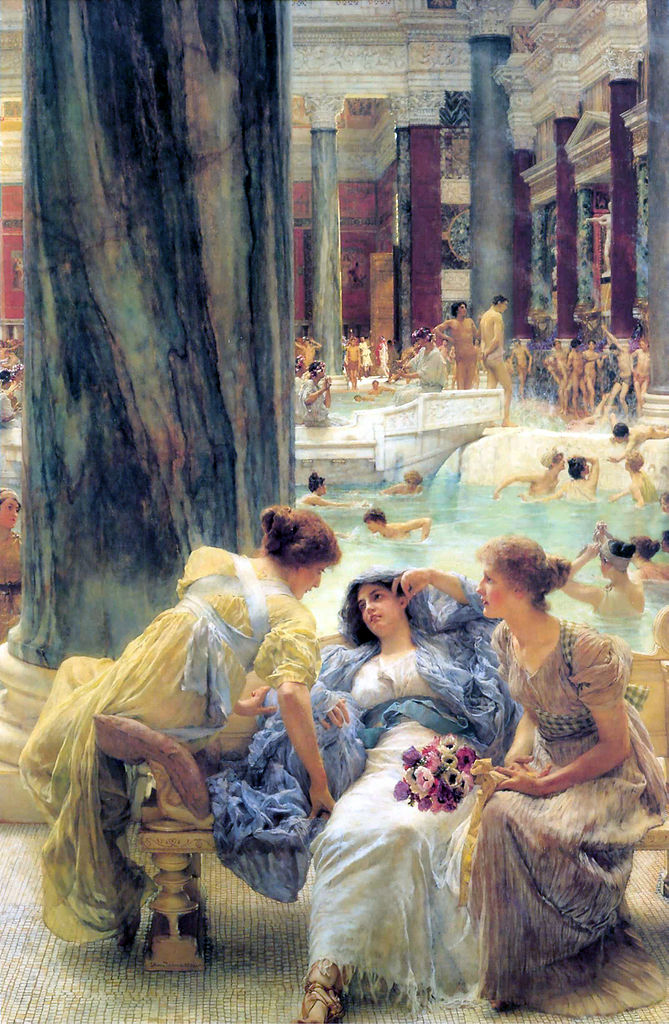
Painting of Baths of Caracalla by Laurence Alma Tadema
Baths were such an intrinsic part of the Roman world that we can’t think of one without the other. Everybody went to the baths – everybody. Read how here.
Well, none of us like to smell. A recent trip to the former bathhouse in my nearby town of Thouars in the Deux-Sèvres set me thinking…
Christians and Roman bathing
Despite the denunciation of the mixed bathing style of Roman pools by early Christian clergy, as well as the pagan custom of women bathing naked in front of men, this did not stop the Church from urging its followers to go to public baths for bathing for hygiene and good health (according to the Church Father, Clement of Alexandria).
In fact, the Church built public bathing facilities separate for both sexes near monasteries and pilgrimage sites and popes situated baths within church basilicas and monasteries from the early Middle Ages.
Great bathhouses were built in Byzantine centres such as Constantinople and Antioch. The popes maintained their baths in their residences. Bath houses including hot baths were incorporated into Christian church buildings or those of monasteries, which known as “charity baths” because they served both the clerics and needy poor people.
Medieval bathing
Public bathing were common in mediaeval Christendom larger towns and cities such as Paris, Regensburg and Naples. Later, Protestantism also played a prominent role in the development of British spas.
Returning crusaders in the 11th and 12th centuries who had enjoyed warm baths in the Middle East, introduced Roman style public baths on a limited scale. These, however, rapidly degenerated into brothels – at least that was their reputation _ and were often closed down. In England during the reign of Henry II, bath houses, called bagnios from the Italian word for bath, were set up in Southwark on the River Thames. They were all officially closed down by Henry VIII in 1546 due to their negative reputation.
Modern public bathing
The first modern public baths were opened in Liverpool in 1829. The first known warm fresh-water public wash house was opened in May 1842. As a small child in the late 1950s, I remember a small suite of ‘slipper baths’ in my local swimming pool built around 1906. I was intensely curious about them as I thought everybody had a bath at home.
Today, we see bathing as something we do privately in the home, but bathing in public has been a communal, social activity for a long time.They have included hot-air bathing facilities such as hammams, Victorian Turkish baths, and saunas.
As the percentage of dwellings containing private bathrooms increased in many societies, the need for public baths diminished. This was the story of the Bains-Douches in my local town of Thouars. Intended to serve the hygiene needs of the town’s poorer population, the bathhouse was also designed to include a public laundry area. No more washing clothes in the river, they thought.
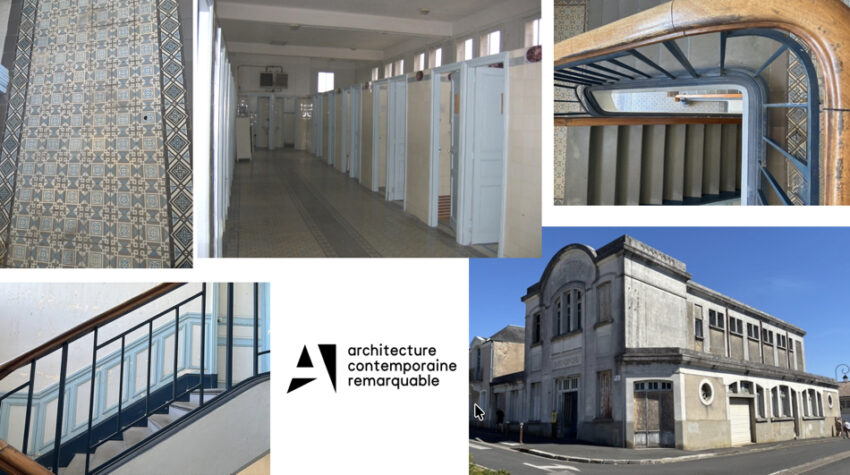
A little bit of history
Although first proposed before the First World War, the construction of a public bathhouse in the up and coming railway town of Thouars was not finally approved until 1923 – a time when the working-class population was growing and few homes had bathrooms. The project faced delays caused by State Railway employees who deemed the venture unprofitable due to a poor choice of location near the historic centre – the railway station and the railway employees’ housing was a good kilometre to the north. Moreover, despite subsidies promised by the Ministry of the Interior, they considered the cost excessive. This opposition prompted the town to modify the original plans.
Ultimately built between 1927 and 1929 by Parisian architect Louis Lablaude, the structure stands on the site of a former medieval tower. The medieval town of Thouars had formidable ramparts with forty towers, so the sacrifice of one to meet modern needs was not considered too much of a sacrifice. However, the roof design caused recurring waterproofing issues and was not finally resolved until the late 1940s.
During the Second World War, German troops took it over. The general public could still access it on Sundays until coal supplies ran out, which they often did. After the Liberation in 1944, people used the Bains-Douches again. It symbolised many things – regaining their town, cleanliness and community cohesion.
However, interest in the public bathhouse waned during the 1960s and 1970s as more households acquired their own bathrooms. In 1974, the town of Thouars decided to limit the bathhouse’s opening hours to just one day a week: Saturday. Given the strong initiative in the late 1950s and 1960s to connect every house in France to running water supply, I’m surprised to hear it was still operating, even on a restricted basis!
In October 1993, the town council voted to permanently close the building, a decision that took effect in 1994.
Architecture and layout
The outstanding feature of the building is the Art Deco style design. The roof consists of several reinforced concrete terraces. The bath and shower area, located on the first floor, was originally laid out – though modified due to budget constraints – to include 17 shower cubicles, 4 bathtubs, and an on-site apartment for the caretaker. A wooden partition down the middle of the main hall ensured separation of the sexes!
A public laundry facility was also available for residents.
After the closure
The building currently houses Les Restos du Cœur, which has remained on the ground floor despite the facility’s closure. The charity was founded by comedian Coluche (1944–1986) and its main activity is to distribute food packages and hot meals to those in need. The association targets the homeless and those with of low income (single families, elderly people with a low pension, young adults, etc.) and also helps people to find housing as well as supporting other projects.
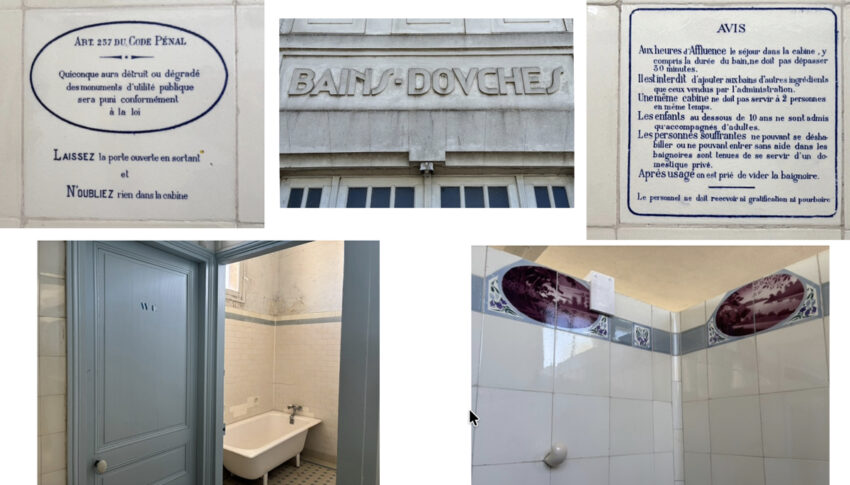
The building has retained its bathtubs, shower cubicles, door-mounted sand timers, and blue-and-white tiles. It’s one of the last bath-and-shower facilities in the Grand Ouest region of France to be preserved in its original state.
In 2015, the Bains-Douches of Thouars was awarded the Patrimoine du xxe siècle label , followed by the Architecture contemporaine remarquable label. It has been listed as a historical monument since November 7, 2022.
My visit
I loved the architecture! Everything is rounded and geared to style as well as creating a human-friendly environment. Original features like the polished wood banister rail and the pretty tiled floor were evidence of this. The shower feed pipes were quite thin, so nothing like the rainfall shower heads of today’s power showers! Decorative tiles depicting landscape scenes both inside and outside the cabins added a luxurious touch. But there were definite but practical rules embedded in the cabins on wall tiles too. I smiled at them – all very sensible – especially the rule that you could be accompanied by one of your servants if you had difficulty getting dressing and undressed. A sign that the baths were used by all classes.
Alison Morton is the author of Roma Nova thrillers – INCEPTIO, CARINA (novella), PERFIDITAS, SUCCESSIO, AURELIA, NEXUS (novella), INSURRECTIO and RETALIO, and ROMA NOVA EXTRA, a collection of short stories. JULIA PRIMA and EXSILIUM, set in the late 4th century, tell the story of Roma Nova’s foundation. Audiobooks are available for four of the series. Double Identity, Double Pursuit and Double Stakes form a new contemporary thriller series. A new collection of Roma Nova short stories, HEROICA, is now out.
Download ‘Welcome to Alison Morton’s Thriller Worlds’, a FREE eBook, as a thank you gift when you sign up to Alison’s monthly email update. As a result, you’ll be among the first to know about news and book progress before everybody else, and take part in giveaways.





Leave a Reply