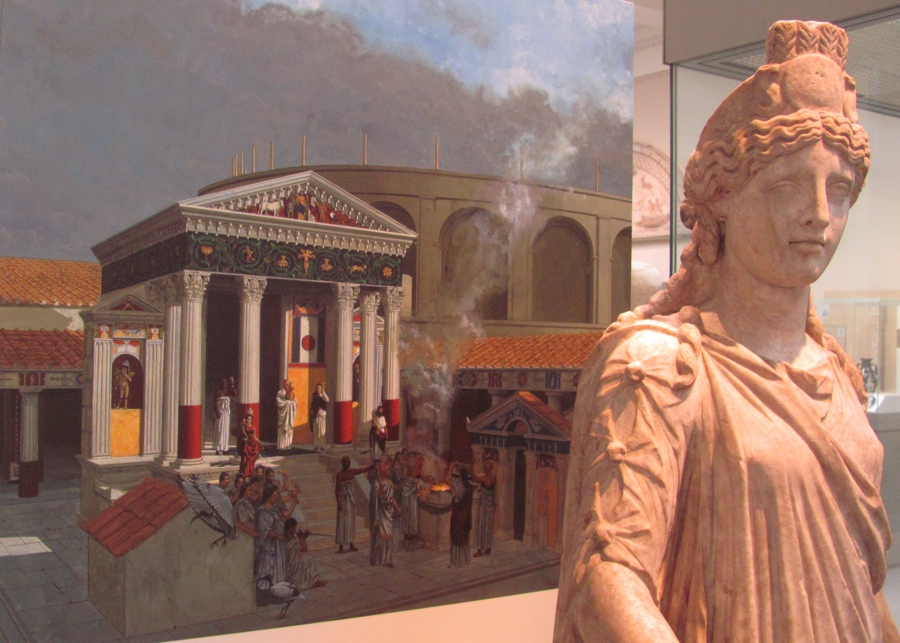
British Museum display (Author photo)
Probably because of various Hollywood films, it’s “general knowledge” that those nasty Romans spent all their time killing Christians.
Well, no…
Romans, for the most part, were comparatively tolerant in matters of religious belief and allowed countless religious sects, cults, saviours and redeemers to proselytise without restrictions. Most often, the local gods were integrated into the Roman pantheon which gave rise to hybridised names like Sulis Minerva and Mars Toutates. Loyal and submissive members of society could believe in any deity they wanted, including Christ. Belief was a private matter of no interest to the Roman authorities.
But… And it’s a big ‘but’.
Roman cohesion was based on obedience to authority and on public pledges of loyalty to the state; you demonstrated this by symbolical sacrifices to the Roman gods. Romans persecuted whoever refused to pledge loyalty to Roman authority. (Even a pinch of incense at an altar iin the name of any of them would do.) Those Christians (and any other religious adherents e.g. Jews) who refused to sacrifice to the Roman gods were deemed to refuse allegiance to the Roman state and that was the crux of the problem.
Persecution of Roman Empire Christians
For much of the first three hundred years, Christians were able to live in peace, practice their professions, and rise to positions of responsibility. However, Christians’ beliefs would not have endeared them to many government officials: their religion was exclusive not accepting the existence of any other deities, they worshipped a convicted criminal, refused to swear by the emperor’s genius, harshly criticised Rome in their holy books and suspiciously conducted their rites in private. Pliny in his letter to Trajan around 112 AD (Letters 10.96-97) found nothing but “depraved, excessive superstition”. Mary Beard (SPQR, Profile Books, 2015) states that Christians were preaching values that threatened to overturn fundamental Graeco-Roman values by saying that poverty was good and the body was to be tamed or rejected rather than cared for.
Cue confused Romans.
Persecution of Christians in the Roman Empire did occur intermittently between the Great Fire of Rome in AD 64 under Nero and the Edict of Milan in AD 313. Officially sanctioned Roman persecution was most intense during the reigns of Marcus Aurelius (AD 161-180), Decius (AD 249-251), Diocletian (AD 281-205) – particularly severe – and Galerius (AD 305-312).
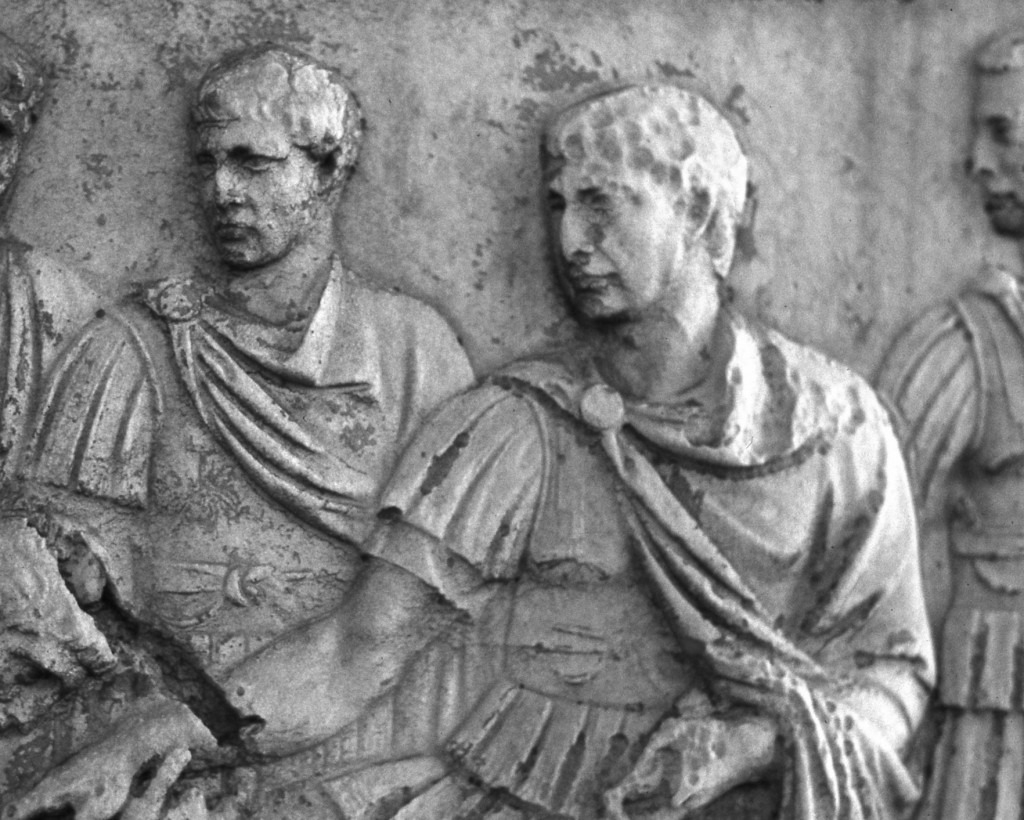
Roman governor, Trajan’s column
Provincial governors had a great deal of personal discretion in their jurisdictions and could choose themselves how to deal with local incidents of persecution and mob violence against Christians.
Empire-wide persecution took place as an indirect consequence of an edict in 250 AD emperor Decius. This required everyone in the Empire (except Jews, who were exempted) to perform a sacrifice to the gods in the presence of a Roman magistrate and obtain a signed and witnessed certificate, called a libellus, to prove they had done this. Decius was determined to restore traditional Roman values. However, there is no evidence that Christians were specifically being targeted. This edict was in force for eighteen months, during which time some Christians were killed while others apostatised to escape execution.
The total number of victims of all these persecutions shows that over the first three centuries AD, the polytheistic Romans killed no more than a few thousand Christians across their territory. Attempts at estimating the numbers involved are inevitably based on inadequate sources, but one historian of the persecutions estimates the overall numbers as between 5,500 and 6,500, (W. H. C. Frend (1984), The Rise of Christianity, Fortress Press, Philadelphia), a number also adopted by later writers including Yuval Noah Harari (Yuval Noah Harari, (2014) Sapiens: A Brief History of Humankind. United Kingdom: Harvil Secker).
Early persecution of Christians arose essentially from a feeling of “otherness” that Christians aroused in the society of the time, being adverse as they were to participating in the religious life of the Roman Empire at large. Private religion, or the sacra privita, was not regulated by the state until official Christianisation of the empire when Roman emperors Constantine and Licinius legalised the Christian religion.
Private religion had been the business of the family and the individual, and varied between various ethnic groups. As such, many of those worshipping traditional gods were not opposed to Christian theology per se, but rather to the motivations of early Christians who seemed rather “unpatriotic” in their isolation and aggressiveness towards other faiths.
So what about the persecution of Roman pagans?
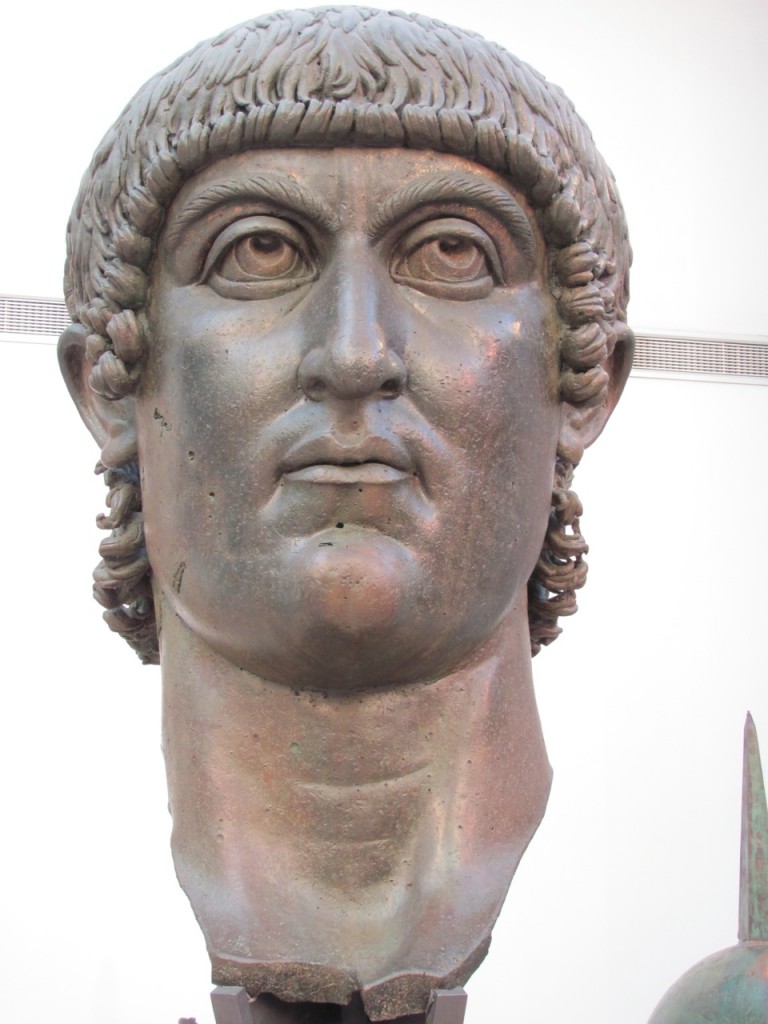
Bronze version of Constantine’s head, Capitoline Museum, Rome (Author photo)
The persecution of pagans in the Roman Empire began late in the reign of Constantine the Great, when he ordered the pillaging and the tearing down of some temples, although he did not initiate a purge. Constantine never directly outlawed paganism. In the words of an early edict, he decreed that polytheists could ‘celebrate the rites of an outmoded illusion’, as long as they did not force Christians to join them. (P.Brown, The Rise of Christendom)
Anti-pagan laws started with Constantine’s son Constantius II; he ordered the closing of all pagan temples, forbade pagan sacrifices under pain of death and removed the traditional Altar of Victory, said to guard the fortune of Rome, from the Senate building in AD 357. Under Constantius II’s reign, ordinary Christians began to vandalise pagan temples, tombs and monuments without legal penalty.
The Altar was later restored by the emperor Julian (reigned AD 361-363), who was the only emperor after the conversion of Constantine I to reject Christianity. From 361 until 375, paganism was relatively tolerated. This ended under the reigns of three emperors – Gratian, Valentinian II and Theodosius I – who were influenced by the austere and ambitious bishop of Milan, Ambrose. At his suggestion, anti-paganism policies of Constantius II were reinstated.
The Momentous Event
Theodosius I became increasingly unsympathetic to any traditional Roman religious practice. While co-emperor in the East, he issued a series of decrees between AD 389 and 391 including a comprehensive law that prohibited the performance of any type of pagan sacrifice or worship (Theodosian Code 16.10.12). Traditional Roman polytheist worship was now proscribed, a ‘religio illicita‘.
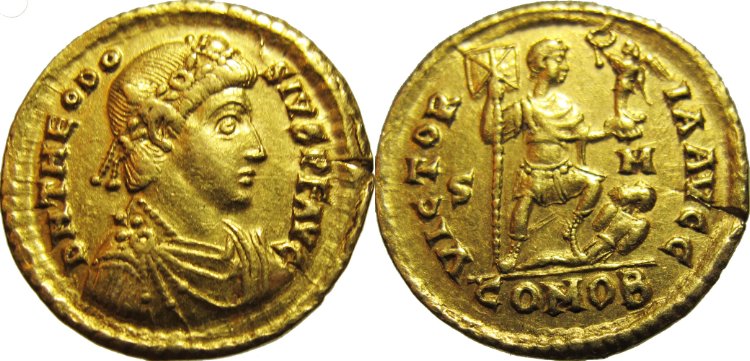
Gold solidus of Theodosius I
By AD 392,Theodosius became de facto emperor of both Eastern and Western Empires and in the same year he officially began to proscribe the practice of paganism. The Roman senatorial families, led by Symmachus, the prefect of Rome, pleaded for religious tolerance but Theodosius made any pagan practice, even dropping a pinch of incense on a family altar in a private home, into a capital offence.
In September 394, the Battle of the Frigidus River was lost by the pagan commander Arbogast under the command of Western emperor Eugenius; this defeat was propagandised as the last military defeat of paganism. And Theodosius’s ‘religious police’ driven by bishop Ambrosius of Milan, became increasingly active in pursuing pagans…
By the mid 390s, Theodosius had closed and destroyed all temples and dismissed all priests. The sacred flame that had burned for over a thousand years in the College of Vestals was extinguished and the Vestal Virgins expelled. The Altar of Victory, removed for a second time by Gratian in AD 382, but restored by the usurper Eugenius during his short-lived rule (392-394), was hauled away from the Senate building for the last time and disappeared from history.
Examples of the destruction of pagan temples in the late fourth century and early fifth century, as recorded in surviving texts, are:
- Martin of Tours attacks on holy sites in Gaul
- the destruction of temples in Syria by Marcellus
- the destruction of temples and images in, and surrounding, Carthage
- the ruination of the temple at Delphi
- the desecration of the mystery cult in Eleusis
- the Patriarch Theophilus who seized and destroyed pagan temples in Alexandria
- the levelling of all the temples in Gaza
- the destruction of the gigantic Serapeum of Alexandria in AD 391
But, of course, there were many deaths.
Hypatia – an example
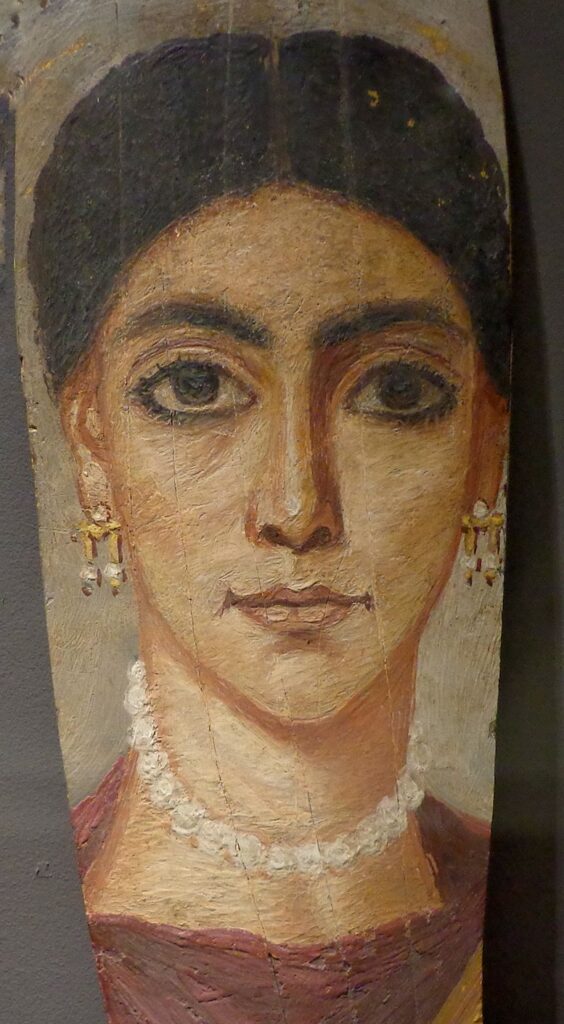
Did Hypatia look like this? Fayum funeral portrait, Musée des Beaux-Arts de Strasbourg
Born between AD 350-370, Hypatia was a Hellenistic Neoplatonist philosopher, astronomer, and mathematician, who lived in Alexandria, Egypt, then part of the Eastern Roman Empire. She was a prominent thinker of the Neoplatonic school in Alexandria where she taught philosophy and astronomy. She is the first female mathematician whose life is reasonably well recorded.
Although she herself was a pagan, she was tolerant towards Christians and taught many Christian students, including Synesius, the future bishop of Ptolemais. Ancient sources record that Hypatia was widely beloved by pagans and Christians alike and that she exercised considerable influence within the political elite in Alexandria. Shortly before she was murdered, Hypatia advised Orestes, the Roman prefect of Alexandria, who was in the midst of a political feud with Cyril, the bishop of Alexandria.
Rumours spread accusing her of preventing Orestes from reconciling with Cyril. In March AD 415, she is said to have been murdered by a mob of Christians led by a lector named Peter. Hypatia had hoped to establish a precedent that Neoplatonism and Christianity could coexist peacefully and cooperatively. Her death and the subsequent failure by the Christian government to impose justice on her killers destroyed that notion entirely and led future Neoplatonists such as Damascius to consider Christian bishops as “dangerous, jealous figures who were also utterly unphilosophical.”
Did it all end there?
Anti-paganism policies continued from Theodosius’s reign until the formal end of the Roman Empire in the west (AD 476). Given that anti-paganism laws were brought in throughout this period by succeeding emperors – Arcadius, Honorius, Theodosius II, Marcian and Leo I – and penalties increased, we can assume that traditional Roman religion still had many followers. Support for paganism was still present among Roman nobles, senators, magistrates, imperial palace officers, and other officials, who often protested or failed to enforce the edicts (Sources: Zosimus, Sidonius).
Worship of traditional gods would have been to be carried out in secret in order to comply formally with the edicts. Some pagans pretended to convert to Christianity while secretly continuing traditional practices. Some Christians apostatised by converting back to paganism; we can conclude this from the introduction of numerous laws against apostasy and the increase in penalties. Pagans openly voiced their resentment in historical works, such as the writings of Eunapius and Olympiodorus; some writers blamed the Christian hegemony for the Sack of Rome in AD 410. Christians destroyed almost all such political literature and threatened to cut off the hands of any copyist who dared to make new copies of the offending writings.
Laws declared that buildings belonging to known pagans and heretics were to be appropriated by the churches. Augustine of Hippo exhorted his congregation in Carthage to smash all tangible symbols of paganism they could lay their hands on. Persecution was less rigorous in some periods under the influence of the high-ranking general Stilicho and under the “usurper” Joannes Primicerius. A pagan revival was attempted by Anthemius from AD 467 and intermittently into the beginning of the sixth century. But although people in the countryside or remote locations may have held to the traditional gods, most people living in the lands of the late and then former Western Roman Empire would have been pragmatic; become Christian, or pretend to do so, and thus avoid disadvantage, ostracism and persecution.
________
Further reading:
Christendom: The Triumph of a Religion, AD 300-1300 – Peter Heather
The Darkening Age: The Christian Destruction of the Classical World – Catherine Nixey
Updated and republished March 2024
Alison Morton is the author of Roma Nova thrillers – INCEPTIO, CARINA (novella), PERFIDITAS, SUCCESSIO, AURELIA, NEXUS (novella), INSURRECTIO and RETALIO, and ROMA NOVA EXTRA, a collection of short stories. Audiobooks are available for four of the series. Double Identity, a contemporary conspiracy, starts a new series of thrillers. JULIA PRIMA, Roma Nova story set in the late 4th century, starts the Foundation stories. The sequel, EXSILIUM, is now out.
Download ‘Welcome to Alison Morton’s Thriller Worlds’, a FREE eBook, as a thank you gift when you sign up to Alison’s monthly email update. You’ll also be among the first to know about news and book progress before everybody else, and take part in giveaways.