


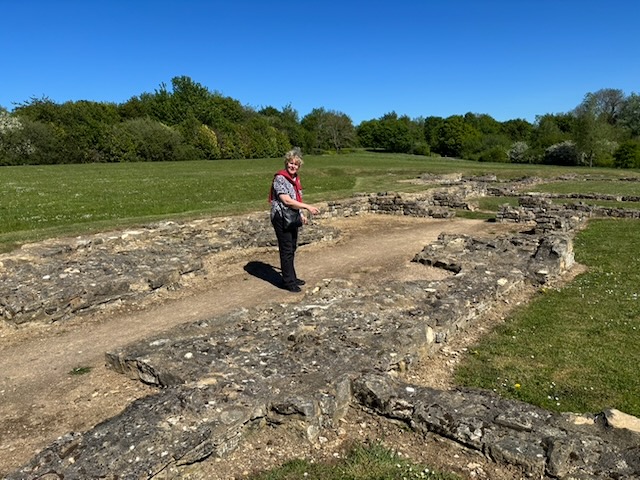
Me standing in the bathhouse
When you think of Milton Keynes in the UK, you might be forgiven for visualising concrete cows or muttering “new town” to yourself. But the Romans got there well before. Of course they did. 🙂
Bancroft Roman Villa was originally a fairly simple winged-corridor house, but eventually became a grand building with mosaics and a formal garden. The site has been conserved, with the principal rooms marked out and the fish-pond reconstructed. One of the mosaics is on display in Central Milton Keynes Shopping Centre. (I’m not quite sure if that’s appropriate or not!)
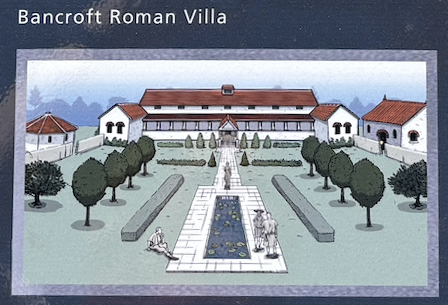
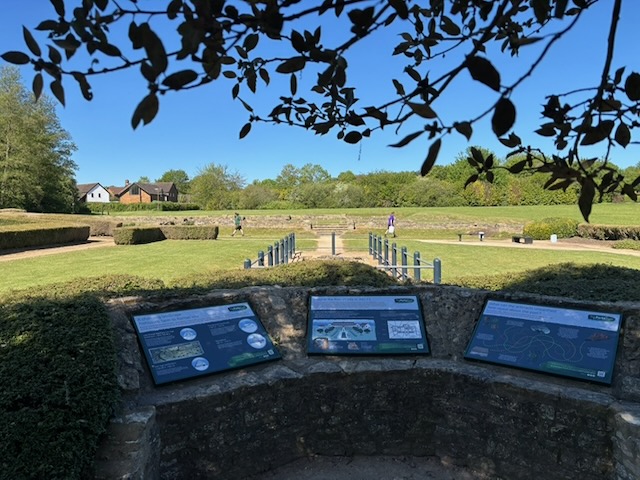
In the 4th century (from the public noticeboard)
Like many Roman sites in Britain, Bancroft has history – over several centuries
The earliest occupation dates to the late Bronze Age/Early Iron Age when settlers built a farmstead in the hilltop at Blue Bridge. It was centred on one of the largest round houses of this period discovered in the UK, measuring nearly 20 metres in diameter.
The first Roman period farmhouse was constructed downhill from the windswept hilltop farmstead in around AD 100. A ‘des res’ it wasn’t! The farm buildings including a large rectangular farmhouse were built in stone and timber in the Roman style around a cobbled yard. The interior of the farmhouse was very basic, with floors of beaten earth and undecorated walls. There were two rooms at the eastern end and a corridor that led to a bath suite which consisted of a stoke room, two heated rooms and a cold room with a rectangular plunge bath. At least they could clean themselves after a hard day’s graft in the fields.
Buckingham Archaeological Society have mapped several buildings which could have served as barns, animal stalls, granaries and accommodation and traced enclosures.
In the 2nd century, a temple or mausoleum was constructed on the hilltop. Around AD180, the farmhouse was destroyed by fire. For the next hundred years or so, very little happened as the site appears to have been more or less abandoned. Perhaps some of the fields were farmed, but that’s just speculation.
In about AD 275, somebody or several somebodies came back and built a new stone house at right angles to the original house and partly overlying it. This new house measured 31 x 10 metres and, not neglecting a great source of materials lying around, they used stone from the original farmhouse and farm buildings, and added a tiled roof. Inside were three main rooms, one with underfloor heating, plus a bath suite at the south end of the house. No more beaten earth floors, but mortared and painted red or black. Walls were also brightly painted and there may even have been an upper floor. A great step up from the original farm.
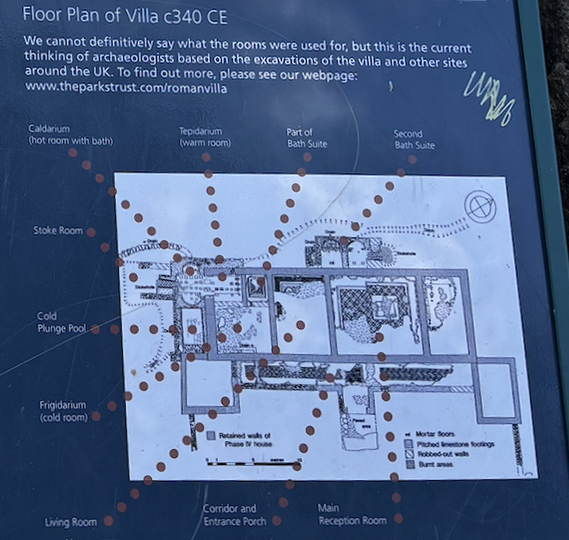
Not the best angle, but the sun was shining on the noticeboard
The 4th century saw major renovations. In the main house, geometric mosaics – some of very high quality and possibly by craftsmen from as far away as Corinium (Cirencester) – were added to nearly every room. Not forgetting that essential Roman facility, the main bath suite was rebuilt and enlarged. In front of the villa, a formal garden was laid out together with an ornamental fish-pond. On the top of the hill, the mausoleum was demolished and a circular shrine was built nearby. A cottage, possibly for a farm manager, was also built nearby. The implication of all this is that money moved in. Perhaps a wealthy merchant on the up bought it for his summer place…
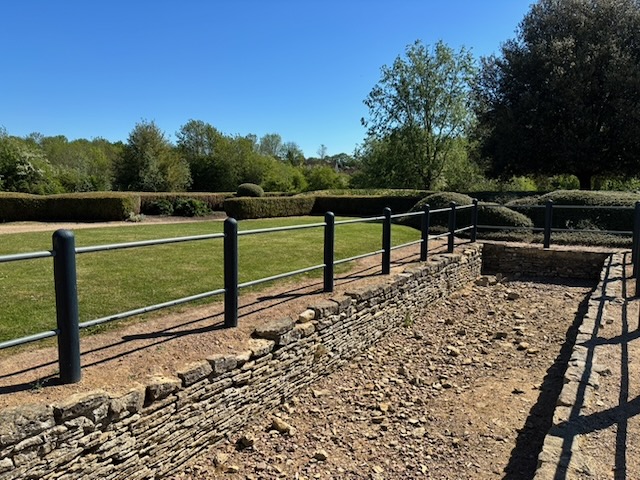
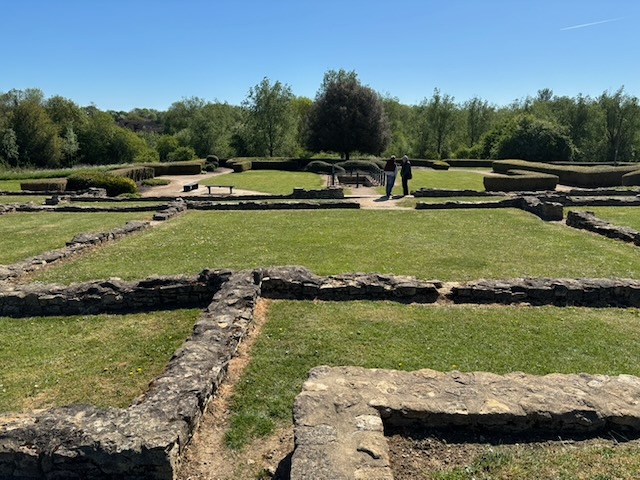
Ye fishpond
Digging it up
The villa was partially excavated in the 1970s, and then more fully in 1983-7, becoming one of the most extensively excavated Roman villas in Britain. I discovered later that to ensure its preservation, the villa had since been reburied, but the principal rooms have been marked out on the ground with modern stonework and the fish-pond has been reconstructed. I remember looking closely at the stone and concrete at the time and wasn’t convinced it was 1,600 years old!
Anyway, the mosaics were removed from the site and one was prominently displayed in Queen’s Court, CMK Shopping Centre as mentioned above. Due to redevelopment of Queen’s Court, the mosaic was remounted subsequently in the “guest services lounge” of the centre.
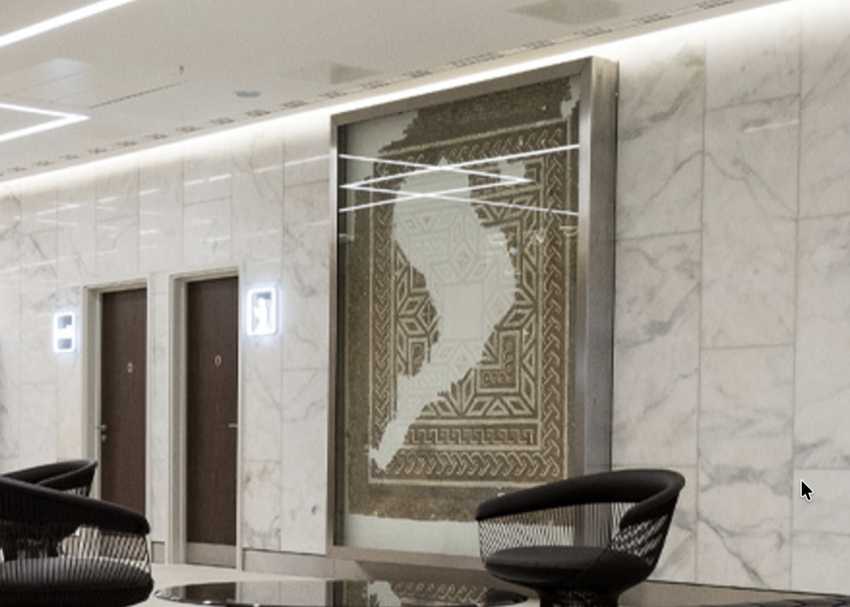
Mosaic by the Central MK guest services lounge (a.k.a. toilets)
As in much of the southern half of Britain, Milton Keynes was intensely farmed during the Roman period. Within two kilometres of Bancroft, two villa sites (Stantonbury and Wymbush) and two native farmsteads (now Abbey Hill Golf Course and one between Heelands and Bradwell Common) have been discovered. Sheep and cattle were reared, with wheat and oats the favoured arable crops. Apart from satisfying the food requirements of the inhabitants and any requirements by the army, surpluses would have been traded at markets in the nearby Roman settlements of Lactodorum (Towcester) and Magiovinium (near Fenny Stratford).
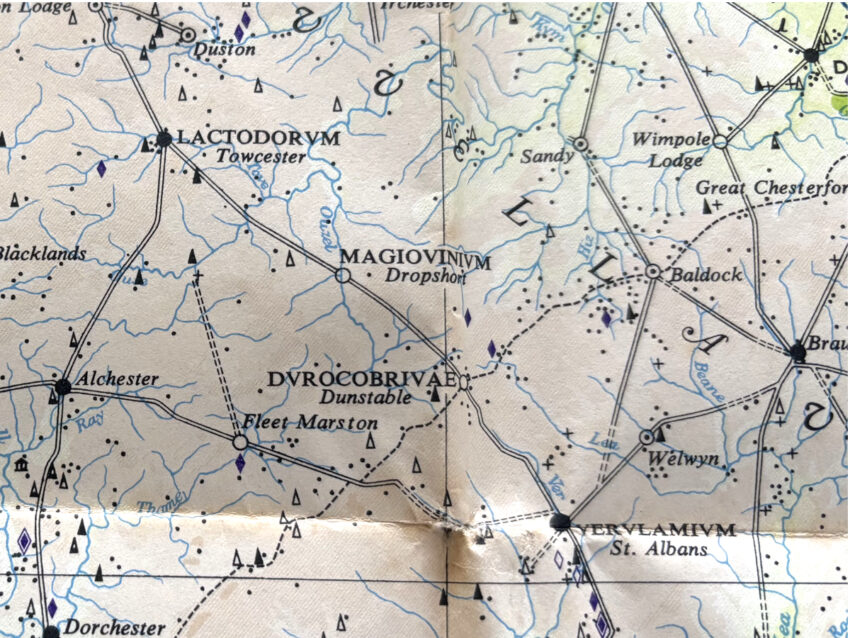
From the classic OS Map of Roman Britain (1956)
More information:
https://www.theparkstrust.com/our-work/heritage/bancroft-roman-villa/
Buckinghamshire Archaeological Society: In addition to talks and online information, they have also published detailed books and reports on the excavations.
Milton Keynes Museum – They have models of the area and now house many of the artefacts that were discovered on site, including most of the mosaics.
Alison Morton is the author of Roma Nova thrillers – INCEPTIO, CARINA (novella), PERFIDITAS, SUCCESSIO, AURELIA, NEXUS (novella), INSURRECTIO and RETALIO, and ROMA NOVA EXTRA, a collection of short stories. JULIA PRIMA and EXSILIUM, set in the late 4th century, tell the story of Roma Nova’s foundation. Audiobooks are available for four of the series. Double Identity, Double Pursuit and Double Stakes form a new contemporary thriller series. A new collection of Roma Nova short stories, HEROICA, is now out.
Download ‘Welcome to Alison Morton’s Thriller Worlds’, a FREE eBook, as a thank you gift when you sign up to Alison’s monthly email update. As a result, you’ll be among the first to know about news and book progress before everybody else, and take part in giveaways.








We are so lucky to still have access to ancient ruins! I look at this map and I could easily read a map of old Dacia, with Latin names imposed over local ones 🙂
What fun you had!
Maps are brilliant! the 1956 one was a classic and is still one of the clearest. I have the more modern one from 2015, but it doesn’t feel quite the same.