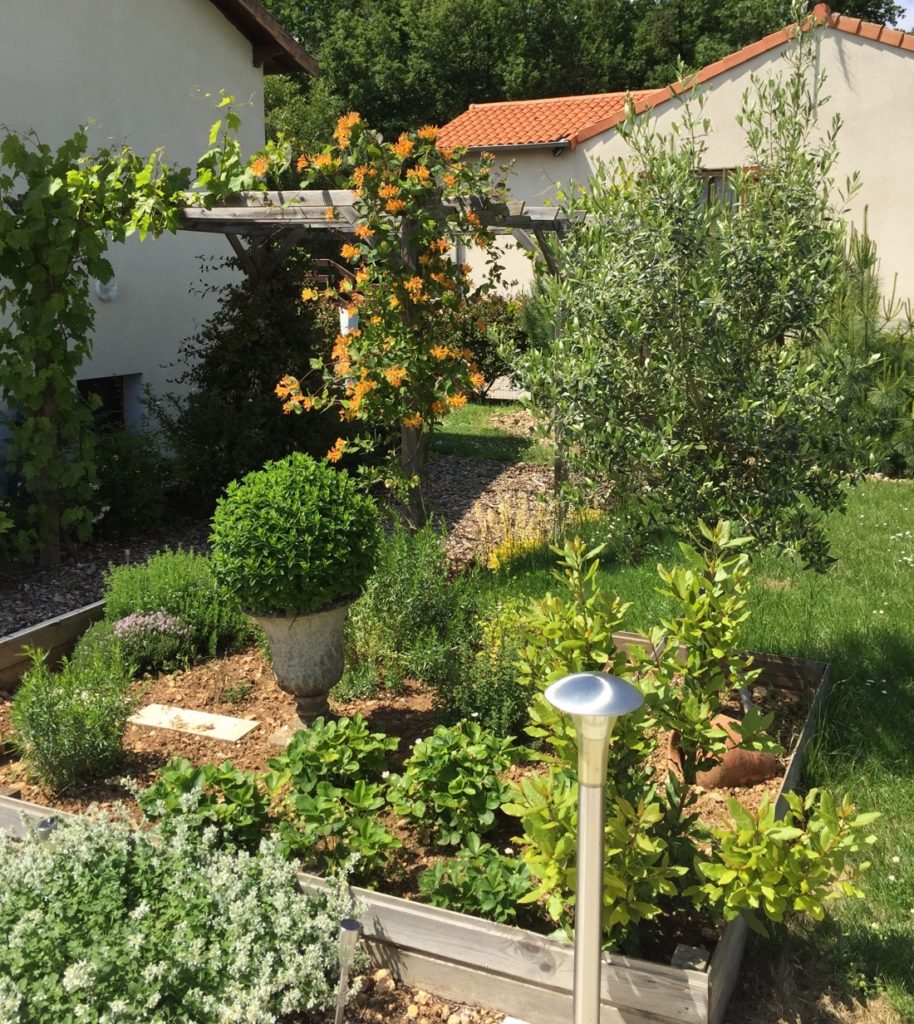
 My ‘Roman’ garden Gardening and nosing around other people’s gardens are two of my favourite hobbies; my own is designed on Roman lines and I even have a Roman herb garden. You’ll know that I often mention gardens, plants and flowers in the Roma Nova books; Carina has the key to a walled garden full of figs, vines, myrtle and other aromatic plants. Several characters in Roma Nova are serious rose growers: Aurelia, Sylvia and Apollodorus – a very Roman trait.
Ancient Romans loved their gardens (Latin: hortus) and ornamental horticulture became highly developed during much of the Roman period. In the earliest times gardens were a common way for the less wealthy Romans to grow food, mainly herbs and vegetables, for themselves and their families. Herbs not only seasoned food, they were important for medicinal and religious purposes. Growing family food continued even when ornamental gardens became much more fashionable but food production was relegated to a side or back area. Gardens were places of peace and tranquility, refuges from urban life and places filled with religious and symbolic meanings. The perfect place to entertain guests, relax and unwind.
Foreign bodies
With conquest and trade, ideas and techniques from Greek, Egyptian, Italian and Persian gardens influenced Roman culture as villa and palace pleasure gardens, public parks and exercise gardens. Modified versions of Roman garden designs were adopted in Roman settlements in Africa, Gaul and Britannia.
Formal gardens had existed in Egypt as early as 2800 BC to beautify the homes of the wealthy. Porticos were developed to connect the home with the outdoors, to create outdoor living spaces. (Nothing new under the sun!) Persian gardens were enclosed to protect from drought, and were rich and fertile in contrast to the dry and arid terrain.
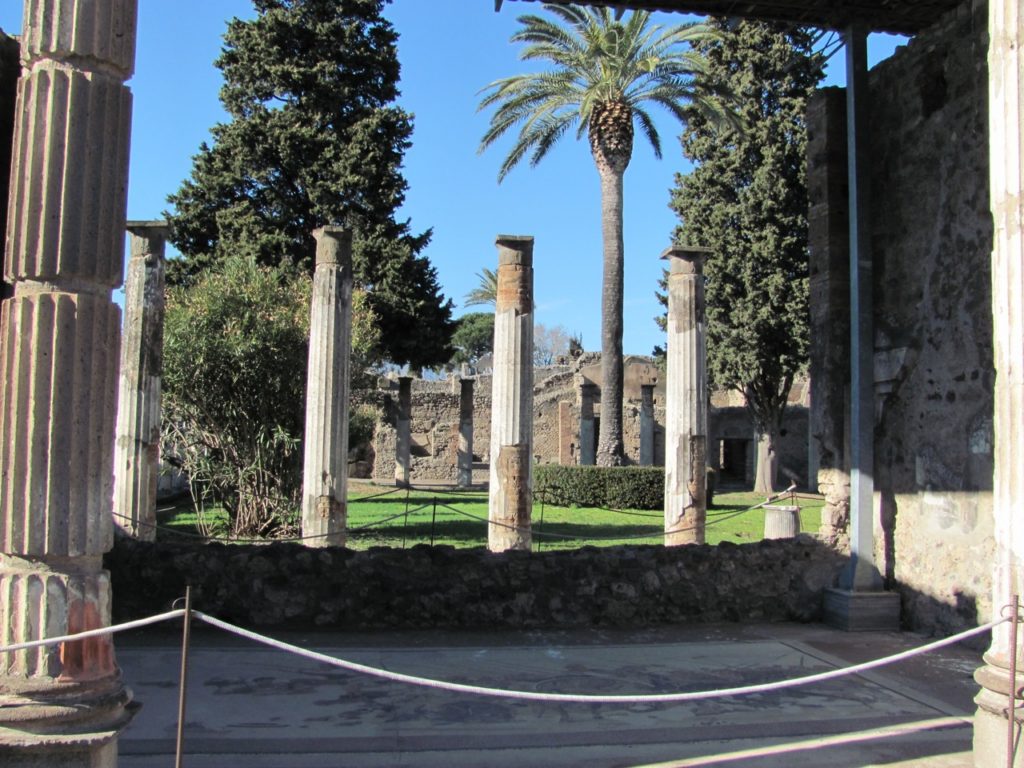 Peristyle, Pompeii The peristyle garden derived from Greek influence; it was used to beautify temple groves and create recreational spaces and was adapted to a domestic scale as a town house inner courtyard garden. In Ancient Latium, a garden was part of every farm. According to Cato the Elder, every garden should be close to the house and should have flower beds and ornamental trees. Alexander the Great is credited with bringing back new varieties of fruits and plants from Western Asia which stimulated increased interest in horticulture. Horace wrote that during his time, flower gardens became a national indulgence. Augustus constructed the Porticus Liviae, a public garden on the Oppian Hill in Rome.
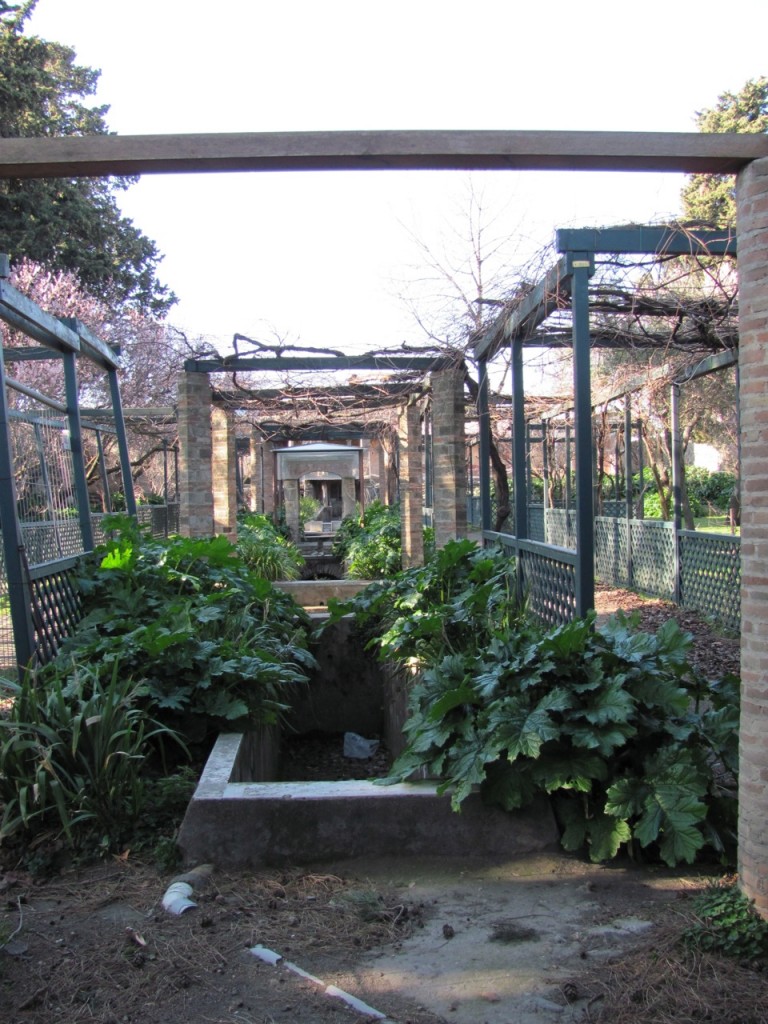 Roman garden in Pompeii Size mattered
Large villas and estates had much larger gardens laid out on a grand scale something copied by aristocrats from the Renaissance period over a thousand years later.Topiary, lakes, riding grounds, swimming pools, even water theatres as at Hadrian’s villa at Tivoli. But the country garden would also stay true to its origins in the simple hortus. Each garden maintained an olera or vegetable patch. But even these practical gardens evolved. By the first century AD, they were joined by hothouses for the forcing of grapes and melons. Excavations in Pompeii show that gardens attaching to residences were scaled down to meet the space constraints of the home of the average Roman. As town houses were replaced by tall insulae (apartment buildings), these urban gardens were replaced by window boxes or roof gardens.
Common parts
Roman gardens were generally separated into the same basic parts whatever the style or type of garden. A xystus lay at the centre of Roman gardens; a garden walk in front of porticoes and divided into flower beds with box borders. The xystus often overlooked a lower garden, or ambulation. The ambulation consisted of a variety of flowers, trees and other foliage and served as an ideal place for a leisurely stroll after a meal or conversation. Paths or walkways were often constructed of loose stone, gravel, sand or packed earth. Gardens featured many ornamental styles, from sculpture to frescoes to sundials depicting nature scenes or a shrine (aediculae) to the gods or other non-worldly creatures. A summer dining room – a triclinium – an open-air dining area attached to the house was often overhung with vines to provide shade.
A pleasure
Pleasure gardens incorporated different designs depending on the taste of those who built them and generally consisted of a patio at the entrance, a terrace, an orchard or vineyard, several water features, a kitchen garden, shrines or grottoes and other decorations. The patio would normally be decorated with garden furniture, water basins/fountains and lead to walkways to other parts of the garden.
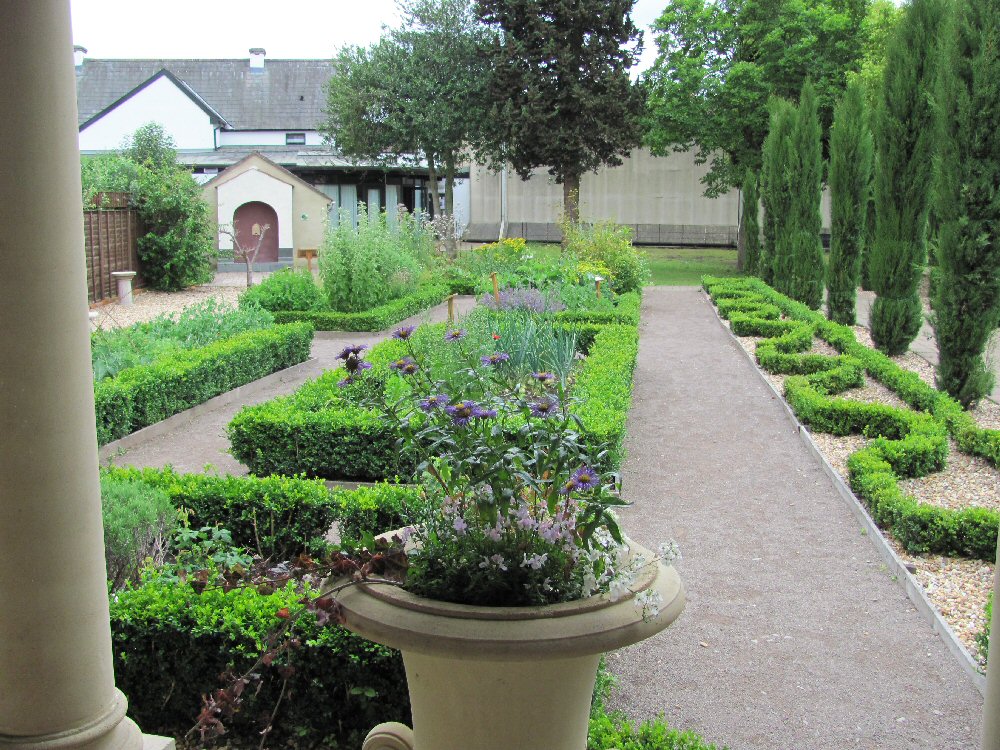 Garden at the National Roman Legion Museum, Caerleon The green stuff
Weather often played a decisive part in what went into the ground. Planting ranged from flowering shrubs to herbs and vegetables for everyday use, and trees. Walkways and beds were often edged with box, sometimes cypresses and plane trees. The most popular plants found in the typical Roman family’s garden were roses, mulberry and fig trees along with a variety of dwarf trees, tall trees, marigolds, hyacinths, narcissi, oleanders, violets, saffron, cassia, lily, gladioli, iris, poppy, amaranth, acanthus. Favourite herbs included thyme mint, savory, celery seed, basil, bay, rosemary and hyssop.
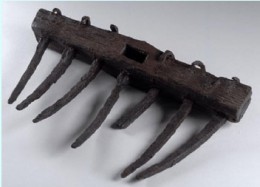 Roman rake
And we still use gardening and horticultural techniques which the Romans established 2,000 years ago, from turning soil in the autumn and mixing compost, to hoeing beds, sowing seeds in spring and forcing flowers, fruit and vegetables. And our standard garden tools are not modern inventions…
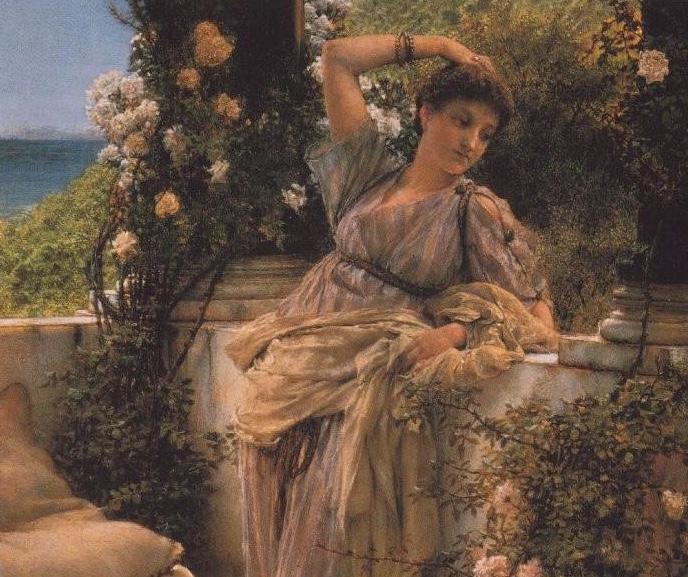 Thou Rose of All Roses, Alma-Tadema Roses by any other name
Almost all aristocrats in ancient Rome had rose gardens at their residences. Like the Greeks and Phoenicians, Romans not only cultivated roses but also traded them. They acquired the roses while they conquered and occupied and planted them in their old and new homes throughout the Empire. Consequently, roses spread rapidly and extensively throughout the Middle East and Mediterranean.
During the Roman era, a repeat-blooming variant of the Damask rose evidently appeared, the first member of a group which came to be called “Damask Perpetuals.” The Romans were so sophisticated that they developed a hot-house technology which allowed them to ‘force’ roses into more bloom; they also imported roses from Egypt. Damasks, Albas and Gallicas dates from these most ancient times in Europe and the Mediterranean.
So how does your garden grow?
Updated 2026: Alison Morton is the author of Roma Nova thrillers – INCEPTIO, CARINA (novella), PERFIDITAS, SUCCESSIO, AURELIA, NEXUS (novella), INSURRECTIO and RETALIO, and ROMA NOVA EXTRA, a collection of short stories. JULIA PRIMA and EXSILIUM, set in the late 4th century, tell the story of Roma Nova’s foundation. Audiobooks are available for four of the series. Double Identity, Double Pursuit and Double Stakes form a new contemporary thriller series. A new collection of Roma Nova short stories, HEROICA, is now out.
Download ‘Welcome to Alison Morton’s Thriller Worlds’, a FREE eBook, as a thank you gift when you sign up to Alison’s monthly email update. As a result, you’ll be among the first to know about news and book progress before everybody else, and take part in giveaways.
If you enjoyed this post, do share it with your friends!
Buy now from Amazon Kindle Nook Kobo Apple
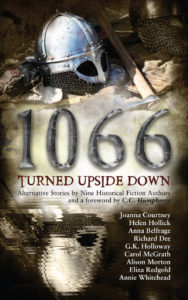
1066 Turned Upside Down – a collection of stories by nine historical fiction writers – is now out! Now what does 1066 have to do with Roma Nova? Good question.
Suppose there had been a Roma Novan around trying to intervene in 1066 between Harold’s Saxon England and William’s Normandy? Could she have influenced either of these tough, ambitious and determined men and changed history? Read what happened when Galla Mitela, 11th century Roma Novan, met William of Normandy in ‘A Roman intervenes’.
1066 is the most known year in English history, and the most intriguing. It represents a key turning point: a year in which everything was up for grabs, a year in which England’s historical story could have gone any number of ways – a year of ‘what ifs’.
What if King Edward’s great-nephew, Edgar, had been thought old enough to rule, and chosen as king? What if the Northern Earls has defeated the Norwegian, Harald Hardrada and King Harold’s own brother, Tostig, at Gate Fulford – or what if Harald Hardrada had won the Battle of Stamford Bridge in Yorkshire? What if Harold had defeated the Normans at sea? What if Svein of Denmark had invaded or a European political power like Roma Nova had intervened? What if William had died when he was unhorsed at Hastings or had been defeated at London Bridge in November? What if the Bayeux Tapestry carries a hidden, secret meaning about the truth of 1066 – or a time machine could alter the past?
So much could have been different and now, at last, we can explore some of those ‘what ifs’ in this exciting collection of ‘virtual history’ short stories, written by known and loved writers of the period (and a few from outside it) to celebrate the 950th anniversary of this incredible year.
Our authors are:
Helen Hollick, author of multiple historical and pirate novels, including Harold the King
Joanna Courtney, author of the Queens of the Conquest series
and
Anna Belfrage, Historical Novel Society Indie Award Winner 2015, author of the Graham Saga
Richard Dee, fantasy author of Ribbonworld
G K Holloway, author of 1066: What Fates Impose
Carol McGrath, author of The Daughters of Hastings trilogy
Alison Morton, author of the Roma Nova thrillers (me!)
Eliza Redgold, author of Naked, a novel of Lady Godiva
Annie Whitehead, who writes about Mercia and Saxon England
with a foreword by writer and actor, C.C. Humphreys
The stunning cover is by Cathy Helms of Avalon Graphics. The collection includes historical notes of what really did happen each month alongside the fictional re-interpretations, as well as authors’ notes on what fascinates them about 1066 and why they chose to ‘change’ what they did. Each story has a few suggestions for ‘discussion’ points for schools, writer’s groups – or just your own curiosity!
So where can you buy this fascinating collection?
Amazon Kindle Nook Kobo Apple
Read this fabulous review!
Happy speculating!
Alison Morton is the author of Roma Nova thrillers – INCEPTIO, PERFIDITAS, SUCCESSIO, AURELIA, INSURRECTIO and RETALIO. CARINA, a novella, and ROMA NOVA EXTRA, a collection of short stories, are now available. Audiobooks are available for four of the series. NEXUS, an Aurelia Mitela novella, is now out.
Download ‘Welcome to Roma Nova’, a FREE eBook, as a thank you gift when you sign up to Alison’s monthly email newsletter. You’ll also be first to know about Roma Nova news and book progress before everybody else, and take part in giveaways.>
If you enjoyed this post, do share it with your friends!
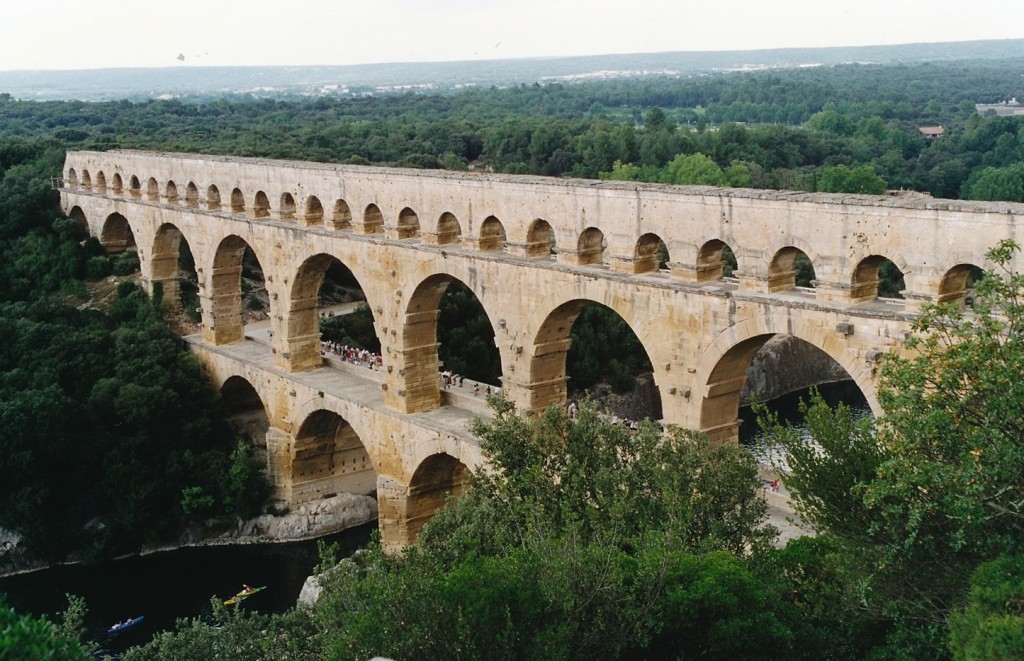 Romans in the 21st century? Possibly provocative, but a perfectly feasible venture into alternative history fiction. How do you do this with no historical foundation? Romans in the 21st century? Possibly provocative, but a perfectly feasible venture into alternative history fiction. How do you do this with no historical foundation?
Setting a story in the past or in another country is already a challenge. But if you invent the country and need to meld it with history that the reader already knows, then the task is doubled.
Unless writing post-apocalyptic, the geography and climate must resemble the ones in the region where the imagined country lies. And no alternate history writer can neglect their imagined country’s social, economic and political development. This sounds dry, but every living person is a product of their local conditions. Their experience of living in a place, and struggle to make sense of it, is expressed through culture and behaviour.
Norman Davies in Vanished Kingdoms: The History of Half-Forgotten Europe reminds us that:
…in order to survive, newborn states need to possess a set of viable internal organs, including a functioning executive, a defence force, a revenue system and a diplomatic force. If they possess none of these things, they lack the means to sustain an autonomous existence and they perish before they can breathe and flourish.
I would add history and willpower as essential factors.
 So these are the givens. How do writers weave them into their stories? The key is plausibility. Take a character working in law enforcement. Readers can accept cops being gentle or tough, enthusiastic, intellectual or world-weary. Law enforcers come from all genders, classes, races and ages and stand in different places along the personal morality ruler. But whether corrupt or clean, they must act like a recognisable form of cop. They catch criminals, arrest and charge them and operate within a judicial system. Legal practicalities may differ significantly from those we know, but they must be consistent with that society while remaining plausible for the reader. But a flashing light and an oscillating siren on a police vehicle are universal symbols that instantly connect readers back to their own world. So these are the givens. How do writers weave them into their stories? The key is plausibility. Take a character working in law enforcement. Readers can accept cops being gentle or tough, enthusiastic, intellectual or world-weary. Law enforcers come from all genders, classes, races and ages and stand in different places along the personal morality ruler. But whether corrupt or clean, they must act like a recognisable form of cop. They catch criminals, arrest and charge them and operate within a judicial system. Legal practicalities may differ significantly from those we know, but they must be consistent with that society while remaining plausible for the reader. But a flashing light and an oscillating siren on a police vehicle are universal symbols that instantly connect readers back to their own world.
Almost every story written hinges upon implausibility – a set-up or a problem the writer has purposefully created. Readers will engage with it and follow as long as the writer keeps their trust. One way to do this is to infuse, but not flood, the story with corroborative detail so that it verifies and reinforces the original setting the writer has introduced. Even though my book is set in the 21st century, the Roma Novan characters say things like ‘I wouldn’t be in your sandals (not ‘shoes’) when he finds out.’ And there are honey-coated biscuits (Honey was important for the ancient Romans.) not chocolate digestives (iconic British cookie) or bagels in the squad room.
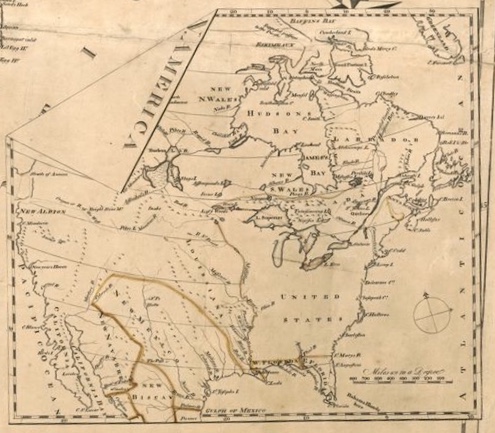 Inset in the map “The United States according to the definitive treaty of peace signed at Paris Sept. 3d. 1783. William McMurray, Robert Scot” In my first novel, INCEPTIO, the core story of a twenty-five year old New Yorker who faces total disruption to her life when a sinister government enforcer compels her to flee to her dead mother’s mysterious homeland in Europe could be set anywhere. But I’ve made New York an Autonomous City in the Eastern United States (EUS) that the Dutch only left in 1813 and the British in 1865. The New World French states of Louisiane and Québec are ruled by Gouverneurs-Généraux on behalf of Napoléon VI; California and Texas belong to the Spanish Empire; and the Western Territories are a protected area for the Indigenous Peoples. These are background details as the New World is only the setting for the first few chapters. But as J K Rowling knew with Harry Potter’s world, although you don’t put it in the books, you have to have worked it all out in your head.
So, how to do this?
1. Decide on your Point of Divergence [POD] from real timeline history
Research this to death; know the political set-up, religion, customs, dress, food, agriculture, geography, economy, legal background, defence forces, cultural attitudes, everyday life of all classes and groups. These are the building blocks for your alternate society.
Illustrating this with Roma Nova:
In AD 395 [fixing the POD], three months after the final blow of Theodosius’ last decree banning all pagan religions [political/legal set-up], over four hundred Romans loyal to the old gods [religious background], and so in danger of execution, trekked north out of Italy to a semi-mountainous area similar to modern Slovenia [geography]. Led by Senator Apulius at the head of twelve senatorial families [social/political background], they established a colony based initially on land owned by Apulius’ Celtic father-in-law [cultural – intermarriage with non-Romans]. By purchase [land-management], alliance [politics] and conquest [normal Roman behaviour!], this grew into Roma Nova.
2. Know how you want your society to be and develop it with historic logic
If your story world doesn’t hang together, you will break a reader’s trust. You can have a fantastic world, such as Romans and steampunk but it needs to have reached that place in a plausible way. Writers need to provide motivation, whether personal or political or just forced by circumstances from outside. In my modern Roma Nova world, women are prominent.
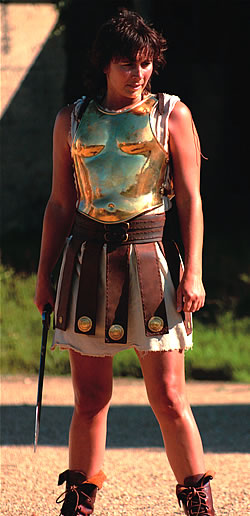 Photo courtesy of Britannia www.durolitum.co.uk This seems a long way from the ancient world where Roman attitudes to women were repressive [starting point]. But towards the later Imperial period [moving time on] women gained much more freedom to act, trade and own property and to run businesses of all types [social and economic development]. Divorce was easy, and step and adopted families were commonplace [standard Roman social custom].
Apulius, the leader of Roma Nova’s founders, had married Julia Bacausa, the tough daughter of a Celtic princeling in Noricum. She came from a society in which, although Romanised for several generations, women in her family made decisions, fought in battles and managed inheritance and property [non-Roman values introduced]. Their four daughters [next generation] were amongst the first pioneers [automatically new tough environment] so necessarily had to act more decisively [changing behaviour patterns] than they would have in a traditional urban Roman setting.
Given the unstable, dangerous times in Roma Nova’s first few hundred years [outside circumstances], eventually the daughters as well as sons had to put on armour and carry weapons to defend their homeland and their way of life [societal motivation]. So I don’t think that it’s too far a stretch for women to have developed leadership roles in all parts of Roma Novan life over the next sixteen centuries.
3. Keep some anchors to the readers’ pre-knowledge
Creating a story should be fun for the writer and the result rewarding for the reader. Although most writers like to encourage the reader to work a little and participate in the experience, writers shouldn’t bewilder readers. I mentioned plausibility earlier and how to inject corroborative details into the world being created. Anchors are equally important. For example, if you say “Roman legionary” most readers have an idea in their head already.
Taking Roma Nova as an example:
Roma Nova’s continued existence has been favoured by three factors: the discovery and exploitation of high-grade silver in their mountains [geography with a dollop of luck!], their efficient technology [historical fact], and their robust response to any threat [core Roman attitude]. Remembering their Byzantine cousins’ defeat in the Fall of Constantinople [known historical fact], Roma Novan troops assisted the western nations at the Battle of Vienna in 1683 to halt the Ottoman advance into Europe [known historical turning point]. Nearly two hundred years later, they used their diplomatic skills to help forge an alliance to push Napoleon IV back across the Rhine as he attempted to expand his grandfather’s empire [building on known historical person’s story].
4. Make the alternate present real
Writers need to imbue their characters with a sense of living in the present, in the now. This is their current existence, for them it’s not some story in a book(!). Character-based stories are popular; readers are intrigued by what happens to individual people living in different environments as well as taking part in major historical events. Sometimes it’s more interesting to follow the person’s story than the big event itself…
5. Go visible
Obviously, an imagined country is pretty hard to photograph. If you can draw, then you have the tools literally at your fingertips, but if like me your artistic skills are limited to turning out sketches of pin-men, then it’s back to the camera.
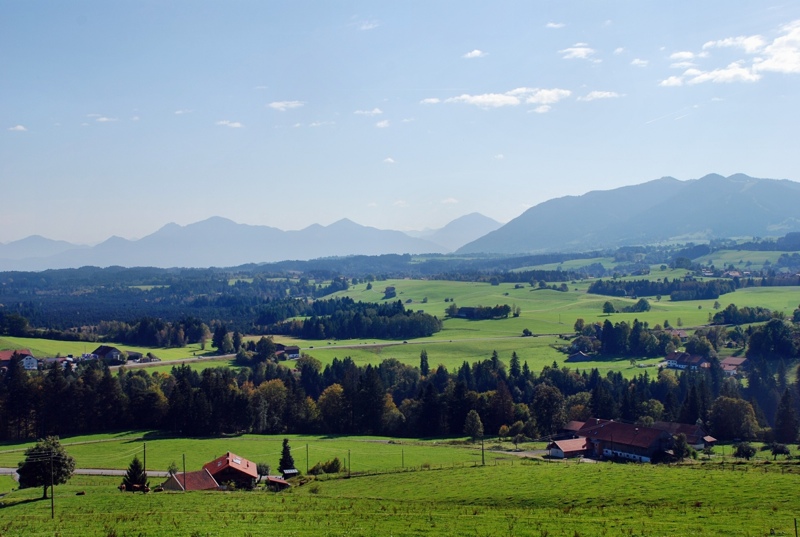 Images suggest tones, possibilities, and elements on which to base your ideas. Roma Nova is situated in the middle of Europe. I’m a European and have visited most countries, including a trip to Rome and Pompeii last year, so I have an idea of the countryside and cityscapes I’m looking for. The results are here; I refer back to them if I’m finding it difficult to visualise my characters in a particular location. Readers have loved them as well so it’s a double benefit. Images suggest tones, possibilities, and elements on which to base your ideas. Roma Nova is situated in the middle of Europe. I’m a European and have visited most countries, including a trip to Rome and Pompeii last year, so I have an idea of the countryside and cityscapes I’m looking for. The results are here; I refer back to them if I’m finding it difficult to visualise my characters in a particular location. Readers have loved them as well so it’s a double benefit.
In summary, alternate history gives us a rich environment in which to develop our storytelling. As with any story in any genre, the writing must create a plausible world, backed by meticulous research, but the writer is, of course, the master of their universe.
Based on a post I wrote in 2013 for Daniel Ottalini’s blog Modern Papyrus
Alison Morton is the author of Roma Nova thrillers – INCEPTIO, PERFIDITAS, SUCCESSIO, AURELIA, INSURRECTIO and RETALIO. CARINA, a novella, and ROMA NOVA EXTRA, a collection of short stories, are now available. Audiobooks are available for four of the series. NEXUS, an Aurelia Mitela novella, is now out.
Download ‘Welcome to Roma Nova’, a FREE eBook, as a thank you gift when you sign up to Alison’s monthly email newsletter. You’ll also be first to know about Roma Nova news and book progress before everybody else, and take part in giveaways.
If you enjoyed this post, do share it with your friends!
|
Subscribe to Blog via Email
Join 37 other subscribers.
Buy AURELIA from Apple!
UK

US
|