 After breaking out of Italy, Romans spread all over Europe. During the 1st century BC they looked north and east and a Roman military stronghold was built on the site of the present day Ljubljana in Slovenia. Construction of the Roman settlement of Emona (Colonia Iulia Aemona), fortified with strong walls, followed in AD 14.
The Ljubljana basin had already been populated before Roman times and already during prehistory important trade routes from the Apennine Peninsula, the Baltic Sea and the Balkans ran through it.
It had a population of 5,000 to 6,000 people serving the town’s settlers – mostly artisans and merchants, colonists from the northern part of Roman Italy, army veterans and their slaves – and the rest of the empire, and later became an significant Early Christian centre.
Emona’s administrative territory or ager stretched from Atrans (Trojane) along the Karawanks mountains towards the north, near Višnja Gora to the east, along the Kolpa River in the south, and bordered to the west with the territory of Aquileia.
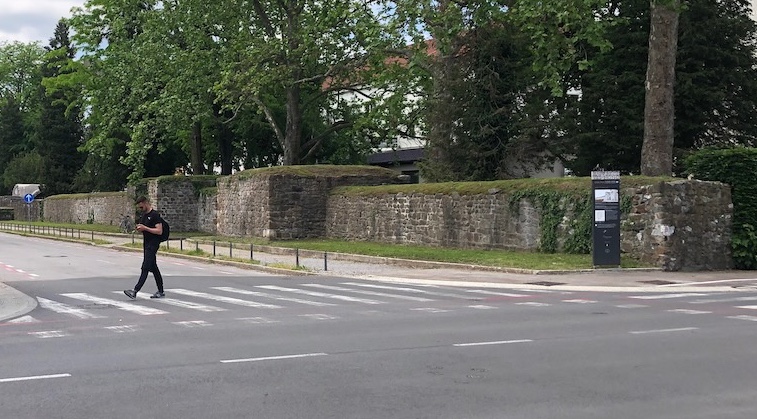
Emona’s southern wall
Emona held an important role in the defence of Italy between the 2nd and 4th century. During the 2nd century the city suffered due to Marcomannic Wars and plague, while in 238 AD its own citizens burned it down and abandoned it to prevent the army of the usurper Maximinus Thrax making camp there.
According to Ammianus Marcellinus, one of the reasons for the war between the Licinius and the Constantine the Great was that the Licinius destroyed the busts and statues of Constantine at Emona. After few months of occupation in 388, the citizens of Emona saluted Emperor Theodosius I entering the liberated city after the victorious Battle of the Save, where Theodosius I defeated the army of the Roman usurper Magnus Maximus.
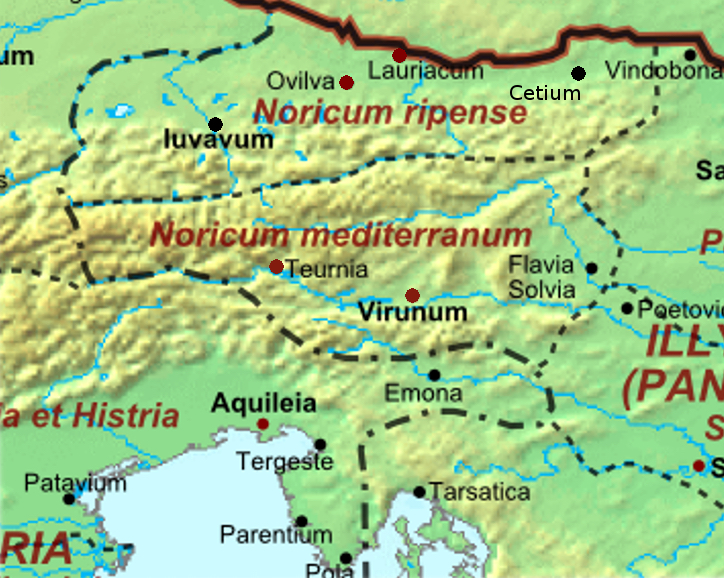
In 408, Emona was “visited” by Alaric I, king of the Visigoths. As the Byzantine magister militium, he was on a mission to retake Italy for the Byzantine Empire. Not being cynical (of course, I am) it’s highly probable that bribes saved the skins of Emonans on this occasion.
In 452, Emona was virtually destroyed by the Huns, led by Attila. Its remaining inhabitants fled the city; some of them made it to the coast of Istria, where they founded a “second Emona”, Aemonia, today the town of Novigrad (meaning “New City”), in Croatia.
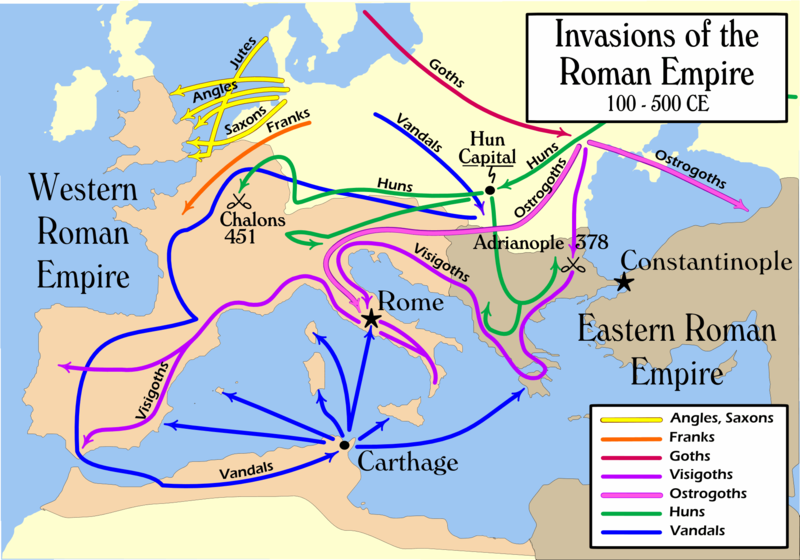
Come the Great Migrations and Emona saw it all. The ancient cemetery in Dravlje indicates that the original inhabitants and invaders were able to live (relatively) peacefully side by side for several decades. In 452, the city was ravaged and partially destroyed by the Huns. Emona was impoverished but lived on. At the end of the 5th and start of the 6th century, the city was ruled by the Visigoths, who left only a few traces behind. During the restless times of Late Antiquity and the Migration Period in the 6th century people started taking refuge in remote and inaccessible locations (Sveti Lovrenc on the Polhograjska gora hill, Molnik, Moreček, Golo) and migrating to coastal cities, especially Koper, Piran and Novigrad, until the last citizen left Emona.
In the 18th century, the Ljubljana Renaissance movement (along with the rest of Europe) started to take an active interest in antiquity, in the former’s case supporting Zosimus’s attribution of the founding of Ljubljana to the mythical Jason and the Argonauts. (Yes, well…)
Other ancient Roman towns located in present-day Slovenia include Nauportus (now Vrhnika), Celeia (now Celje), Neviodunum (now the village of Drnovo) and Poetovio (now Ptuj).
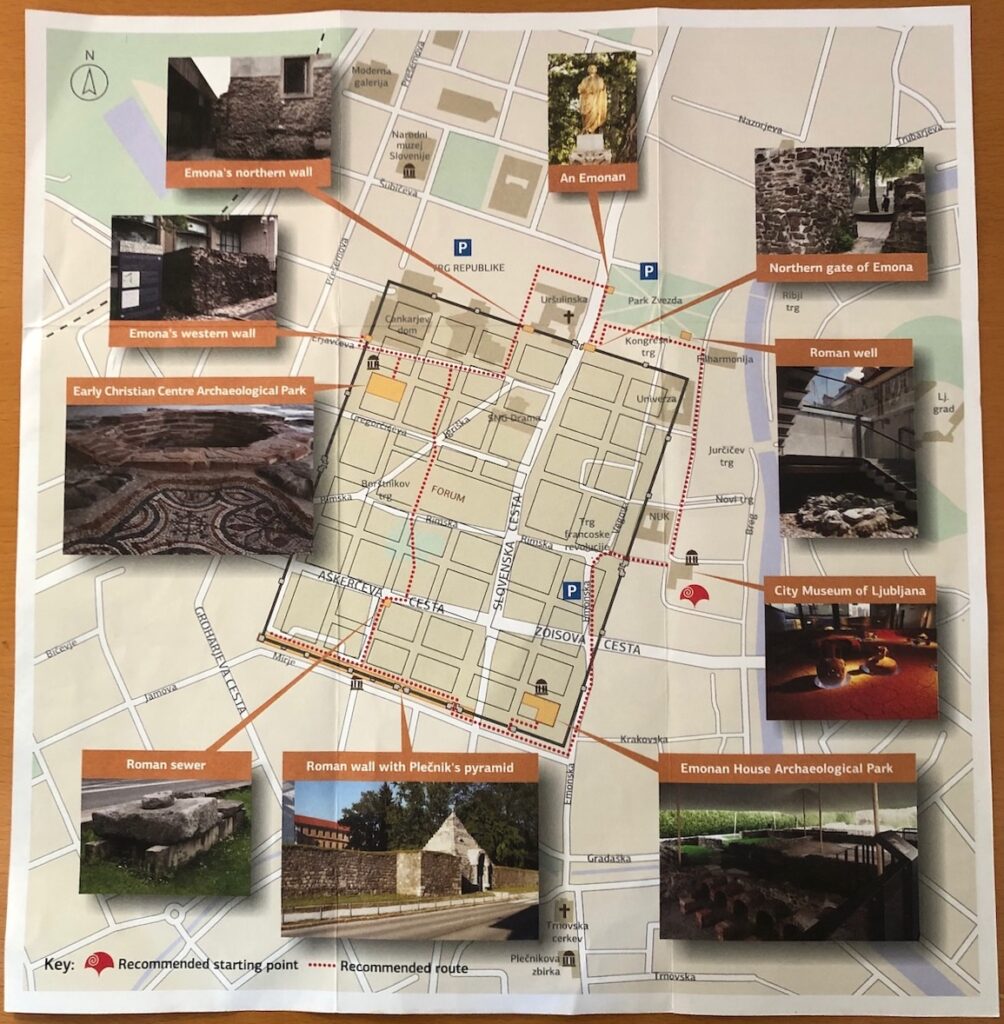
Emona walk leaflet
One of the first things I did when I arrived there was to follow the Emona walk. Sadly, we couldn’t access the Emona Roman House as it wasn’t yet open for visitors (despite the info on the website). 🙁 During excavations in the Jakopič Garden in the 1963/64 remains of a late 4th/early 5th century residential building were discovered. Judging by the high-quality building finishes and utilities (floors, mosaics, heating), the building was home to a wealthy and respectable Roman family. You can see it here: https://www.visitljubljana.com/en/poi/emona-house-arhaeological-park/ (Although the text in the link is misspelt, it does take you to the right place.)
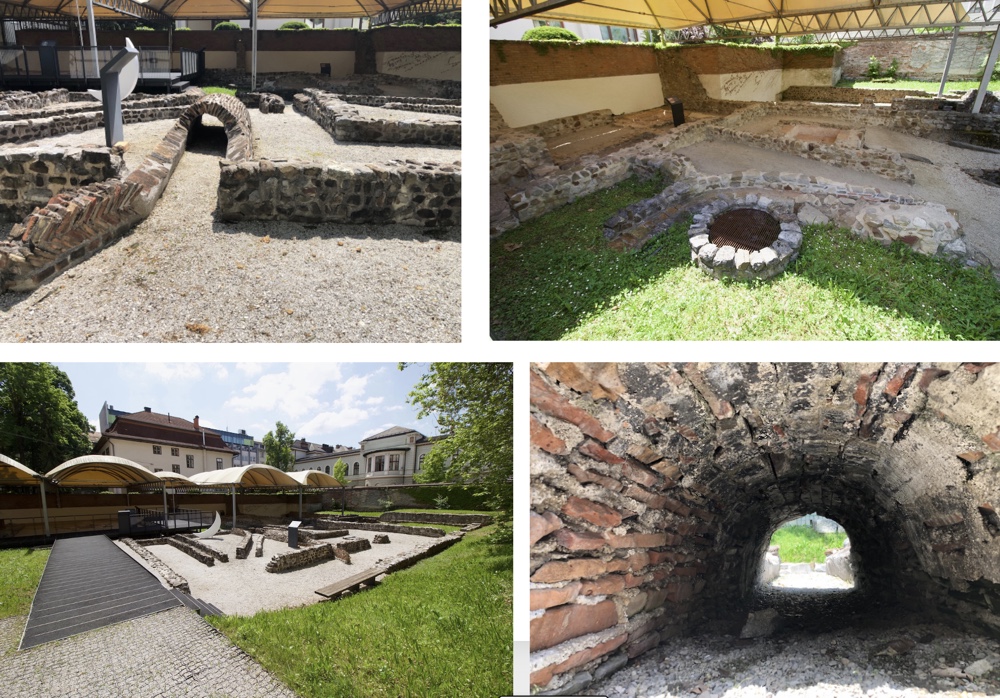
Early Christian centre house
But we could get into the the Early Christian Centre where excavations unearthed a Roman residential building. As with the majority of Emonan houses, it was built at the beginning of the 1st century AD. During the nearly 500 years of its existence it was rebuilt several times. The first major rebuild occurred in the early 4th century when the floors were renovated, the hypocaust heating remodelled and three small pools were added, suggesting that part of the building might have been turned into private baths.
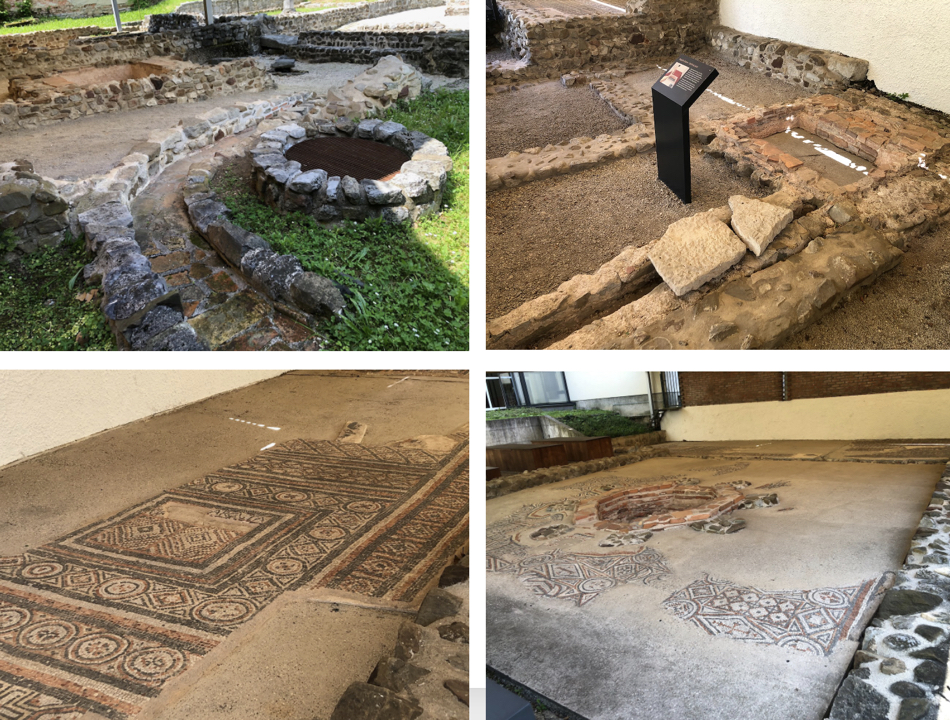
In the second half of the 4th century, one section of the house was rebuilt as an early Christian chapel. However, a major alteration occurred at the beginning of the 5th century when a rectangular baptistery with a small pool in the centre intended for baptism was built alongside the central courtyard. The baptistery floor is covered in a multi-coloured mosaic with inbuilt inscriptions bearing the names of the Emonans who had donated the funds for its construction. A covered portico featuring a coloured mosaic led to the baptistery. The mosaic had an inbuilt inscription with the name of the builder, Archdeacon Antioha. This shows there was a strong community of early Christians in Emona, something confirmed by written records which refer to Emonan bishops.
Roman walls – everywhere!
CC Commons, Wikipedia
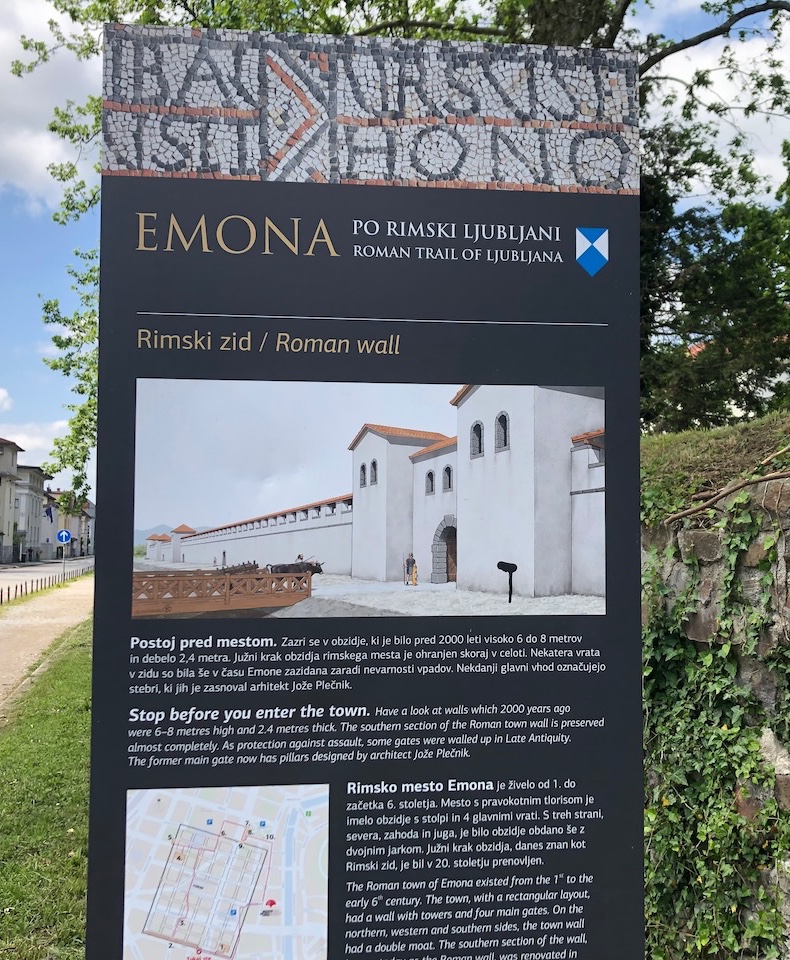
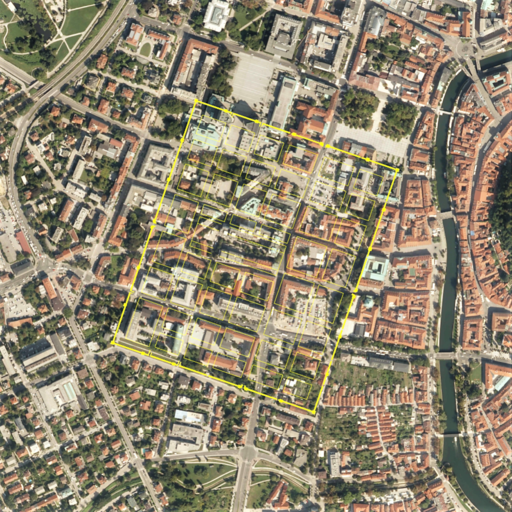
The Roman town of Emona existed from the 1st to the early 6th century. As with many Roman towns it had a rectangular layout, walls with towers and four main gates. On the northern, western and southern sides, the town wall had a double moat.
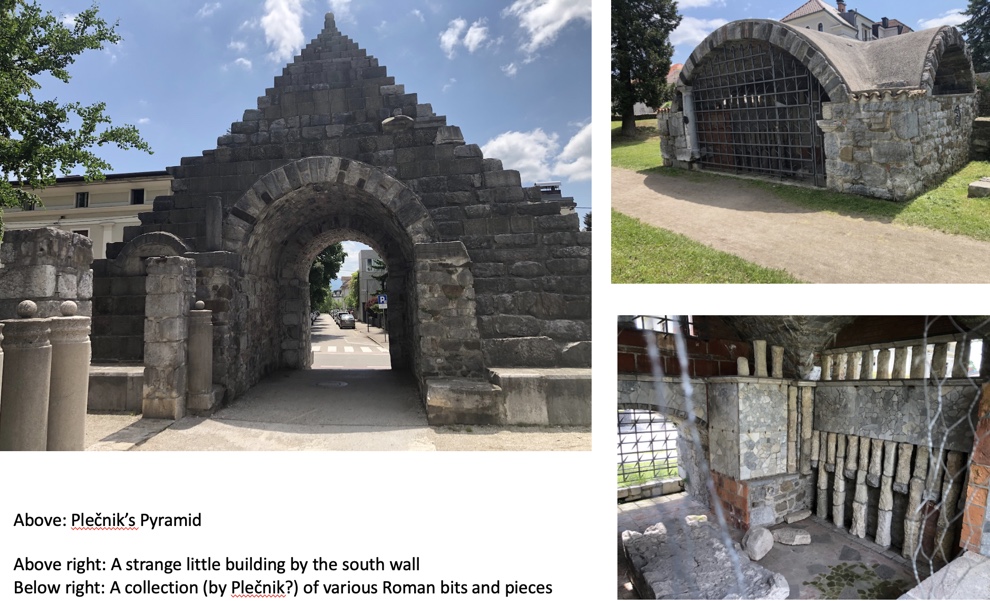
The southern section of the wall, known today as the Roman wall, was “renovated” in the 20th century by Jože Plečnik, an internationally renowned architect whose works created after 1921 left an indelible mark on the whole of Ljubljana.
Many of his contemporary buildings are very impressive, but… He redesigned the remains of the Roman walls: he cut two new passages to create a link to Snežnik Street and Murnik Street, and behind the walls he arranged a park displaying architectural elements from Antiquity, with a stone monument collection in the Emona city gate. Above the passageway to Murnik Street he set up a pyramid, which he covered with turf.
After the Second World War, attempts were made to embed references to Emona grid into modern Ljubljana, with the Roman forum becoming part of the Ferant Park apartment blocks and an echo of the rotunda located along Slovenia Street.
Plečnik’s Pyramid is odd indeed, but it’s a perfect demonstration of the different attitude of previous periods to archaeology. It’s now a “sight” to be visited in its own right. 😉
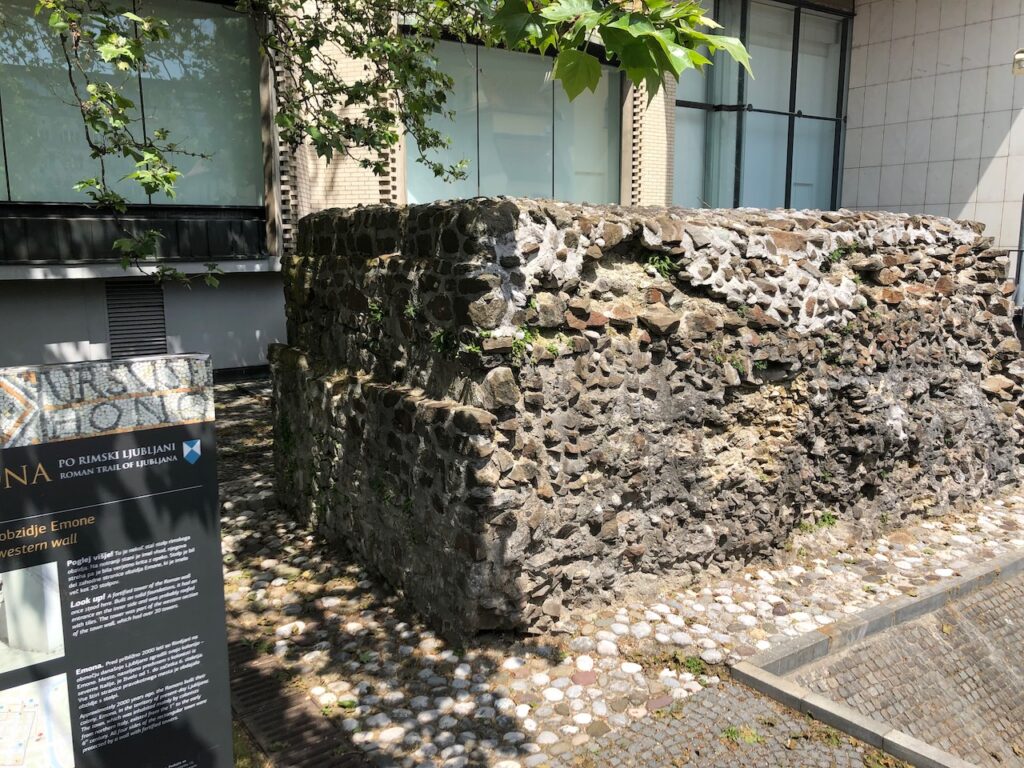
A chunk of the western wall which looks mostly as was, especially the lower half.
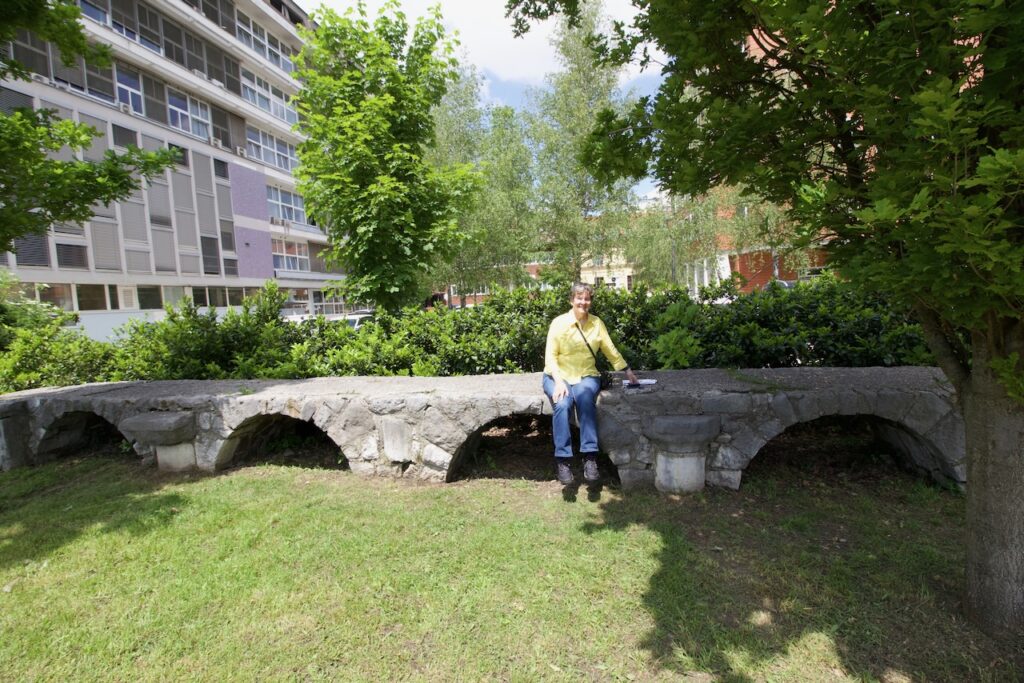
My conclusion?
We received the distinct impression that Ljubljana, although a forward looking and modern European city, is proud of its Roman history. The Roman heritage is very honoured and the city museum finds are imaginatively displayed. A lot has been developed from what there is available and the supporting research is serious and well done; digs are now organised in the modern way. But a number of the existing monuments, especially by the south wall were mucked about with in the 19th and 20th centuries, probably with the best of intentions. This series of arches where I’m sitting (above) was reconstructed from Roman rubble. However, it was a way of remembering and honouring a distant heritage and trying to recapture it after centuries of oblivion.
Alison Morton is the author of Roma Nova thrillers – INCEPTIO, CARINA (novella), PERFIDITAS, SUCCESSIO, AURELIA, NEXUS (novella), INSURRECTIO and RETALIO, and ROMA NOVA EXTRA, a collection of short stories. Audiobooks are available for four of the series. Double Identity, a contemporary conspiracy, starts a new series of thrillers. JULIA PRIMA, a new Roma Nova story set in the late 4th century, is now out.
Download ‘Welcome to Alison Morton’s Thriller Worlds’, a FREE eBook, as a thank you gift when you sign up to Alison’s monthly email update. You’ll also be among the first to know about news and book progress before everybody else, and take part in giveaways.
If you enjoyed this post, do share it with your friends!