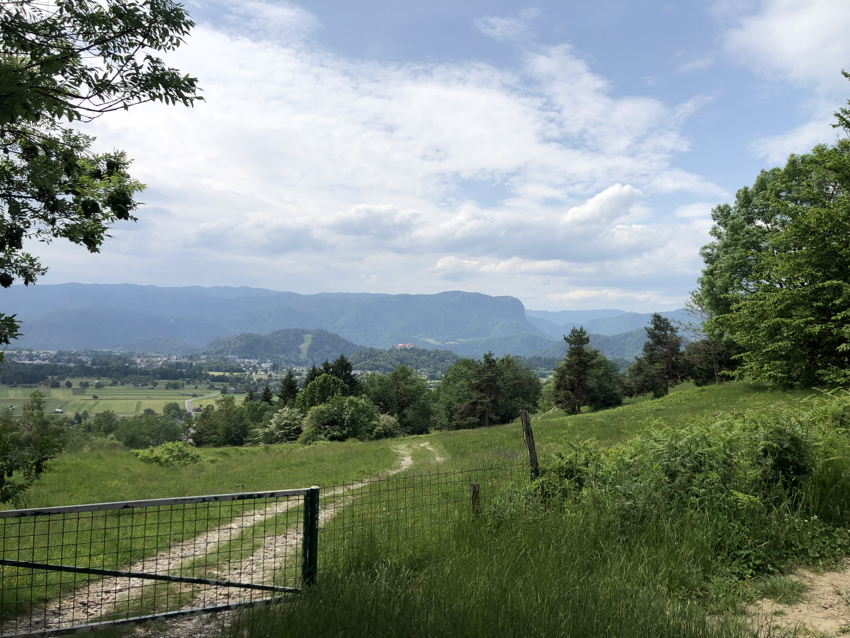
 View from St Katerina, above the Vintner Gorge, Slovenia When I placed Roma Nova, the setting for the Carina and Aurelia adventures, in ‘Central Europe’ (wherever that is), it was vaguely based on Austria and Slovenia. I was lucky enough to visit both countries this year (2023) and see some wonderful Roman archaeology. But what about the landscape – the places where people lived, farmed, and worked?
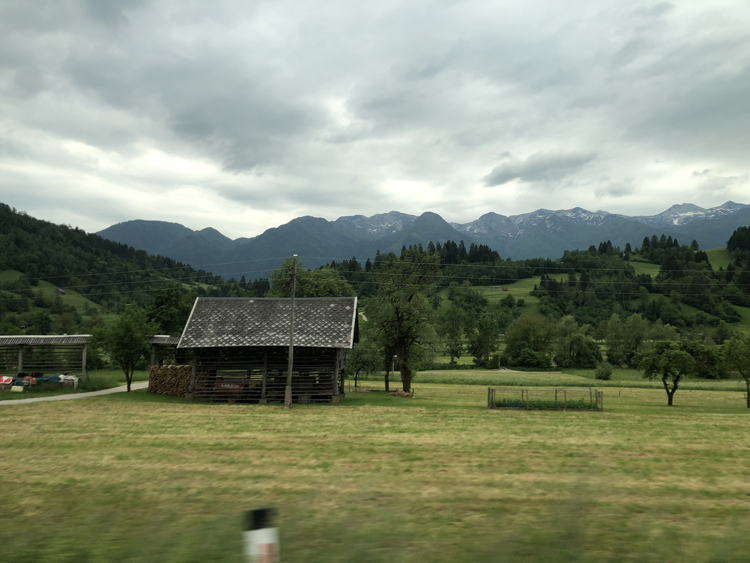 Drying shed and farm, Slovenia Despite the cities and towns in both countries, a significant number of people in Austria and Slovenia still work on the land, whether part time or full time. Many have roots ‘back on the farm’ and return there at festival and/or holiday times.
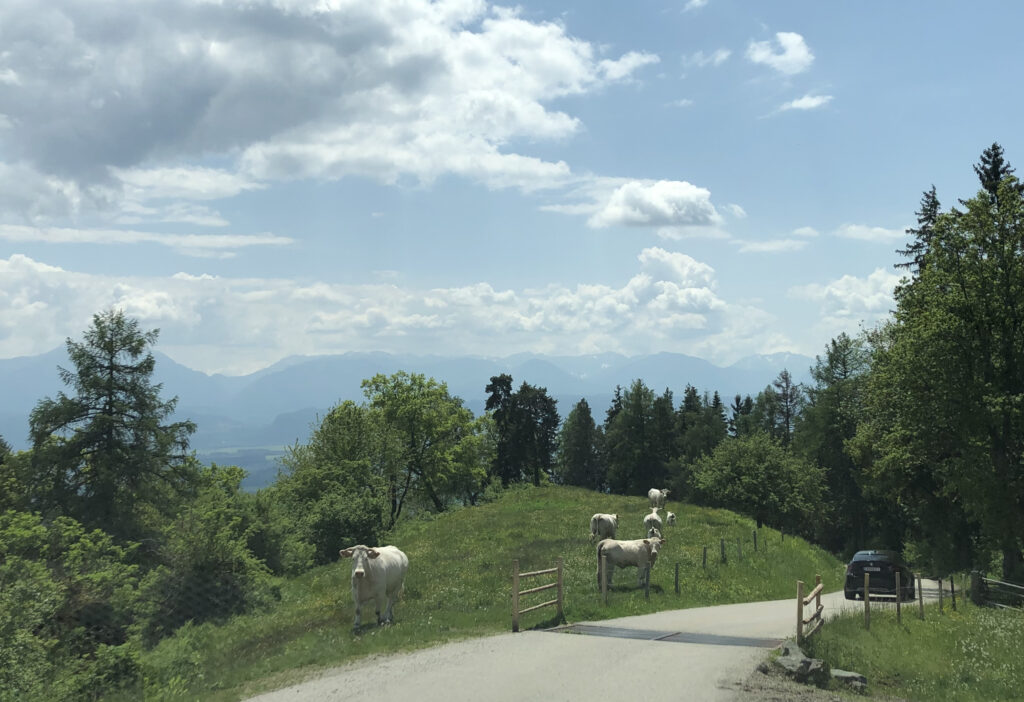 Don’t run the cows over! Magdalensberg, Austria Roma Novans have this ‘split identity’ – it’s a reflection of the land itself which has pastures, fields, forests and mountains, plus some spectacular rivers. So in this post, you’ll see a few inspirations…
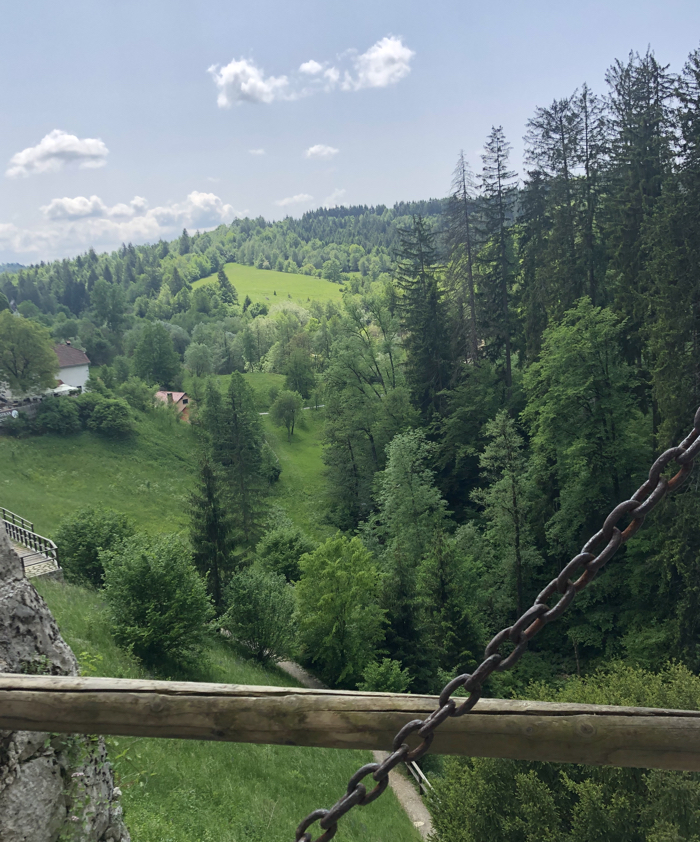 Woodland, Predjama, Slovenia Forests and the timber industry are extremely important, especially in Alpine countries where it often is/has been the main source of fuel and building material.
As well as hosting the great rivers of the region such as the Danube, the Sava and the Drava/Drau, these mountains are often endowed with fast flowing rivers that cut their way down through the rock making steep-sided gorges.
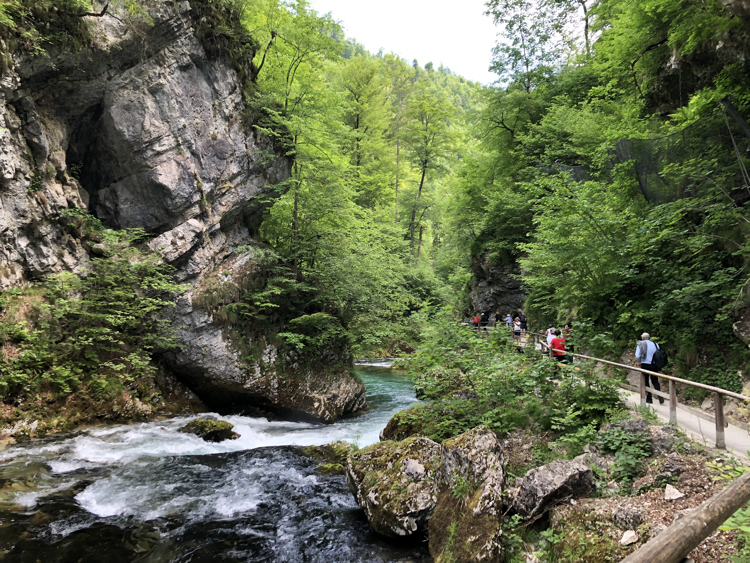 Vintner Gorge, Slovenia In an area covered by glaciers in the Ice Age, the resulting flat-bottomed valleys have been cultivated by humans over thousands of years and today provide rich pasture as well as fields for wheat, spelt, oats and barley. (Ignore the tourist who photobombed the field.)
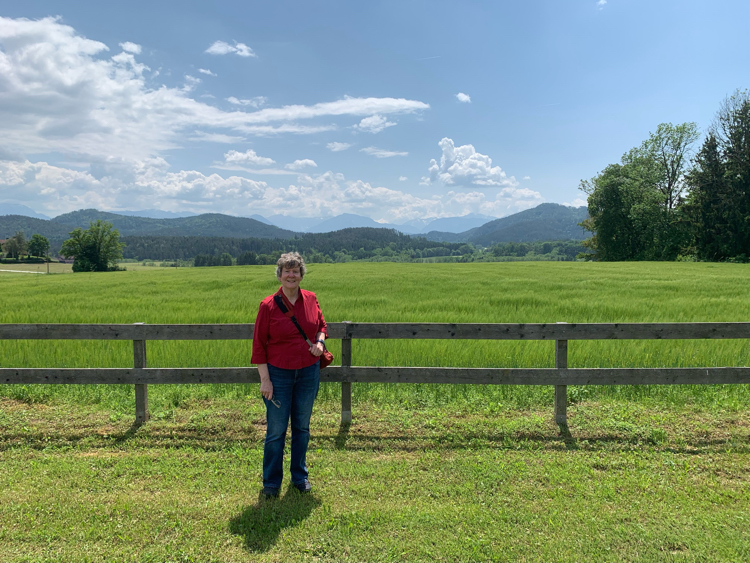 Hayfield, Maria Saal, Austria And there are lakes everywhere in this Alpine region – some formed where the glacier has scoured the valley particularly enthusiastically such as Lake Bohinj in Slovenia, some from a tectonic depression (as my Geography teacher called a hole in the ground) or a combination of both such as the famous Lake Bled, also in Slovenia. As in the photo below, castles commanding the landscape were often built to watch over valleys, lakes or rivers.
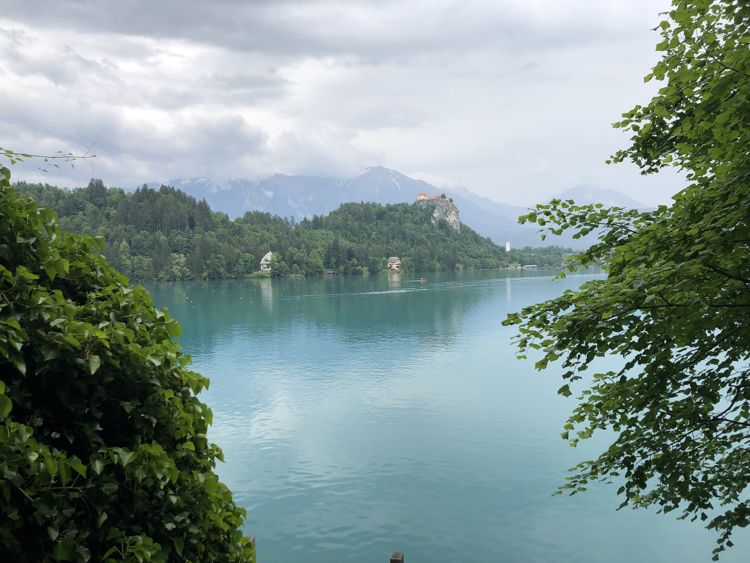 Lake Bled with Bled Castle Villages, towns, markets, even small ports and resorts have grown up round these lakes.
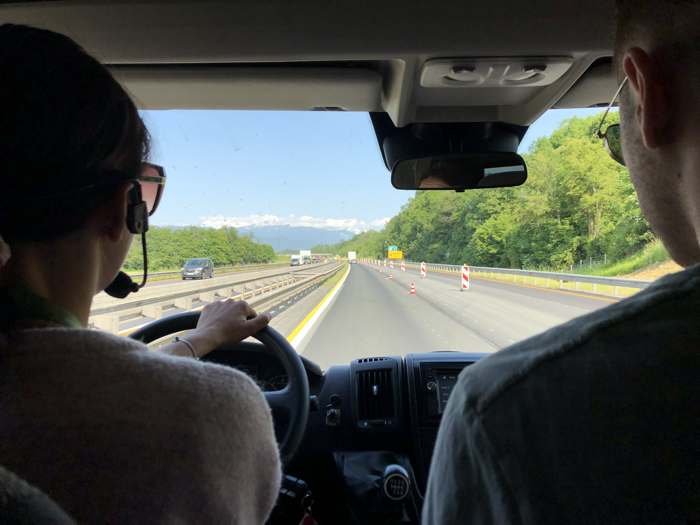
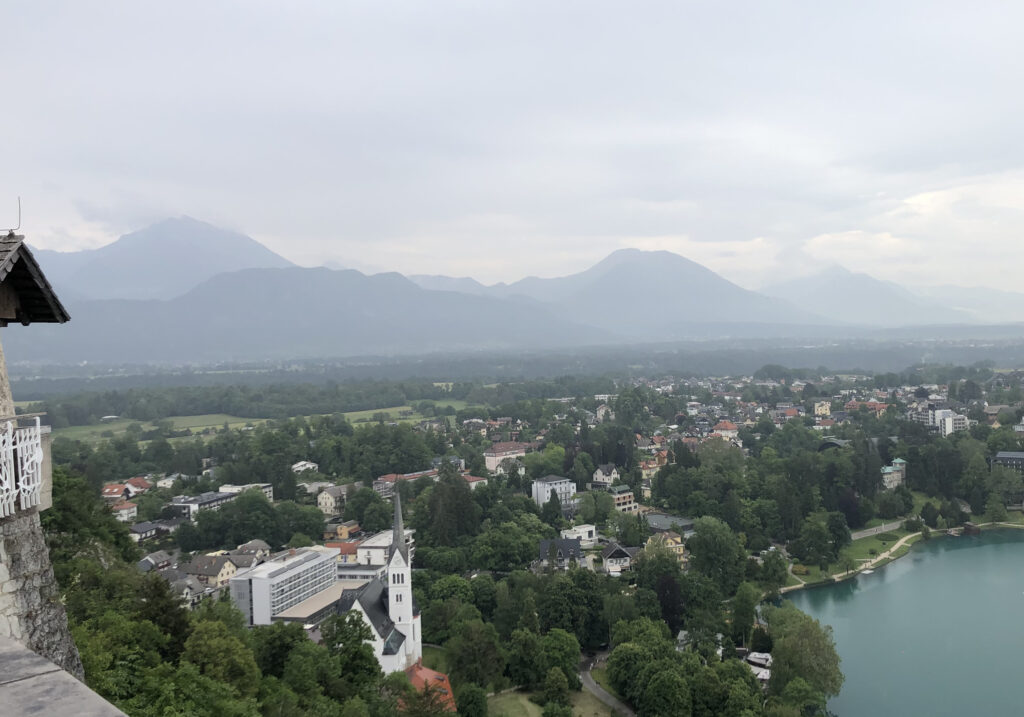 Bled (It was raining!) But the mountains are always around you, even when you are driving out of the city into this landscape.
Alison Morton is the author of Roma Nova thrillers – INCEPTIO, CARINA (novella), PERFIDITAS, SUCCESSIO, AURELIA, NEXUS (novella), INSURRECTIO and RETALIO, and ROMA NOVA EXTRA, a collection of short stories. Audiobooks are available for four of the series. Double Identity, a contemporary conspiracy, starts a new series of thrillers. JULIA PRIMA, a new Roma Nova story set in the late 4th century, is now out.
Download ‘Welcome to Alison Morton’s Thriller Worlds’, a FREE eBook, as a thank you gift when you sign up to Alison’s monthly email update. You’ll also be among the first to know about news and book progress before everybody else, and take part in giveaways.
If you enjoyed this post, do share it with your friends!
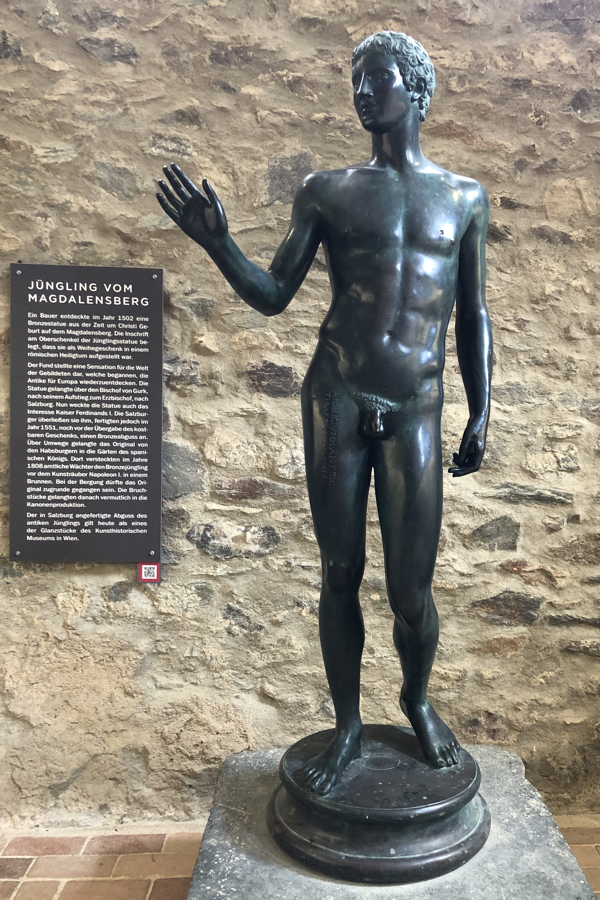 Modern copy in the collection of the Landesmuseum Kärnten at Magdalensberg When I was writing JULIA PRIMA, my research about her hometown of Virunum uncovered the story of the Youth of Magdalensberg (Der Jüngling vom Magdalensberg), an ancient Roman bronze statue dating to the first century BC. Now, Romans, statues – nothing new, you might think. There are thousands of them; we know the Romans left a lot of ‘stuff’ behind.
But this one is surrounded, or even shrouded, in mystery as it’s been missing since the 1810s and is now presumed lost.
I did promise in June to relate this story, but the York and Colchester festivals intervened. However, this mystery has existed for a couple of centuries, so I hope you forgive me a couple of months’ delay.
So, let’s unravel it…
The statue of a rather well-formed, naked young man was discovered in 1502 in Carinthia in the south of Austria on the Magdalensberg mountain, once the major late Celtic and early Roman city of Noricum that we know and love. But what we see today is a 16th century cast now held in the Kunsthistorisches Museum, Vienna and until 1986 was mistakenly regarded as the original.
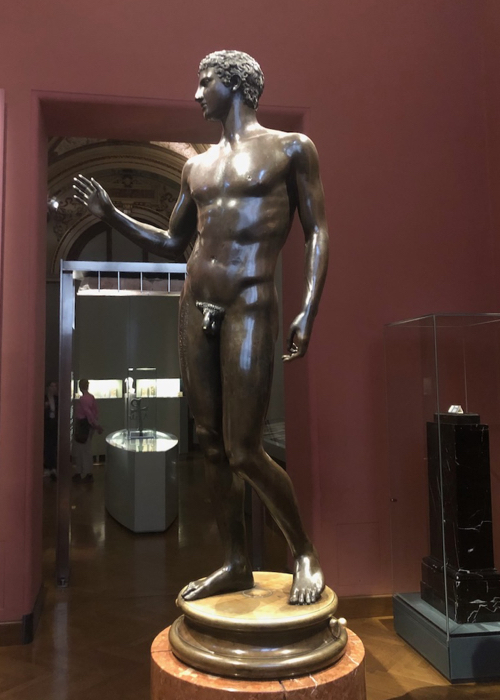 16th century ‘original copy’ of the Youth of Magdalensberg in the Kunsthistorisches Museum, Vienna When I visited the Magdalensberg this summer, I was delighted to see the Youth in his splendid beauty as in the photo above. It’s a remarkably intact and high quality find – well buried apparently. But this is a modern copy of the one in Vienna.
Imagine how pleased I was to see the ‘original copy’ – the 16th century cast – when I visited the Kunsthistorisches Museum in Vienna a week later. It’s a huge, awe-inspiring building in itself in the grand imperial style, but I confined myself to visiting the Roman rooms – I was on a mission!
When I found him – it was quite a quest given the richness and variety of stunning exhibits – I actually said out loud, ‘There you are’ as if I knew him personally. Other visitors nearby moved on quickly. They must have been wondering who this mad Englishwoman was.
(The light wasn’t very good in the museum as it’s deliberately kept subdued so as not to batter ancient objects with too many lumens, so my photo is a bit dark.)
But the Youth’s story is tied up firmly with the history of Virunum and Noricum itself.
Let’s get into detail
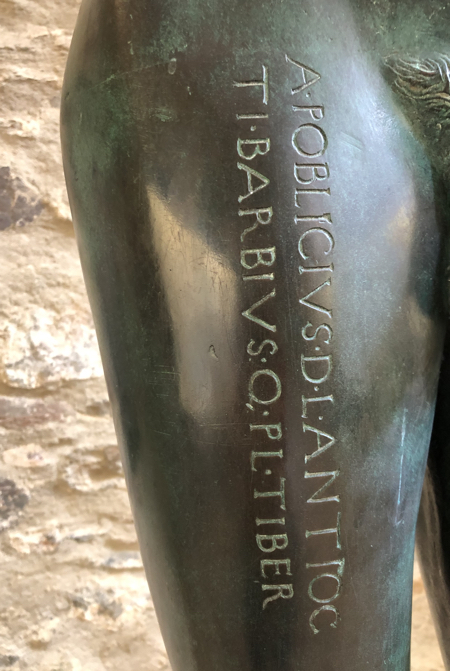 The statue is about life size, more precisely 1.85 metres (6’1″). His right thigh is of great interest. (No, not that sort!) The statue is about life size, more precisely 1.85 metres (6’1″). His right thigh is of great interest. (No, not that sort!)
On that thigh you can read an inscription:
Latin: A[ulus] Poblicius D[ecimi] l[ibertus] Antio[cus]
Ti[berius] Barbius Q[uinti] P[ublii] l[ibertus] Tiber[inus or -ianus]
English: (A[ulus] Poblicus Antio[chus], fr[eedman] of D[ecimus]; Ti[berius] Barbius Tiber[inus or ianus], fr[eedman] of Q[uintus] P[ublius].)
This dedication seems to be by two freedmen, probably merchants active in the town on the Magdalensberg.
Interestingly, a round shield found together with the Youth, which is now lost(!), bore this inscription:
Latin: Gallicinus Vindili f[ilius] L[ucius] Barb[ius] L[ucii] l[ibertus] Philoterus pr[ocurator] / Craxsantus / Barbi[i] P[ublii] s[ervus].
English: (M[arcus] Gallicinus, son of Vindilus; L[ucius] Barb[ius] Philoterus, fr[eedman] of L[ucius]; Craxsantus, s[lave] of Barbi[us] P[ublius])
The donors of the shield seem to be a free Celt, a freedman of the North Italian gens Barbia and local Celtic slave of the same family. One of the two donors of the Youth itself was also from this family.
But who is the statue meant to represent?
Of course, no nobody agrees. The inscriptions by themselves don’t identify the figure as a god. Recent interpretations think it might be a cult statue of a Celtic Mars from the sanctuary on the mountaintop, or as a priest from Noreia (the ancient lost city of Noricum – see the note in this post about my scepticism). Could it have been part of a statue group dedicated to Noreia, or as a statue of Mercury which stood in the town’s forum?
I have my own thoughts which I shall be including in the sequel to JULIA PRIMA.
The disappearing statue – a historical mystery of its own
The Youth was found in 1502 by a farmer ploughing on a terrace south of the summit. Soon afterwards, it ‘came into the possession’ of Matthäus Lang von Wellenburg, the Bishop of Gurk . (Make your own conclusion how that happened.) He took it with him to Salzburg in 1519 when he became Archbishop of Salzburg.
Until the 1980s it was assumed that the statue had come from Salzburg to Vienna in 1806 following the Peace of Pressburg. However, investigations of the casting technique and scientific analysis of the metal in 1986 led to the realisation that the statue in Vienna was a cast made in the sixteenth century.
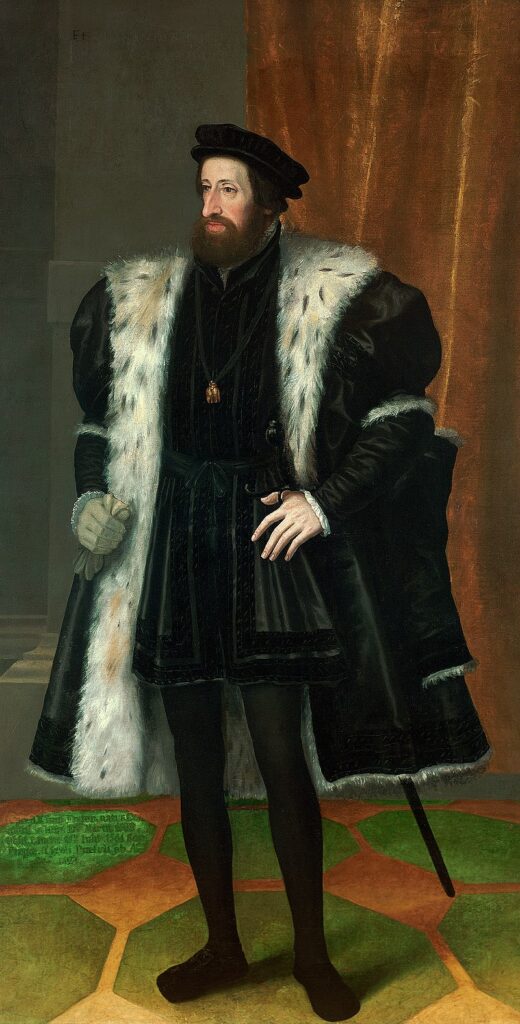 Ferdinand I by (the said) Hans Bocksberger the Elder Then everything becomes very murky. Documents in the Salzburg cathedral chapter reveal that Emperor Ferdinand I owned it in 1551. A cast was made which ended up in Vienna in 1806. The original was moved to Spain, where it is attested in 1662 and 1786 as being in the gardens of the Royal Palace of Aranjuez.
But one thing is sure – the original definitely existed. The Youth is the only ancient full-size bronze statue known from the Eastern Alpine region and therefore is of great significance in Austria.
Two illustrations of the original statue are known. The first comes from Peter Apian and Bartholemew Amand’s Inscriptiones Sacrosanctae Vetustatis of 1534, the other from a fresco by Austrian painter Hans Bocksberger the Elder in the chapel aisle of the Landshut Residence, Lower Bavaria from 1542.
But from the beginning of the 19th century, the original statue disappears.
Did it end up in a private collection?
Is it mouldering away in somebody’s garden and turned green?
Was it melted down for the bronze?
Or did it return incognito to a small country in central Europe that still lived by Roman values and culture…?
Speculative, of course, but you never know…
Alison Morton is the author of Roma Nova thrillers – INCEPTIO, CARINA (novella), PERFIDITAS, SUCCESSIO, AURELIA, NEXUS (novella), INSURRECTIO and RETALIO, and ROMA NOVA EXTRA, a collection of short stories. Audiobooks are available for four of the series. Double Identity, a contemporary conspiracy, starts a new series of thrillers. JULIA PRIMA, a new Roma Nova story set in the late 4th century, is now out.
Download ‘Welcome to Alison Morton’s Thriller Worlds’, a FREE eBook, as a thank you gift when you sign up to Alison’s monthly email update. You’ll also be among the first to know about news and book progress before everybody else, and take part in giveaways.
If you enjoyed this post, do share it with your friends!
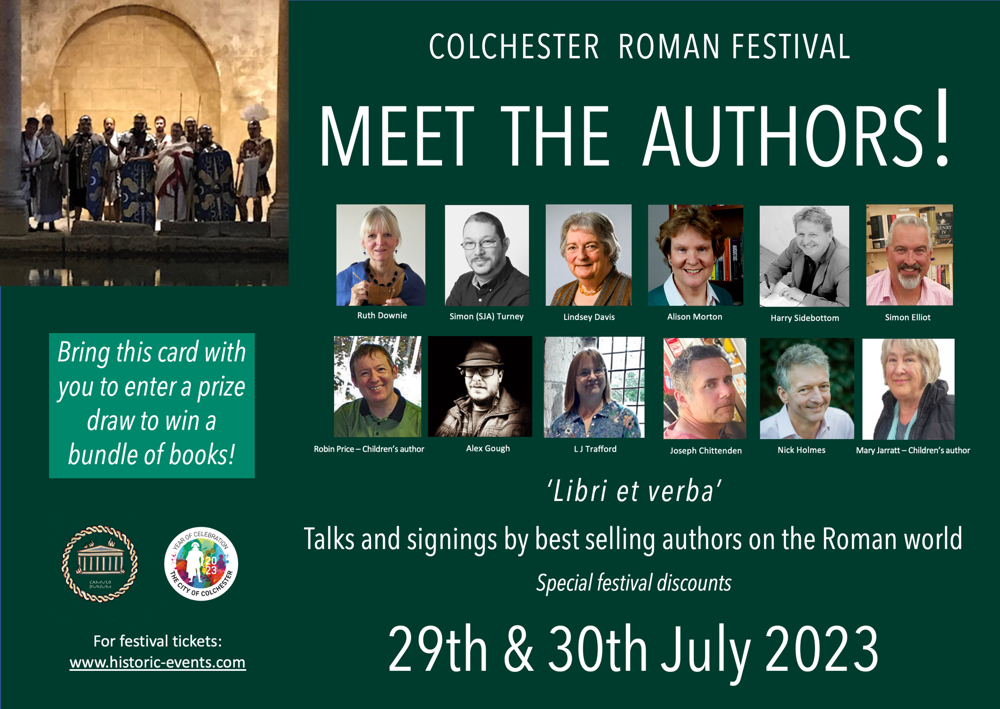
Yes, they let us back to the second Roman festival in Colchester (Camulodonum for Romans) on 29 and 30 July.
The ‘old crowd of authors – Simon Turney (S J A Turney), Ruth Downie, Alex Gough, Harry Sidebottom, L J Trafford, Mary Jarratt, Robin Price and I from last year were enhanced by historian, author and archaeologist Simon Elliot of the University of Kent plus Nick Holmes of The Fall of the Roman Empire podcast. But to our immense pleasure, our star fellow author was Lindsey Davis of Falco and Flavia Albia fame!
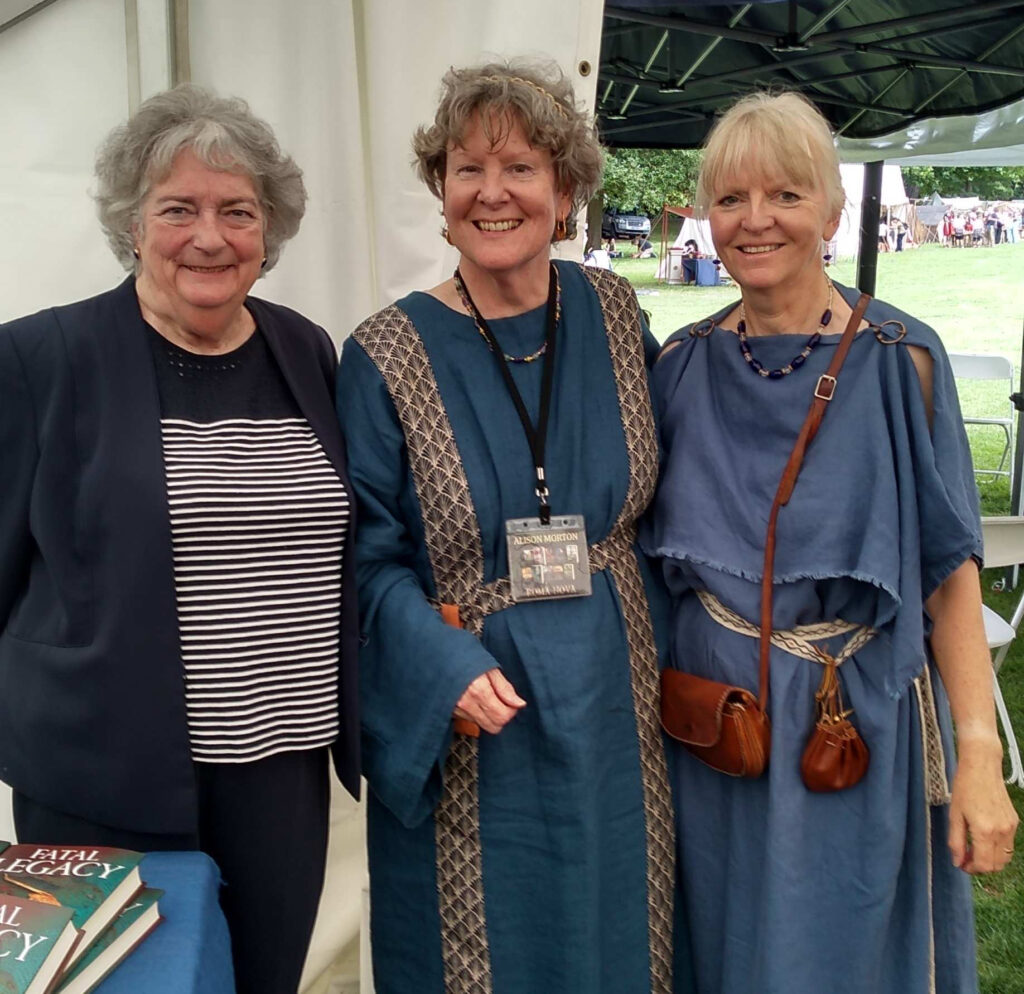 Lindsey, Alison and Ruth As before, we ran a prize draw for visitors to the author tent and the winner scooped one of each of our books. He seemed very happy about it when I gave him the news! For two days, we met some wonderful readers, talked Romans and signed books. And much banter and news was exchanged…
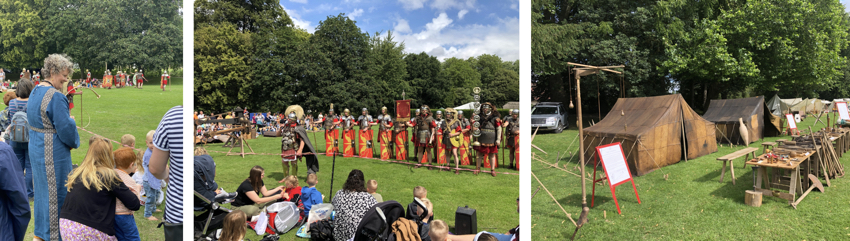
What was there? Re-enactors, archaeological trust staff and volunteers running mosaic and amulet making and tables of Roman games, stalls with ceramics, furs, swords, oysters plus fabulous displays of gladiatorial skills. The cream were the displays by the famous Ermine Street Guard of uniform, equipment, training and (some terrifying!) tactics. I had taken my then young son to see them over twenty-five years ago and this year, it was my grandson who was as fascinated as his father had been.
The range of talks and panels expanded considerably. My first was as a participant in ‘Was the Fall of Rome inevitable?’ Harry and Nick were the strong leaders on this, much more expert than I, but I could chip in occasionally, particularly giving other historical contexts such as the Austro-Hungarian empire and the British and French empires. ‘Best and Worst Emperors’ gave LJ Trafford, Alex Gough, Simon Turney full rein under the chairmanship of Robin Price. Augustus, the first emperor, was voted the best by the audience and the sad and ineffective Honorius the worst.
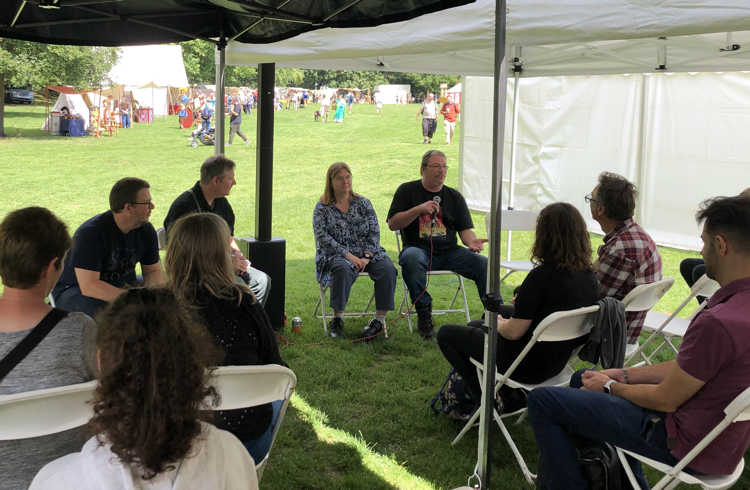 Best and Worst Emperors panel. Left to right: Alex Gough, Robin Price (chair), L J Trafford, Simon Turney Next up was a talk by Lindsey Davis about her work. Apart from her self-deprecating sense of humour, she gave a fascinating insight to her publishing journey as well as the world of Roman fiction.
Then I had an outbreak of nerves, but hid it well (I hope!); I chaired a panel on ‘Bringing Rome to Life on the Page’. Fair enough, I had written eight reasonably successful Roma Nova books, mostly thrillers, plus JULIA PRIMA in the 370s AD and readers seemed to like them and appreciate the research I had done for them. But my panellists were Harry, Nick and… Lindsey. Now, a moderator is supposed to control the conversation and I did worry beforehand about this aspect with such lively and knowledgeable participants, but they were professional, entertaining and thoroughly collegiate. We had such fun!
On Sunday, the last panel, ably chaired by Alex, was entitled ‘Gender, Sexuality and Identity in Ancient Rome.’ Harry and I were back on stage, but with LJ Trafford who had written a whole book about the subject. It was a frank, delightfully uninhibited and very informative discussion. Romans had complicated attitudes to and values about sex, marriage and gender that often sits awkwardly with today’s. of course, the knack in fiction is to convey that without upsetting the modern reader too much… 😉
This year, in celebration of launching JULIA PRIMA, I’d made a late 4th century costume for events. I’ll explain the ins, outs, traps and frustrations of putting it together in another post, but it seemed to work. I’d had a trial run at the Eboracum Roman Festival a few weeks before.
Tracey Turney (partner of Simon) persuaded me to do this little video about my latest book. https://youtu.be/_7gLa5UQprc
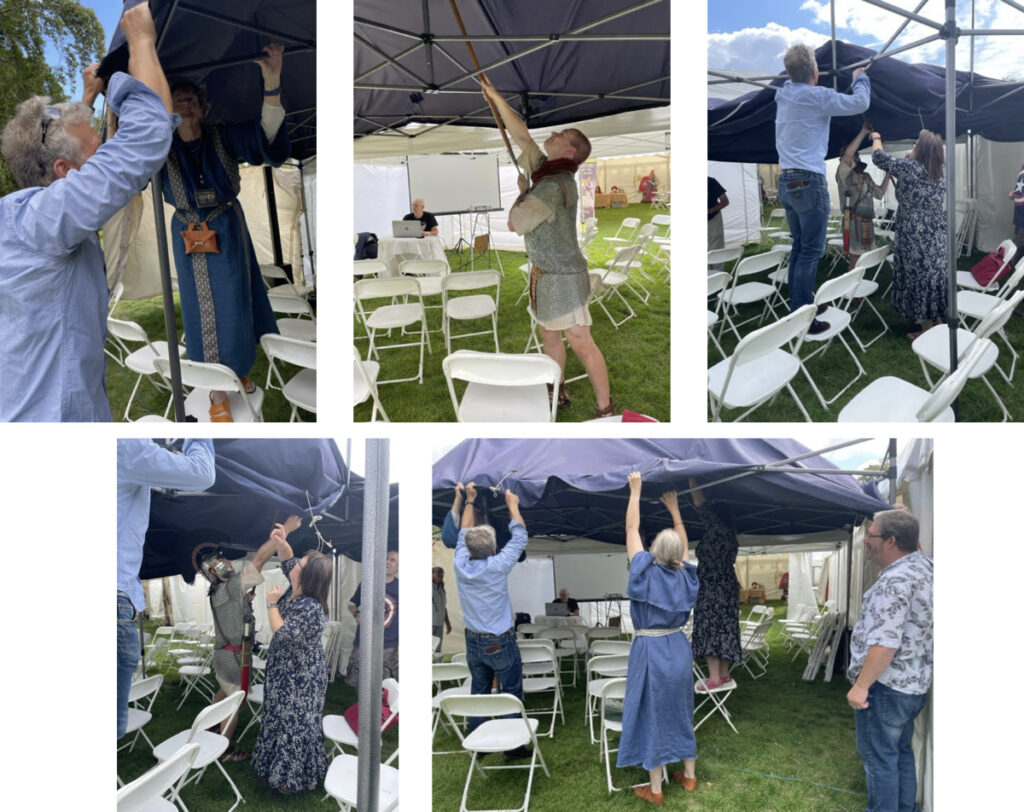
The wind? It blew a howling gale and took the roof off the talk tent gazebo, but authors and a Roman soldier were there to remedy the situation…
If you’d like to know more about Roman Colchester, read on…
Camulodunum was an important city in Roman Britain, and the first capital of the province. It became known/was marketed in the 1960s as the ‘oldest recorded town in Britain’. (I wonder if they have competition for that title now.) Originally the site of the Brythonic-Celtic oppidum of Camulodunon (meaning ‘stronghold of Camulos’), capital of the Trinovantes and later the Catuvellauni tribes, it was first mentioned by name on coinage minted by the chieftain Tasciovanus some time between 20 and 10 BC.
Following Claudius’s invasion of the enigmatic, foggy and slightly strange northern island in AD43, a Roman legionary base was built in the AD 40s on the site of the Brythonic-Celtic fortress. A Roman legionary castrum (fortress) established in the confines of Camulodunon became the first permanent one in Britain and home to the Twentieth Legion. The legion withdrew around AD 49, the legionary defences were dismantled and the fortress converted into a town, with many of the barrack blocks converted into housing. A large number of Roman army veterans settled there with land grants and an unspoken mission to show the native population the advantage of the Roman way. Hm…
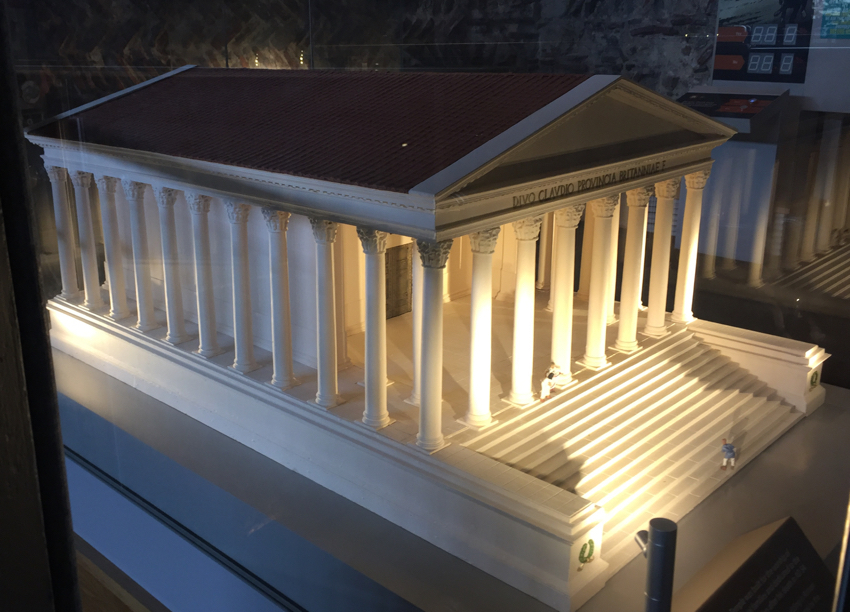 Model of the Temple of Claudius, Colchester The town was not only the the capital of the Roman province of Britannia, but also its temple (the only classical-style temple in Britain) was the centre of the Imperial cult in the province and initially home to the provincial procurator of Britannia. It also had few soldiers (around 200-strong procurator’s guard) and no walls, so was a juicy target for Boudicca when she raised the tribes to revolt in AD60/61 and burned the whole place down, along with Londinium and Verulamium, and slaughtered every living soul.
But the Romans were a persistent lot and rebuilt the town, although the capital of Britannia moved to Londonium. Unsurprisingly, new walls and a large defensive ditch were built around the rebuilt colonia – the first town walls in Britain, predating other such walls in the province by at least 150 years.
Camulodunum (official name Colonia Claudia Victricensis) reached its zenith in the 2nd and 3rd centuries AD and was home to a large classical temple, two theatres (including Britain’s largest), several Romano-British temples, Britain’s only known chariot circus, Britain’s first town walls, several large cemeteries and may have reached a population of 30,000 at its height.
The colonia became a large industrial centre, including brick making and was the largest, and for a short time the only, place in the province of Britannia where samian ware was produced, along with glasswork and metalwork and a coin mint. Apparently they also grew grapes and made wine in the area! Dozens of mosaics and tessellated pavements have been found, along with hypocausts, sophisticated waterpipes and drains which would indicate townhouses belonging to prosperous owners.
But as with many Roman cities in Late Antiquity, the town diminished with the lessening of trade, literacy and skills in the late fourth century and the formal collapse of Roman administration in 409/411 AD, although much everyday life probably continued much the same for most people. Enter the Saxons and other eastern tribes when the area was subject to invasion, then settlement of new populations. Colchester first re-enters the written historical record again in the Anglo-Saxon Chronicle for 917, the year it was retaken from the Danes by a Saxon army led by King Edward the Elder, who ‘restored’ the borough to English rule. The Temple of Claudius was a standing ruin until the Normans cleared the superstructure to incorporate the podium into Colchester Castle in the 11th Century.
And yes, they might even invite us back next year…
Alison Morton is the author of Roma Nova thrillers – INCEPTIO, CARINA (novella), PERFIDITAS, SUCCESSIO, AURELIA, NEXUS (novella), INSURRECTIO and RETALIO, and ROMA NOVA EXTRA, a collection of short stories. Audiobooks are available for four of the series. Double Identity, a contemporary conspiracy, starts a new series of thrillers. JULIA PRIMA, a new Roma Nova story set in the late 4th century, is now out.
Download ‘Welcome to Alison Morton’s Thriller Worlds’, a FREE eBook, as a thank you gift when you sign up to Alison’s monthly email update. You’ll also be among the first to know about news and book progress before everybody else, and take part in giveaways.
If you enjoyed this post, do share it with your friends!
|
Subscribe to Blog via Email
Join 37 other subscribers.
Buy AURELIA from Apple!
UK

US
|