 This is one for the writers, but readers might be interested in a vital part of the process that goes to producing a story. I say producing, because like a piece of pottery, a story starts as a heap of dull, wet mud. Writing the first draft is like throwing that heap on to the wheel and teasing out a not-too-bad shape. After several tries, and a lot of concentration, hard work an a dollop of inspiration, you eventually have a well-shaped story which holds together, with no holes and no obvious imperfections. Now it has to be finished, decorated and glazed before firing in the publishing process. (Or do I mean kiln?)
Writers use different finishing routes; mine always includes a professional (yes, parting with money!) report. If you are lucky enough to be a member of the Romantic Novelist’ Association’s New Writers Scheme, you will receive a massively subsidised report as part of your membership.
Professional readers can be multi-published authors, editors, creative writing tutors or literary consultants. Obviously, you will have checked out their qualifications and track record. Personal recommendation and references are vital; you are handing over your hours of hard graft, inspiration and possibly a part of your soul.
After a few weeks, the report drops into your inbox. Whether it’s the first time or the fourth time (as it is for me), the feelings of excitement and dread intermingle; did the reader ‘get’ your story? Is it a potential bestseller or a heap of crap? Are they going to suggest you take up accountancy instead?
 Make a cup of tea/coffee and open the damned thing; it’s done. This may sound hard, but nothing you feel now is going to change the report. You’ll be better off using that nervous energy in working on the revisions which result from it. But I’m getting ahead of myself – something I am told I do when I read my report. 😉
Let’s get practical
1. Sit quietly and read through it fairly quickly. That gets rid of anticipation and you can then read the content properly and with your writing brain rather than your emotions.
2. Then look at the structure of the report. Usually, there’s a general/introductory section at the beginning (usually with some nice words!), followed by headed sections about the chief concerns, for example, start of the story, each major character, minor characters, setting/world building, plot, then options and ways forward.
3. Reports will normally pinpoint only the weaker areas. If something isn’t mentioned or is only included in the introductory section with praise, then you’ve cracked those areas and don’t need to worry.
4. Print the report out in 1.5 spacing, or double, if you prefer. (I use up my old business letterhead for this internal stuff, so ignore the logo in the image.) Next mark up the report. You can’t use it effectively until you’ve analysed it. I underline the key words/phrases, e.g. “One of your strengths is writing action scenes.” I don’t need to underline “They are all terrific, immediate, visceral” which develops that comment, although I do go back and read it when I have an attack of self-doubt!
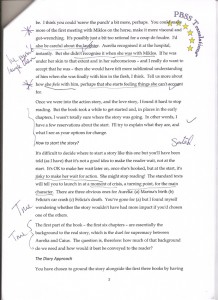 Moving on… “You have a lovely turn of phrase” I just tick that – job done. Then you read ”But I’d be careful about…” For me that’s a massive asterisk in the margin – an action point that must be addressed. I mark up things where I see the reader is right with ’True’. This alerts me to revisit that section of my manuscript. And importantly, any factual queries, I mark with ‘Check’. Doing this analysis methodically takes the sting out of any negatives identified. You are a in worker mode rather than reactor mode.
5. If the reader has also annotated the text, work through those comments first, bearing in mind the overall points made in the report. A warning – you will find other things the reader hasn’t mentioned but which scream out at you now your senses are alerted. This is a great opportunity to tighten up other parts of the text and snip bits out of scenes that you now see are superfluous. And to develop scanty scenes which could contribute much more.
6.When you’ve finished that run through, have a glass of wine to celebrate. (Juice/tea/coffee as you prefer, but I need wine at this stage.)
7. Next day, sit at your keyboard and work through the general points underlined in the report. If it’s a major restructure, print out the sections/chapters concerned and work on them with a pen. You will be able to scribble, circle and arrow them much more easily than on the screen. You may even find a pair of scissors and a stapler/gluestick handy…
You may feel you’re starting all over again, but altering the detailed comments in the days before will have slotted you back into the story after a break of several weeks. I’ll ‘fess up – I had dithered around at the start of my latest manuscript, AURELIA, and had several interesting but redundant chapters at the beginning. Following the advice in my report, I consigned six chapters to the pyre, but two tighter chapters, full of tension, emotion and action, emerged from the flames.
8. No, you haven’t finished! Send the revised manuscript to your Kindle/print it out in single spacing and read it through as if it were a ‘real book’. Make notes, but don’t stop to change anything or you’ll lose the flow.
9. Incorporate changes you have spotted on your read through.
10. Send the manuscript to a trusted friend/critique partner/beta reader asking them to comment on the reader experience. They shouldn’t spot spelling, bad grammar and typos; you will have sorted out those glitches by now.
11. Final check and then send the manuscript off to the next stage, be it agent, publisher, or as I do to my copy editor before it goes to my publishing services company, SilverWood Books.
 Now is definitely time to celebrate – you’ve achieved a huge step in your book’s existence.
Sometimes, a reader report is a genuine dud, but not often. In that case, go back to the reader/organisation and set out your points logically why it didn’t meet your expectations; keep the emotion out. Out of six reports from various sources, I’ve only had one poorly produced one and even the scheme organiser thought it wasn’t very good and offered me a second one free!
A reader’s job is not to slate, target or destroy your work and your confidence, but to show you weaknesses, and offer you ways to remedy them. They are industry professionals who want good books for the public. However emotionally you feel about it at first, do the hard work on it and it will not only make the current story better but also help you develop as a writer.
Any other tips?
Alison Morton is the author of Roma Nova thrillers, INCEPTIO, and PERFIDITAS. Third in series, SUCCESSIO, is now out and Book 4 is in the editing process!
Find out about Roma Nova book progress, news, writing tips and info by signing up for my free monthly email newsletter.
If you enjoyed this post, do share it with your friends!
Like this:
Like Loading...


 So, split the atom time. Well, as I’ve created two blogs out of one, it’s more a case of splitting the byte.
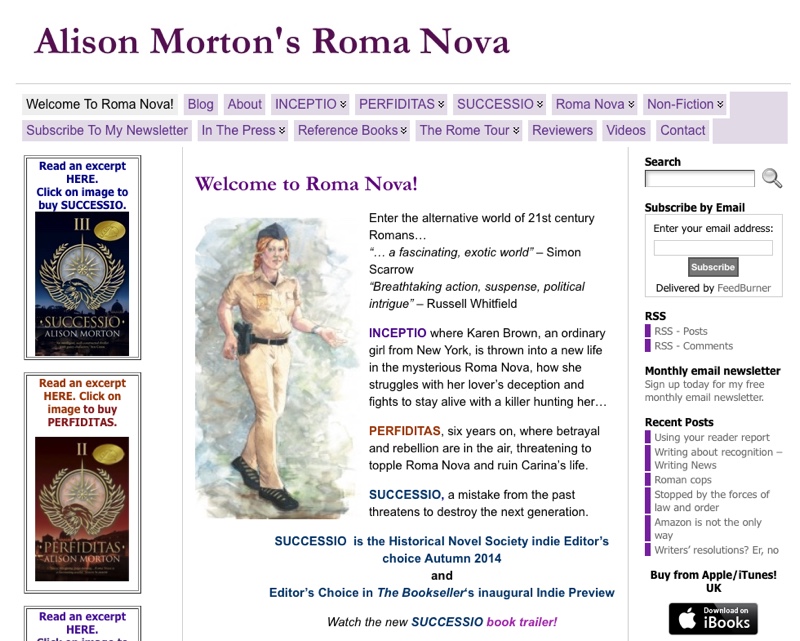 My website, originally Write A Novel? I Must Be Mad! had one main theme – a newbie’s adventures in writing-and-publishing-land, peppered with the odd post about Rome and alternative history. When my first book, INCEPTIO, came out, I changed it to Alison Morton’s Roma Nova and added in stuff about my books.