Lupercales, Andrea Camassei (1602-1649), Prado Museum Mid February, the time of roses and chocolate when romance is in the air… And isn’t it the quaint descendant of the old Roman festival of Lupercalia?
Er, no. ‘Quaint’ is definitely not the word.
In AD 495, Christian bishop of Rome, Gelasius, finally managed to suppress the more than thousand year old Roman festival of Lupercalia. Gelasius’ letter to senator Andromachus taunted the nominally Christian senators who were intent on preserving the Roman tradition: “If you assert that this rite has salutary force, celebrate it yourselves in the ancestral fashion; run nude yourselves that you may properly carry out the mockery.” That would have been something to see!
So, two questions: What was the Lupercalia? And why was a pagan festival still celebrated a hundred years after emperor Theodosius had banned all manifestations of pagan religion on pain of death in his last edict in AD 395. (The same edict that had triggered the exodus of pagan Romans northwards to found Roma Nova…)
Superficially, Lupercalia looks like a mob of scantily clad young men of rank, running around the posh part of the city, full of sauce and whipping people, especially young women – sounds very student-like… But this was a quintessential Roman rite about purging, purification and fertility and significant on many levels to Romans for a thousand years.
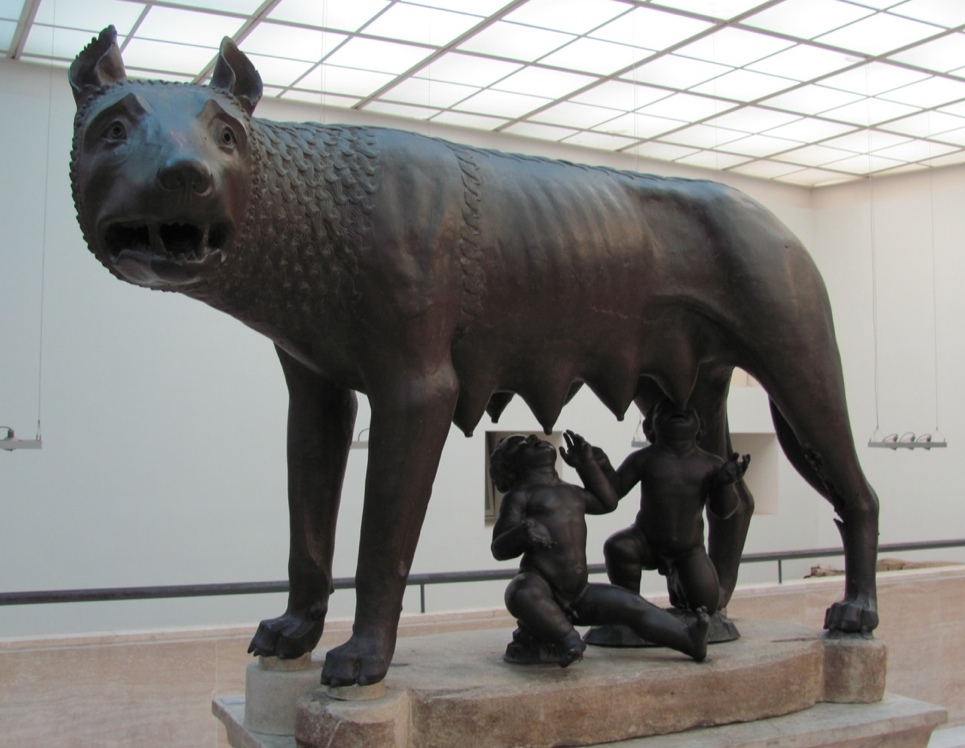 Capitoline Museum (Author photo) The name Lupercalia was believed in antiquity to be linked with the Ancient Greek festival of the Arcadian Lykaia (from Ancient Greek: λύκος – lukos, “wolf”, Latin lupus). In Roman mythology, Lupercus is the god of shepherds. His festival was celebrated on the anniversary of the founding of his temple on 15 February near the cave of Lupercal on the Palatine Hill where, according to Rome’s founding myth, Romulus and Remus were suckled by a she-wolf, or lupa.
The rites were directed by the Luperci, the ‘brothers of the wolf’, a corporation of sacerdotes (priests) of Faunus, usually of equestrian ran, who were dressed only in goatskins. After the sacrifice by the Luperci (or the flamen dialis – a leading priest) of two male goats and a dog, Luperci were led to the altar and anointed on their foreheads with the sacrificial blood, which was wiped off the bloody knife with wool soaked in milk, after which they were expected to smile and laugh. (Nice)
 The Palatine Hill today (Author photo) Sacrificial feasting (and obviously drinking) followed, after which the Luperci cut thongs from the skins of the animals (februa), then ran round the walls of the old Palatine city with said thongs in their hands. As then ran, in two bands, they struck people who crowded near. Girls and young women would line up on their route to receive lashes from these whips. The theory went that this encouraged fertility, prevented sterility in women and eased the pains of childbirth.
So why did this rite persist into the fifth century? Even though the festival had deteriorated and was no longer organised by patrician young men but left to the rabble to run, Romans still claimed it was such an ancient part of their lore, their history, that it was vital for the safety and prosperity of Rome that it should continue. A strong claim that came from Roman hearts, it was said. Perhaps it was a sense of clinging on to the memory of a past when Rome was a world power rather than a diminished city, one of many in Italy. Perhaps it was a chance for rebellious young men to let off steam.
Although strongly contested, Gelasius did eventually suppress Lupercalia. Significantly, this festival of fertility and purification with violent overtones, which had given its name — dies februatus, from februare, to purify — to the month of February, was replaced. Instead, a Christian festival celebrating the purification after childbirth (a perfectly normal, natural function) of the soft and compliant Virgin Mary – Candlemas, observed forty days after Christmas, on 2 February – became the time for purification. Those with a sense of the ironic may let a little smile cross their lips.
Oh, and fierce, pagan Lupercalia has no connection with Valentine’s Day.
Updated 2025: Alison Morton is the author of Roma Nova thrillers – INCEPTIO, CARINA (novella), PERFIDITAS, SUCCESSIO, AURELIA, NEXUS (novella), INSURRECTIO and RETALIO, and ROMA NOVA EXTRA, a collection of short stories. Audiobooks are available for four of the series. Double Identity, a contemporary conspiracy, starts a new series of thrillers. JULIA PRIMA, Roma Nova story set in the late 4th century, starts the Foundation stories. The sequel, EXSILIUM, is now out.
Download ‘Welcome to Alison Morton’s Thriller Worlds’, a FREE eBook, as a thank you gift when you sign up to Alison’s monthly email update. As a result, you’ll be among the first to know about news and book progress before everybody else, and take part in giveaways.
If you enjoyed this post, do share it with your friends!Like this:Like Loading...
 If you have subscribed to this Roma Nova blog, thank you! I really appreciate your interest and commitment. Here you will find info about the Roma Nova thrillers, Ancient Rome, events I’ll be at (speaking and cavorting) and more about the mysterious Roma Nova itself. If you have subscribed to this Roma Nova blog, thank you! I really appreciate your interest and commitment. Here you will find info about the Roma Nova thrillers, Ancient Rome, events I’ll be at (speaking and cavorting) and more about the mysterious Roma Nova itself.
If you would also like to read about writing techniques, (independent) publishing, marketing, fabulous guests, author-entrepreneur skills, writing life and what I’ve been up to, do also subscribe to Alison Morton’s Writing Blog (by RSS or email).
Happy reading!
Alison Morton is the author of Roma Nova thrillers, INCEPTIO, and PERFIDITAS. Third in series, SUCCESSIO, is now out.
Find out Roma Nova news and book progress before everybody else, and take part in giveaways by signing up for my free monthly email newsletter.
If you enjoyed this post, do share it with your friends!Like this:Like Loading...
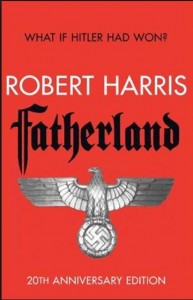 When I first picked up Robert Harris’ Fatherland in my local independent bookshop in 1992, I was fascinated by the concept of ‘what if Nazi Germany had won the war?’ What would have been the alternate path of history? When I first picked up Robert Harris’ Fatherland in my local independent bookshop in 1992, I was fascinated by the concept of ‘what if Nazi Germany had won the war?’ What would have been the alternate path of history?
Fatherland was intrinsically a political thriller. In 1992, the whole of Europe was attempting to realign after the exhilaration of the fall of the Berlin Wall in 1989 and dissolution of the East/West Iron Curtain imposed after the Second War World. Perfect timing by the astute political journalist, Robert Harris. Fatherland went on to become an best-seller immediately and ever since.
The story begins in April 1964 in a Nazi Germany which won the Second World War. It’s the week leading up to Adolf Hitler’s 75th birthday and shortly before his meeting with American president Joseph P Kennedy (JFK’s father in our world). The plot follows police detective Xavier March as he investigates the suspicious death of a high-ranking Nazi. As March uncovers more details he realises that he is caught up in a political scandal involving senior Nazi Party officials, who are being systematically murdered under staged circumstances. As soon as the body is identified, the Gestapo claims jurisdiction and shuts down March’s investigation. March meets a female American journalist who is also investigating the case. Ultimately, the two uncover the horrific truth behind the staged murders.
At its best, alternate history challenges fixed ideas while providing entertainment. In Fatherland, we enjoy the frisson of terror at the nightmare of what could have been. Readers, especially those who haven’t tried an ‘althist’ book before, are intrigued by the different setting and the ‘what if’ trope, but are still after a cracking good story with emotional grip.
Harris is a political journalist and this shows through his writing. I love his succinct, pictorial style, the inference of tension and past memory he can conjure up in a few words:
Xavier March, homicide investigator with the Berlin Kriminalpolizei – the Kripo – climbed out of his Volkswagen and tilted his face to the rain. He was a connoisseur of this particular rain. He knew the taste of it, the smell of it. It was Baltic rain, rain from the north, cold and sea-scented, tangy with salt. For an instant he was back twenty years in the conning tower of a U-boat, slipping out of Wilhelmshaven, lights doused, into the darkness.
According to Robert Harris, in an interview with The Guardian, Fatherland attracted heaviest outrage from Germans who castigated Harris for ‘trivialising’ their history; thirty publishers in Germany refused to handle the book. Das Spiegel magazine ran a six-page denunciation of Fatherland which ensured it became a bestseller in Germany.
My own ‘what if’ story was bubbling away in my head, more as a fantasy than a concrete idea for a book, but the idea of bending and extending history as Robert Harris had done planted itself beside it. It spurred me on to find other such stories such as Keith Roberts’ Pavane about an England after being defeated by the Spanish Armada, Kingsley Amis’ The Alteration and Michael Chabon’s The Yiddish Policemen’s Union. Historic novelist C J Sansom took up the ‘what if Nazi Germany had won the war’ theme in Dominion, but used ordinary people as the carriers of the narration while using the great smog of 1952 (which really happened) as a symbol of obfuscation. Clever stuff.
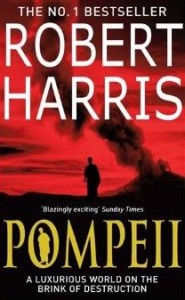 In 2003, Harris turned his attention to ancient Rome with his acclaimed Pompeii which has become another international best-seller. He followed this in 2006 with Imperium, the first novel in a trilogy about Roman orator and politician Cicero. The second novel, Lustrum, was published in October 2009 (Conspirata in the US).The third and final novel, when it does appear, is already on my to-be-read pile. In 2003, Harris turned his attention to ancient Rome with his acclaimed Pompeii which has become another international best-seller. He followed this in 2006 with Imperium, the first novel in a trilogy about Roman orator and politician Cicero. The second novel, Lustrum, was published in October 2009 (Conspirata in the US).The third and final novel, when it does appear, is already on my to-be-read pile.
Pompeii, centres on Marcus Attilius, an ordinary engineer placed in charge of the massive aqueduct that services the tens of thousands living close packed around the Bay of Naples. Quiet, expert, and stubborn, Marcus has to face the facts that his predecessor in the job vanished mysteriously and that the towns’ wells and springs around the whole bay are failing. On top of this, the greatest aqueduct in the world – the mighty Aqua Augusta – has suddenly ceased to flow. Marcus is tasked by the scholar Pliny to undertake crucial repairs to the aqueduct, all under the shadow of the restless Mount Vesuvius. For me, Harris’ genius for narrative is pronounced in this work.
He reached for the decanter but stopped, his hand poised in midair. The heavy crystal glass was not merely shaking now: it was moving sideways along the polished wooden surface. He frowned at it stupidly. That couldn’t be right. Even so, it reached the end of the sideboard and crashed to the floor. He glanced at the tiles. There was a vibration beneath his feet. It gradually built in strength and then a gust of hot air passed through the house, powerful enough to bang the shutters. An instant later, far away – but very distinctly, unlike anything that he or anyone else had ever heard – came the sound of a double boom.
Newer work includes The Ghost, a thinly disguised story of the recently unseated prime minister, Tony Blair. Harris adapted the book with Roman Polanski for a 2010 film starring Pierce Brosnan, Ewan McGregor, Olivia Williams and Kim Cattrall. For me, it echoed the political conspiracy, corruption and twisted allegiances in the Roman novels centred on Cicero.
So who is Robert Harris?
Born in Nottingham, Harris spent his childhood in a small rented house on a Nottingham council estate. His ambition to become a writer arose at an early age, from visits to the local printing plant where his father worked. Harris read English literature at Selwyn College, Cambridge, where he was president of the Union and editor of the student newspaper Varsity.
He became a columnist for the Sunday Times, but gave it up in 1997. He returned to journalism in 2001, writing for the Daily Telegraph and was named “Columnist of the Year” at the 2003 British Press Awards.
So, in conclusion, if you are looking for tight writing, excellent research and a cracking story that challenges, I don’t think you can go wrong with Robert Harris.
For me, he will always be one of the triggers for writing the world of Roma Nova.
(This is a reworked version of a guest post I wrote for Layered Pages when INCEPTIO was launched in 2013.)
Alison Morton is the author of Roma Nova thrillers, INCEPTIO, and PERFIDITAS. Third in series, SUCCESSIO, is now out.
Find out Roma Nova news and book progress before everybody else, and take part in giveaways by signing up for my free monthly email newsletter.
If you enjoyed this post, do share it with your friends!Like this:Like Loading...
|
Subscribe to Blog via Email
Join 37 other subscribers.
Buy AURELIA from Apple!
UK

US
|