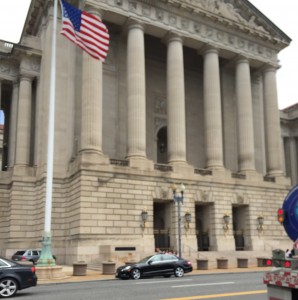
 As I walked past the colonnaded white buildings around the Capitol, the National Mall and the Federal Triangle, I knew I couldn’t be the first visitor to make a connection between Washington DC and ancient Rome.
Both sat/sit on a series of hills and both were/are centres of world power.
The massive scale of prestigious buildings, the columns, porticos, iconic status, eagles and strong, straight lines would be very familiar any ancient Roman.
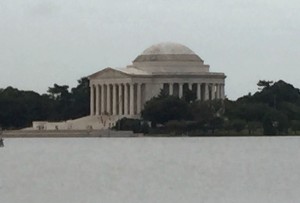
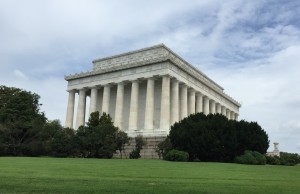
The roof of the final version of the Jefferson Memorial (left) is based on the Pantheon in Rome (Jefferson’s favourite building, so it is said). The Lincoln Memorial (below right) although more Greek in style, to my mind, would not be amiss in the Roman world.
And of course, there is a senate here and a Capitol(ine) Hill. At the US Capitol, Italian artist Constantino Brumidi painted George Washington ascending to Heaven, surrounded by such Roman deities as Minerva, Neptune and Vulcan. In short, the connections, imagined or real, are many.
But I discovered that one part of the area where Washington came to be built was once called Rome…
In the “Original Patentees of Land at Washington,” by Bessie Wilmarth Gahn is the record:
“No. 7.Francis Pope, owner of “Rome” on the Tyber, June 5, 1663.”
In the early records of Annapolis, one finds:
ffrancis Pope, transported since 1635; wife 1649
And in the proceedings of the early Assemblies:
ffrancis Pope—member of the Assembly in September, 1642, and 1667 and 1670, he was Justice of the Peace for Charles County, Maryland.
In an old volume of records at Annapolis, Liber 6, folio 318:
“June 5th, 1663, Lyd out for Francis Pope of this Province, Gent., a parcel of land in Charles County called Rome, lying on the East side of the Anacostian River [meaning here, the main channel of the Potomac], beginning at a marked oak standing by the River side, the bounded tree of Captain Robert Troop and running north by the river for breadth the length 200 perches to a bounded oak standing at the mought of a bay or inlet called Tiber, bounding on the north by the said Lett and a line drawn east for the length of 320 perches to a bounded oak standing in the woods on the East with a line drawn south from the end of the former line until you meet with the exterior bounded tree of Robert Troop called Scotland Yard on the south with the said land, on the west with the said river (Tyber), containing and now laid out for 400 acres more or less.”
Capt. Robert Troop’s “Scotland Yard,” itself north of the tract “New Troy” which extended far north of the Capitol and Congressional Library of today, was therefore the southern boundary of Mr. Pope’s Rome.
(Sources: http://www.genealogy.com/forum/surnames/topics/pope/3903/) Much more about the early history of the Capitol site from the US Capitol Historical Society http://www.capitolhillhistory.org/library/04/Jenkins%20Hill.html
For the love of Rome…
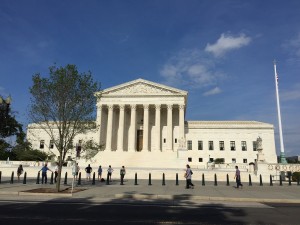
As Enlightenment gentlemen, the founding fathers of the new United States rather liked the idea of a representative democracy modelled on that of the Roman Republic, but they also conceived of a capital city that looked like Rome — or what they thought Rome looked like.
In fact, during the Republic (traditionally dated to 509 BC, and ending in 27 BC) Rome was largely brick, not a city of shiny marble, which came later, started under the stewardship of Augustus and his right-hand man, Agrippa.
Of course, the Roman Republic eventually fell and the Roman Empire eventually crumbled. And the sharp minded might note the irony that the first volume of Edward Gibbon’s The History of the Decline and Fall of the Roman Empire was published in 1776, the year of American Independence.
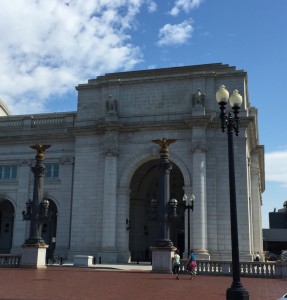
Union Station, DC
————–
New – a late addition
A bonus picture I spotted when reviewing my photos…
Arches with columns and eagles either side in perfect symmetry, single columns with eagles topping them…
Take out the electric street light and you’d be in ancient Rome.
(Or perhaps – retaining the streetlights – the in the imaginary Roma Nova itself…)
Alison Morton is the author of Roma Nova thrillers – INCEPTIO, PERFIDITAS, SUCCESSIO, AURELIA, INSURRECTIO and RETALIO. CARINA, a novella, and ROMA NOVA EXTRA, a collection of short stories, are now available. Audiobooks are available for four of the series. NEXUS, an Aurelia Mitela novella, is now out.
Download ‘Welcome to Roma Nova’, a FREE eBook, as a thank you gift when you sign up to Alison’s monthly email newsletter. You’ll also be first to know about Roma Nova news and book progress before everybody else, and take part in giveaways.