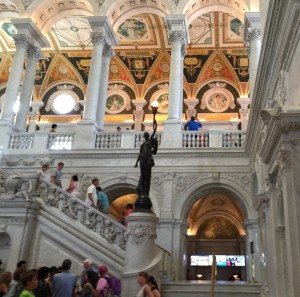
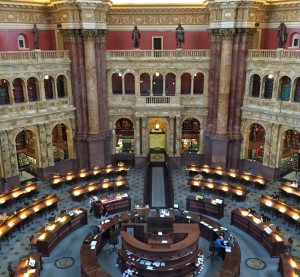
 In summer 2015, I visited the USA and part of Canada. It was seven weeks of hectic fun. In Washington, one of the highlights was a visit to the Library of Congress, specifically the Jefferson Building. It was ‘all kinds of awesome’: the magnificent colourful entrance hall and sumptuous steps, Jefferson’s book collection, an original Gutenberg Bible, the incredible reading room which reminded me of my days using the British Library although the two buildings couldn’t be more different. In summer 2015, I visited the USA and part of Canada. It was seven weeks of hectic fun. In Washington, one of the highlights was a visit to the Library of Congress, specifically the Jefferson Building. It was ‘all kinds of awesome’: the magnificent colourful entrance hall and sumptuous steps, Jefferson’s book collection, an original Gutenberg Bible, the incredible reading room which reminded me of my days using the British Library although the two buildings couldn’t be more different.
But one thing that always attracts me in such places is the map collection. Perhaps having a geography teacher mother influenced me, but I LOVE maps – they reveal so much not only about the place they represent, but also what people thought important, a place/nations’s history and development, the attitude, knowledge and aspirations of the mapmakers and their paymasters.
Change fascinates me. The transit of a country from one stage of development to the next always sparks questions in my head – why, who, how, what if? In the hallowed hall of the Library of Congress, I searched for the ‘birth of a nation’ map of the US and found the EUS of my Roma Nova world.
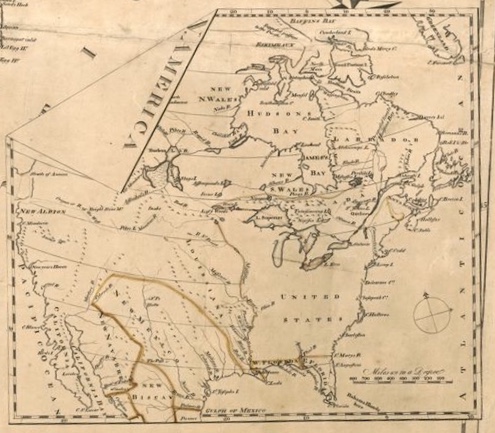 Inset in the map “The United States according to the definitive treaty of peace signed at Paris Sept. 3d. 1783. William McMurray, Robert Scot” Let me explain. In the alternate time line where Roma Nova exists, the ‘Eastern United States’ – the EUS – is only one nation in the North American continent: it was co-ruled by British and Dutch governors up to 1813 then solely by the British until 1867. We have Louisiane (never purchased and much larger than today’s state) and Québec (most of north east Canada) which belong to a France ruled by a constitutional monarch descended from Napoléon Bonaparte, then the Spanish imperial territories in the southwest which include our timeline’s Texas, New Mexico, Arizona and California, and the Indigenous Nations’ Western Territories in between. The boundaries are not fixed and they only form the background, in particular to INCEPTIO, but I had fun working it out.
Imagine the pleasure when I looked at McMurray’s map in the Library of Congress and found an inset with the territories more or less divided in the way they are in Roma Nova! Obviously, things have moved on since 1783, but it could still be like this today, but for chance factors like the odd revolution in our timeline.
You can find the full map with inset here: http://www.loc.gov/item/gm71005423/
Are you a map geek? Please tell me I am not alone in the world…
Update 2018:
Alison Morton is the author of Roma Nova thrillers – INCEPTIO, PERFIDITAS, SUCCESSIO, AURELIA, INSURRECTIO and RETALIO. CARINA, a novella, is available now. Audiobooks are available for the first four of the series.
Get INCEPTIO, the series starter, FREE as a thank you gift when you sign up to Alison’s monthly email newsletter. You’ll also be first to know about Roma Nova news and book progress before everybody else, and take part in giveaways.
If you enjoyed this post, do share it with your friends!
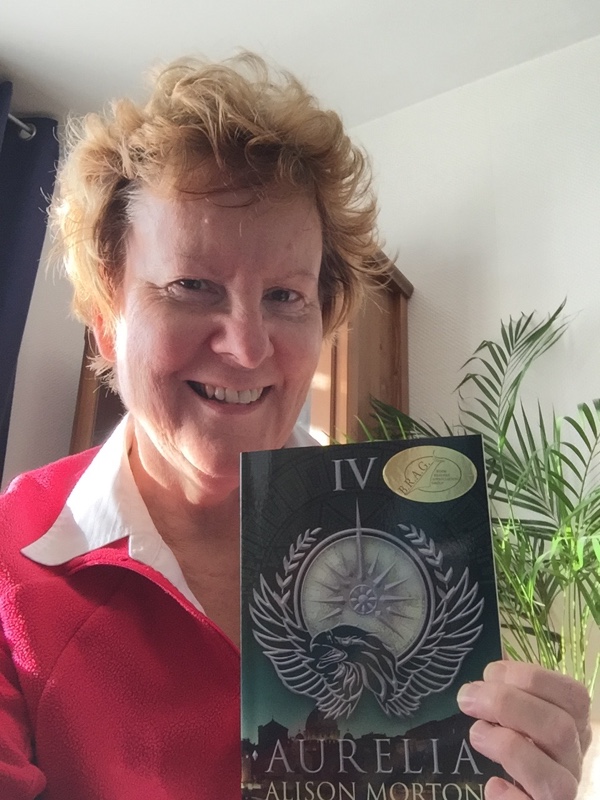 Oh yes! 2016 has begun in a spectacular way and I’m not talking about fireworks. AURELIA, the fourth Roma Nova thriller, first in a new cycle of adventures featuring Praetorian and imperial councillor Aurelia Mitela, has been shortlisted for the 2016 HNS Indie Award. Oh yes! 2016 has begun in a spectacular way and I’m not talking about fireworks. AURELIA, the fourth Roma Nova thriller, first in a new cycle of adventures featuring Praetorian and imperial councillor Aurelia Mitela, has been shortlisted for the 2016 HNS Indie Award.
*Jumps up and down with silly grin on face.*
When AURELIA was selected as an indie Editor’s Choice in the August 2015 Historical Novel Society’s reviews, I was delighted. This was the second Roma Nova book to be so honoured; SUCCESSIO was an Editor’s Choice in 2014. But now it gets serious.
The 2016 longlist derives from all the Editor’s Choices in the previous year; in 2015, there were 38 and all terrific reads. The shortlist of nine is the second ‘sift’ announced today and a final list of four will be chosen to be considered at the HNS Conference in Oxford in September 2016 when the award will be presented.
 The organisers, and judges are all volunteers, but happily give their time and precious reading hours in the mission of driving historical fiction indie writing quality upwards. The organisers, and judges are all volunteers, but happily give their time and precious reading hours in the mission of driving historical fiction indie writing quality upwards.
Even if AURELIA doesn’t go further (but I rather hope she will), this is a huge honour. Being shortlisted for one of the most prestigious indie prizes around will make anybody reach for the champagne. It may have been New Year’s Eve yesterday, but the bubbly will be flowing again today!
What’s AURELIA about?
Late 1960s Roma Nova, the last Roman colony that has survived into the 20th century. Aurelia Mitela is alone – her partner gone, her child sickly and her mother dead – and forced to give up her beloved career as a Praetorian officer.
But her country needs her unique skills. Somebody is smuggling silver – Roma Nova’s lifeblood – on an industrial scale. Sent to Berlin to investigate, she encounters the mysterious and attractive Miklós, a known smuggler who knows too much, and Caius Tellus, a Roma Novan she has despised and feared since childhood.
Barely escaping a trap set by a gang boss intent on terminating her, she discovers that her old enemy is at the heart of all her troubles and pursues him back home to Roma Nova…
Watch the trailer…
Available now as an ebook from Amazon, iBooks, Kobo, B&N Nook and as a paperback, author signed paperback and from other retailers
Alison Morton is the author of Roma Nova thrillers, INCEPTIO, PERFIDITAS, SUCCESSIO and AURELIA. The Roma Nova box set is available until 31 January 2016.
Find out Roma Nova news and book progress before everybody else, and take part in giveaways by signing up for her free monthly email newsletter.
If you enjoyed this post, do share it with your friends!
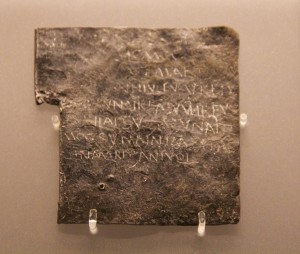 Roman curse tablet from Bath (Photo by Mike Peel (www.mikepeel.net)) The wish to curse a rival, a rip-off merchant, or somebody who cuts us up on the motorway or pushes in front of us in the queue for the first life-saving coffee of the day, is an age old instinct. Nowadays, when we ‘go postal’, we give a ‘load of verbal’, then calm down when something else distracts us.
Nothing so short term for the Romans. Swearing was one thing; cursing was an altogether different pot of garum. They ‘went physical’ by using curse tablets, some of which have survived for 2,000 years.
Curse tablets (tabella defixionis) were used throughout the Graeco-Roman world. Originators would ask the gods, local spirits, or the deceased to bring down a specific disaster on on a person, group or object. For all their pragmatism the Romans were a superstitious bunch and believed the gods and spirits did control nature either directly or via oracles, soothsayers and those practising magic or religion.
Sometimes the writer would change the direction in which words or letters were written, or alternate lines, or write them in mirror-image form, all to give an added magical effect. Some tablets seem to have been written in an arcane or secret language; did a tablet written in a ‘sacred’ language carry more mystique and power with the gods it was addressed to? Tablets with blanks where the names should go have been found which suggests they were prepared in advance; perhaps professional curse writers kept handy stocks ready for the customer in need.
If a victim of a robbery by persons unknown was writing a curse, the target would be described as ‘whether man or woman, boy or girl, slave or free’, or ‘whether pagan or Christian’.
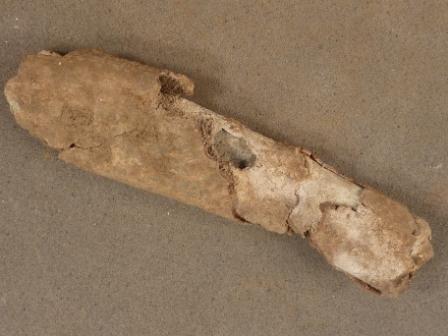 Lead scroll, measuring c. 6 cm long found at the East Farleigh (Photo Maidstone Area Archaeological Group) Typically, the originator scratched his/her message in tiny letters on thin sheets of lead – physically and symbolically a dark, cold and heavy material – usually under 10cm square, then often rolled, folded, or pierced it with nails. These bound tablets, were then usually placed beneath the ground: either buried in graves or tombs, thrown into wells or pools, underground sanctuaries, or nailed to the walls of temples.
Some texts don’t invoke any divine beings but merely listed the targets of the curse, their ‘crimes’ and the intended evil fate to befall them. Examples include cursing the opposing litigant by asking that he botch his performance in court, calling for an evil fate for tricksters who didn’t pay their debts, or wishes that thieves should go blind and mad, while cheaters become as ‘liquid as the water’. One particularly gory curse about a stolen ring said: “…so long as someone, whether slave or free, keeps silent or knows anything about it, he may be accursed in (his) blood, and eyes and every limb and even have all (his) intestines quite eaten away if he has stolen the ring”. A wonderful one found in London reads,”I curse Tretia Maria and her life and mind and memory and liver and lungs mixed up together, and her words, thoughts and memory; thus may she be unable to speak what things are concealed, nor be able.” (translation: British Museum)
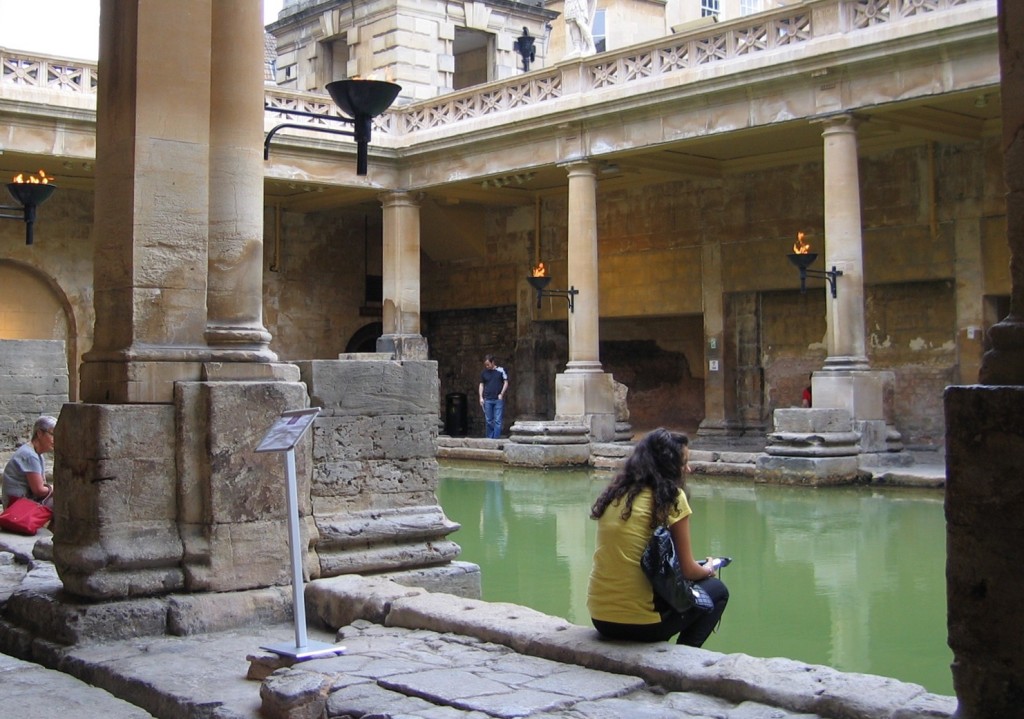 Roman Bath The curse tablets found at Bath are considered to be the most important record of Romano-British religion yet published. They are especially useful as evidence of everyday speech (Vulgar Latin) used in Roman Britain. And the inscriptions illustrate popular attitudes to crime and the system of justice which don’t seem to have changed much over the centuries!
And the significance of the curse tablets today? In 2014, 130 Bath curse tablets were added to the UNESCO Memory of the World register of outstanding documentary heritage – the only documents from Roman Britain on that list. I wonder what the average Romano-Briton would have thought of that?
And, yes, curse tablets are still used in modern Roma Nova. When Aurelia first gets to know Plico the spymaster, he annoys her so much she thinks about “writing a curse tablet and sticking it in the boot of his car.’ (AURELIA )
———————-
Sources and further reading:
Curse tablets from Roman Britain http://curses.csad.ox.ac.uk
Ancient Origins http://www.ancient-origins.net/news-general/significance-roman-curse-tablets-recognised-memory-world-register-001804
Bath curse tablets https://en.wikipedia.org/wiki/Bath_curse_tablets
Lead Scroll found at East Farleigh Roman Villa http://www.maag.btck.co.uk/ExcavationsatEastFarleigh/LeadScroll
Updated 2025: Alison Morton is the author of Roma Nova thrillers – INCEPTIO, CARINA (novella), PERFIDITAS, SUCCESSIO, AURELIA, NEXUS (novella), INSURRECTIO and RETALIO, and ROMA NOVA EXTRA, a collection of short stories. Audiobooks are available for four of the series. Double Identity, a contemporary conspiracy, starts a new series of thrillers. JULIA PRIMA, Roma Nova story set in the late 4th century, starts the Foundation stories. The sequel, EXSILIUM, is now out.
Download ‘Welcome to Alison Morton’s Thriller Worlds’, a FREE eBook, as a thank you gift when you sign up to Alison’s monthly email update. As a result, you’ll be among the first to know about news and book progress before everybody else, and take part in giveaways.
If you enjoyed this post, do share it with your friends!
|
Subscribe to Blog via Email
Join 37 other subscribers.
Buy AURELIA from Apple!
UK

US
|