“I hate romantic fiction – I wouldn’t let my wife read it!” This was how one over-excited male member(!) of a writing group greeted my first pages of INCEPTIO where the heroine meets the hero.
A real gladius point through my neck, but I toughed up like a true Roman and politely pointed out that almost every novel had an emotional relationship in it – what a poor piece it would be without it.
“Rubbish!” he expostulated (Sorry, too tempting, but he did spit in a minor way.) and started to grab books off his shelf of popular thrillers. His face fell as he read the blurbs. Even the grittiest Karin Slaughter or toughest of Ian Rankin’s Rebus betrayed him. He was left chagrined and furious. I smiled in the most condescending way I could muster and was comforted by the faces of the rest of the group members ‘shocked and stunned’ by the attack.
You know I write thrillers featuring tough Praetorian special forces heroines; there are fights, chases, conspiracies and harsh decisions all mixed up with Roman values and a strong sense of survival. But INCEPTIO, CARINA, PERFIDITAS and SUCCESSIO are bound together by the epic love story of Carina and Conrad. Over fifteen years we see attraction, lust, love, betrayal, joy, reconciliation, misunderstanding, broken hearts, envy, jealousy, enduring love, anguish, reconciliation – heart-stopping emotion all the way.
Aurelia has a much rockier time romantically, but she and the mysterious, elusive Miklós are bound together through war and revolution in AURELIA, NEXUS, INSURRECTIO and RETALIO.

Quite a number of the stories in the new collection ROMA NOVA EXTRA are nothing but romances, although still in the robust Roman tradition, so you have the best of both worlds!
When I set out to write JULIA PRIMA, I knew it had to be strongly romantic as it was the story of the meeting of the two who would begin the dynasty that went on to found Roma Nova – Julia Bacausa and Lucius Apulius. But it was firmly entrenched in the Roman society of the late 4th century.
We may like to consider ourselves sentient, logical beings, but who’s kidding whom?
Emotion rules us, especially rude men who know stuff all about writing. Our prime reaction when meeting people is emotional; that’s what the famous ‘gut feeling’ is. Then we sit back and allow our logical brain in.
We value friendship, family love, emotional love and enduring love very highly – that’s what makes us people rather than a walking mass of cells containing 47% water. At this time of the year we become soppy and pink, true, but behind the commercial tinsel lies a fundamental human requirement and expression of life.
As in the real world, human relationships are at the heart of the books’ characters’ actions; they drive the plot. Carina and Conrad’s sparky rock-strewn path in INCEPTIO, her dilemma in PERFIDITAS and Conrad’s in SUCCESSIO wouldn’t be anywhere near as gripping for readers if there was no fundamental emotional connection. And even I had to ask how I would resolve Aurelia and Miklós’s relationship until the end of RETALIO!
And if they don’t care about each other, why should we care about them?
Alison Morton is the author of Roma Nova thrillers – INCEPTIO, CARINA (novella), PERFIDITAS, SUCCESSIO, AURELIA, NEXUS (novella), INSURRECTIO and RETALIO, and ROMA NOVA EXTRA, a collection of short stories. Audiobooks are available for four of the series. Double Identity, a contemporary conspiracy, starts a new series of thrillers. JULIA PRIMA, Roma Nova story set in the late 4th century, starts the Foundation stories. The sequel, EXSILIUM, will be out on 27 February 2024.
Download ‘Welcome to Alison Morton’s Thriller Worlds’, a FREE eBook, as a thank you gift when you sign up to Alison’s monthly email update. You’ll also be among the first to know about news and book progress before everybody else, and take part in giveaways.
If you enjoyed this post, do share it with your friends!Like this:Like Loading...
 Homo sapiens consulting a vademecum Latin isn’t dead; it’s everywhere, perhaps more than we realise – alibi, agenda, consensus, versus, homo sapiens, veto, alias, via, affidavit, vademecum, an item carried around, especially a handbook, and those indispensables i.e. (id est) ‘that is’, and etc. (et cetera) ‘and the rest’.
Maths lovers and problem solvers like putting Q.E.D. (quod erat demonstrandum) ‘that which is to be demonstrated’ after their proof or to clinch their argument.
Some common phrases include:
- non sequitur, ‘something that doesn’t follow’
- bona fide ‘in good faith’ Some we ask for somebody’s bona fides if we want to know if they are genuine.
- alter ego ‘the other self’ Yes, Superman comics have a philosophical Latin concept 😉
- persona non grata (sometimes abbreviated as PNG) ‘unwelcome person’ Used today when expelling diplomats who have been found carrying out activities incompatible with their diplomatic status, i.e. spying
- vice versa ‘position reversed’
- quid pro quo ‘this for that’ or more colloquially, you scratch my back and I’ll scratch yours
- Per se means ‘in itself’ or ‘as such’. It’s become fashionable and sadly, I’ve seen it written persay. (Cringes)
- Cui bono? is a question you should ask if you doubt something. It means ‘for whose benefit?’ And it’s the perfect question to ask if something just seems to be too good to be true…
- Carpe diem is well known; ‘seize the day’ or as we might say today more colloquially ‘Go for it!’
 Roma Novan custodes?
Quis custodiet custodes ipsos? ‘Who guards the guardians themselves?’ Juvenal famously asked in his Satires (Satire VI, lines 347–8) and refers to the problem of controlling the actions of people in positions of power, an issue discussed by Plato in The Republic. Still a question very relevant today…
Mutatis mutandis ‘once the necessary changes have been made’ sounds high flown. Found in law, economics, mathematics and philosophy, it acknowledges that a comparison being made may well require certain obvious alterations, which are left unstated. Not to be confused with the similar ceteris paribus, ‘all things being equal’ which excludes any changes other than those explicitly mentioned.
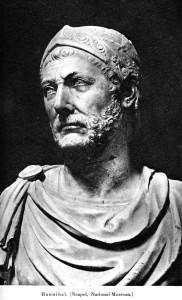 Hannibal (allegedly), bust originally found at Capua, Italy
In ancient Roman history, res publica was used pertaining to the state or public and is the origin of republic, while Hannibal ad portas meant that Hannibal, the great enemy of the Roman Republic was at the gates of Rome, an expression used to frighten naughty children. Perhaps this has given rise to the expression ‘the enemy at the gate’ meaning the opposition are about to flood in and destroy you and now is the time to act.
Vae victis! ‘Woe to the conquered!’ is attributed by Livy to Brennus, the chief of the Gauls, while he demanded more gold from the citizens of the recently sacked Rome in 390 BC.
Damnatio memoriae ‘damnation of memory’ was an ancient Roman custom where all records and likenesses of somebody were eliminated, honours revoked and everybody pretended the person had never existed. Pretty drastic and sometimes visited on Roman emperors by their successors, if they weren’t made gods, on notable public enemies and famously Mark Anthony after his defeat by Octavian and subsequent death.
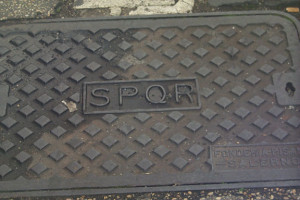 Drain cover in modern day Rome
SPQR (Senatus populusque Romanus) literally means the ‘Roman senate and people’, but popularly called the ‘Senate and people of Rome’. It referred to the government of the ancient Roman Republic, and is even now used as an official emblem of the modern-day municipality of Rome. Many European cities have hijacked the SPQ bit and added their own city initial, even Liverpool – SPQL!
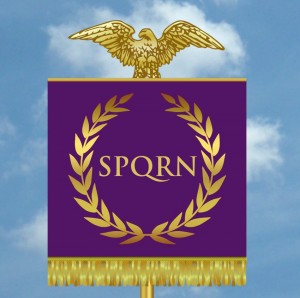 Roma Nova uses SPQRN, of course – Senatus populusque Romanus novus. Roma Nova uses SPQRN, of course – Senatus populusque Romanus novus.
And obiter dicta? This can refer to remarks by a judge which are not necessary to reaching a decision, but are made as comments, illustrations or thoughts. Sometimes a way of saying ‘Here are a few casual comments…” by a senior person in a profession or academic institution. A warning: you should listen to those, because they may well be the most important thing that person has to say…
Do you have any favourite Latin-based sayings?
Updated March 2020:Alison Morton is the author of Roma Nova thrillers – INCEPTIO, PERFIDITAS, SUCCESSIO, AURELIA, INSURRECTIO and RETALIO. CARINA, a novella, and ROMA NOVA EXTRA, a collection of short stories, are now available. Audiobooks are available for four of the series. NEXUS, an Aurelia Mitela novella, is now out.
Download ‘Welcome to Roma Nova’, a FREE eBook, as a thank you gift when you sign up to Alison’s monthly email newsletter. You’ll also be first to know about Roma Nova news and book progress before everybody else, and take part in giveaways.
If you enjoyed this post, do share it with your friends!Like this:Like Loading...
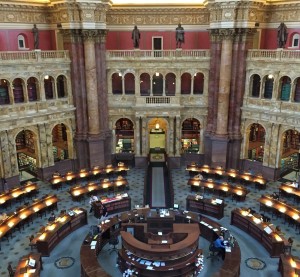
 In summer 2015, I visited the USA and part of Canada. It was seven weeks of hectic fun. In Washington, one of the highlights was a visit to the Library of Congress, specifically the Jefferson Building. It was ‘all kinds of awesome’: the magnificent colourful entrance hall and sumptuous steps, Jefferson’s book collection, an original Gutenberg Bible, the incredible reading room which reminded me of my days using the British Library although the two buildings couldn’t be more different. In summer 2015, I visited the USA and part of Canada. It was seven weeks of hectic fun. In Washington, one of the highlights was a visit to the Library of Congress, specifically the Jefferson Building. It was ‘all kinds of awesome’: the magnificent colourful entrance hall and sumptuous steps, Jefferson’s book collection, an original Gutenberg Bible, the incredible reading room which reminded me of my days using the British Library although the two buildings couldn’t be more different.
But one thing that always attracts me in such places is the map collection. Perhaps having a geography teacher mother influenced me, but I LOVE maps – they reveal so much not only about the place they represent, but also what people thought important, a place/nations’s history and development, the attitude, knowledge and aspirations of the mapmakers and their paymasters.
Change fascinates me. The transit of a country from one stage of development to the next always sparks questions in my head – why, who, how, what if? In the hallowed hall of the Library of Congress, I searched for the ‘birth of a nation’ map of the US and found the EUS of my Roma Nova world.
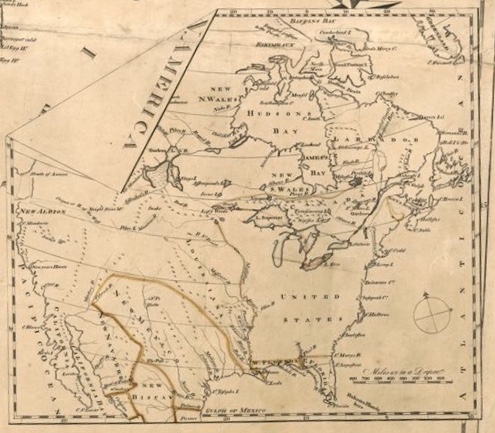 Inset in the map “The United States according to the definitive treaty of peace signed at Paris Sept. 3d. 1783. William McMurray, Robert Scot” Let me explain. In the alternate time line where Roma Nova exists, the ‘Eastern United States’ – the EUS – is only one nation in the North American continent: it was co-ruled by British and Dutch governors up to 1813 then solely by the British until 1867. We have Louisiane (never purchased and much larger than today’s state) and Québec (most of north east Canada) which belong to a France ruled by a constitutional monarch descended from Napoléon Bonaparte, then the Spanish imperial territories in the southwest which include our timeline’s Texas, New Mexico, Arizona and California, and the Indigenous Nations’ Western Territories in between. The boundaries are not fixed and they only form the background, in particular to INCEPTIO, but I had fun working it out.
Imagine the pleasure when I looked at McMurray’s map in the Library of Congress and found an inset with the territories more or less divided in the way they are in Roma Nova! Obviously, things have moved on since 1783, but it could still be like this today, but for chance factors like the odd revolution in our timeline.
You can find the full map with inset here: http://www.loc.gov/item/gm71005423/
Are you a map geek? Please tell me I am not alone in the world…
Update 2018:
Alison Morton is the author of Roma Nova thrillers – INCEPTIO, PERFIDITAS, SUCCESSIO, AURELIA, INSURRECTIO and RETALIO. CARINA, a novella, is available now. Audiobooks are available for the first four of the series.
Get INCEPTIO, the series starter, FREE as a thank you gift when you sign up to Alison’s monthly email newsletter. You’ll also be first to know about Roma Nova news and book progress before everybody else, and take part in giveaways.
If you enjoyed this post, do share it with your friends!Like this:Like Loading...
|
Subscribe to Blog via Email
Join 37 other subscribers.
Buy AURELIA from Apple!
UK

US
|