I’ve clambered over, through or on a fair bit of Roman Europe. Let me share a few with you…
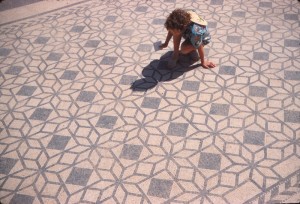 My first Roman mosaic floor, Ampurias/Empúries, Catalonia
I couldn’t believe what I was seeing and touching. The tiny exquisite tile pieces, the faultless geometric patterns, the vast expanse of it and the stunning setting by the Mediterranean Sea.
Mind you, I was eleven!
The Roman world of The Eagle of the Ninth came alive. Touching that mosaic awoke a thirst that has still hasn’t been slaked decades later, not even by the best Falernian!
More here:
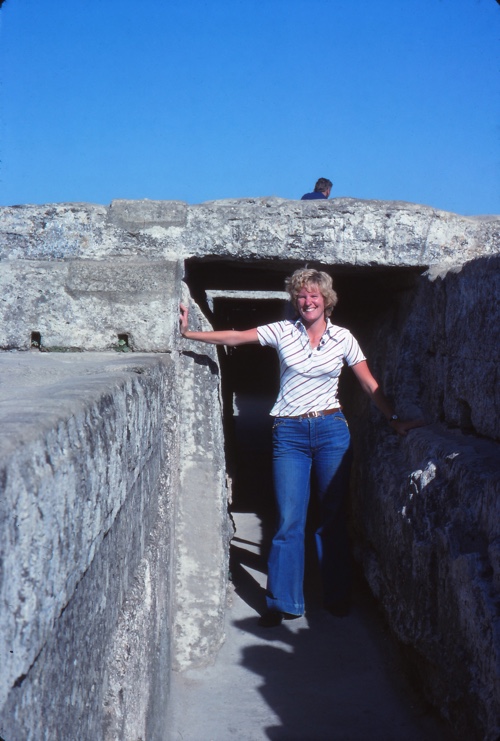
The Pont du Gard, near Nimes
Well, it’s gone all posh now as a UNESCO World Heritage Site, but I first visited it when I was seven.
Later, in my early twenties I was still fascinated, but was too tall at 5’9” (1.75m) to run along the water conduit without bashing my head. But the sheer size of it was still impressive. You’re often disappointed as a adult that things you thought were enormous as a child turn out to be much smaller. The Pont du Gard didn’t disappoint.
I was delighted to then introduce my husband and son to this magnificent construction. Sadly, access to the water conduit was closed due to health and safety. ☹
More here
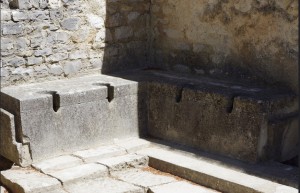 Vaison-la-Romaine, Provence
The Roman loos! Here I learnt that ‘taking your ease’ was a social event. I was shocked by this at fourteen years old. (We were more innocent then at that age.) But it demonstrated to me just how differently Romans saw and did things. The 4-seat latrine from ‘Maison la Tunnelle’ built in the 2nd century AD. Running water in the channel beneath the seats constantly ‘flushed’ the latrines. Photo: Creative Commons
Saalburg, Germany
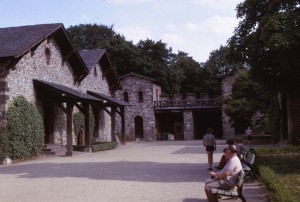 A Roman fort near Bad Homburg, part of the Limes Germanicus, the fortified Roman border separating the Roman Empire from the barbarians. The whole site was extensively examined and researched by archaeologists in the nineteenth century, especially in context of new interest in limes. Germany was in the throes of unification and defining its own identity. In 1897, Kaiser Wilhelm II ordered the reconstruction of the Saalburg fort in line with the detailed results of its earlier excavation making it the most completely reconstructed fort on the entire limes. Now, purists may not like the fact it’s a reconstruction, but it was done sympathetically and carefully. As you move around the site, there’s a distinct feeling you might see a squad marching round the corner with some tough old centurion waving his vine stick at shirkers.
More here
Caerleon, South Wales
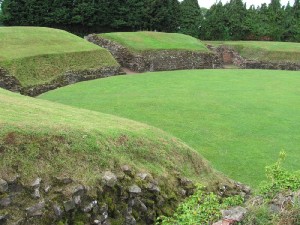 In 2011 I was in Caerleon, attending the Romantic Novelists’ Association conference. But the day before the conference started, a grey, rainy day, I went off on my own ‘Roman holiday’.
Caerleon or Isca Augusta was one of the three permanent Roman military HQs in Britain. Isca became the headquarters of the II Legion Augusta in about AD 75, when Governor Sextus Julius Frontinus began the conquest of Roman Wales. Recent finds suggest Roman occupation of some kind as late as AD 380.
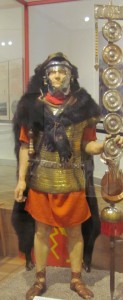 Being me, I took a load of photos. The most impressive remains are of the amphitheatre, the only fully excavated one in Britain. Nearby are part of the fortress wall and the Prysg Field Barracks, the only Roman legionary barracks visible in Europe.
The National Roman Legion Museum in the town contains, gravestones, pottery, tiles, models, mosaics, bathing pool, steps, slabs, courses and some beautiful carved gemstones lost down the drains! Behind the museum is a Roman-inspired garden which gave me a few ideas for my own.
And the cherry on the cake on that drizzly morning? I bumped into one of the Cardiff University archaeologists who told me about the discovery of an extensive river port nearby complete with main quay wall, landing stages and wharves.
More here
Aurelian Walls, Rome
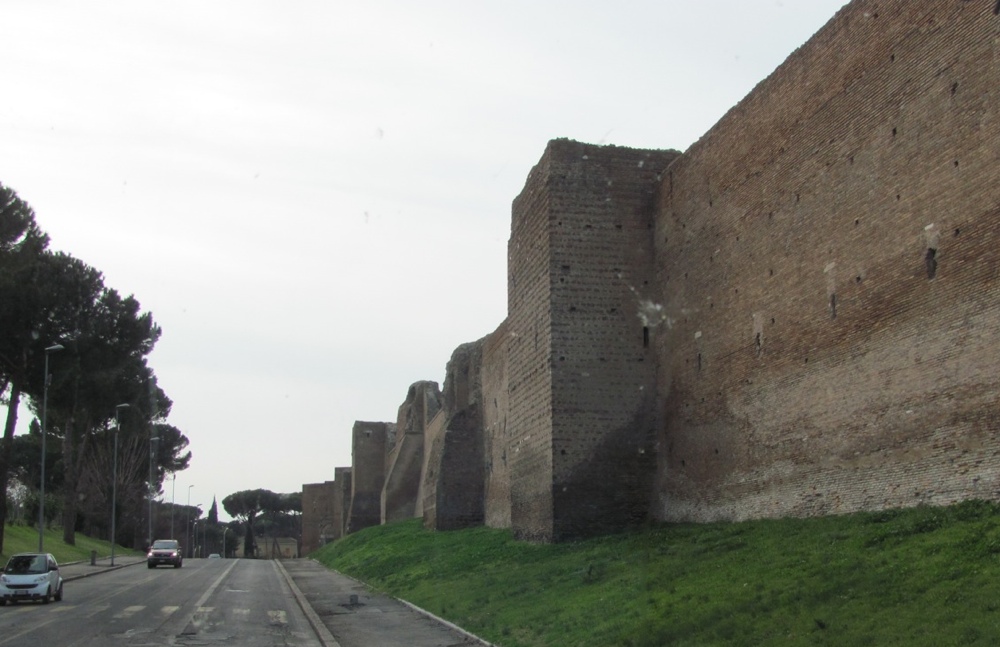 They’re big. The Aurelian Walls are a line of city walls built between 271 AD and 275 AD in Rome, Italy, during the reign of the Roman Emperors Aurelian and Probus.
The walls enclosed all the seven hills of Rome plus the Campus Martius and, on the right bank of the Tiber, the Trastevere district. The river banks within the city limits appear to have been left unfortified, although they were along the Campus Martius. The enclosed area is 1400 hectares. The Aurelian Walls served as a significant military defence for the city of Rome until September 20, 1870, when the Bersaglieri of the royal Italian forces breached the wall near the Porta Pia and captured Rome. The walls also defined the boundary of the city of Rome up until the 19th century; the built-up area was confined within the walled area.
More here
Ostia Antica, near Rome
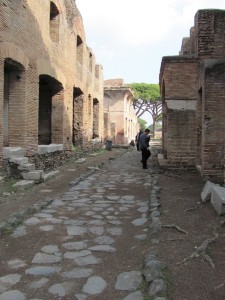 All of it. Rome’s former harbour city is nowhere near as visited or ‘massaged’ in heritage terms as Pompeii has been.
It is one of the ‘must sees’ in the Rome area. I know everybody loves the Coliseum (Flavian Amphitheatre), the imperial fora, Trajan’s column, Capitoline, Pallatine, Hadrian’s villa, etc. etc.
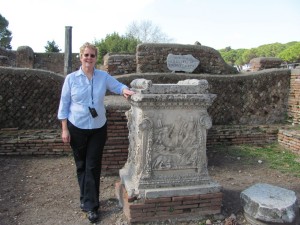
But Ostia Antica was where normal everyday port life went on; shops, games, baths, religious grove, theatre, bars, graveyards; normal living. You’ll need a day.
Of course, there’s the whole of Rome, Pompeii, Nimes…
Which is your favourite?
Alison Morton is the author of Roma Nova thrillers – INCEPTIO, CARINA (novella), PERFIDITAS, SUCCESSIO, AURELIA, NEXUS (novella), INSURRECTIO and RETALIO, and ROMA NOVA EXTRA, a collection of short stories. Audiobooks are available for four of the series. Double Identity, a contemporary conspiracy, starts a new series of thrillers.
Download ‘Welcome to Alison Morton’s Thriller Worlds’, a FREE eBook, as a thank you gift when you sign up to Alison’s monthly email newsletter. You’ll also be among the first to know about news and book progress before everybody else, and take part in giveaways.