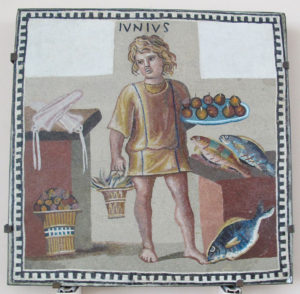
A boy holding a platter of fruits and a bucket of crab(?) in a kitchen with fish and squid, on the June panel from a mosaic depicting the months (3rd century) CC Commons – creator Sailko
Food is one of the most powerful ways of conveying information about characters. It shows readers not only status and wealth (or lack of either), how time rich or poor characters are, the level of complexity in a society, what crops are grown, their traditions and expectations. A real window into the world.
Ancient Roman food varied immensely. In the beginning, dietary differences between Roman social classes were not very significant, but the political changes from kingdom to republic and empire that expanded exponentially exposed Romans to many new foodstuffs, provincial culinary habits and cooking methods.
Traditionally, a breakfast called ientaculum was served at dawn. In the late morning, Romans ate a small lunch, and in the evening they ate cena, the main meal of the day. With the increased importation of foreign foods, the cena grew larger in size and included a wider range of foods. It gradually shifted to the afternoon, while the vesperna, a light supper eaten in the evening was abandoned completely. Prandium, a second breakfast, was introduced around noon. Among the lower status classes these changes were less pronounced as the traditional routines corresponded closely to the daily rhythms of manual labour.
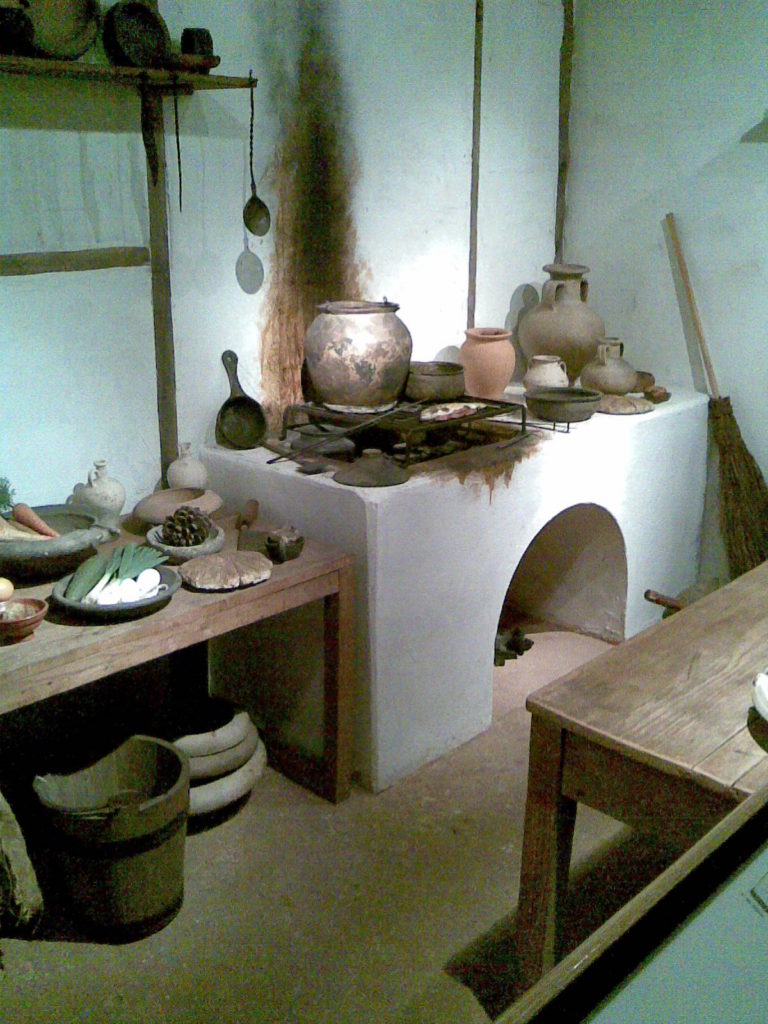
Roman kitchen, Museum of London
In the period of the kings and the early Republic, but also in later periods (for the working classes), the cena essentially consisted of a kind of porridge, the puls. The simplest kind would be made from emmer (a hulled wheat), water, salt and fat. A more sophisticated type was made with olive oil, with an accompaniment of assorted vegetables. The wealthier/higher status classes ate their puls with eggs, cheese, and honey and occasionally meat or fish.
By the end of the Republican period, the cena had developed from two courses – a main course then a dessert with fruit – to three courses: first course (gustatio) which included eggs, snails, fish and seafood, vegetables, cheese. From discoveries at Pompeii and Herculaneum, there were also dormice, served stuffed with pork mince, dormouse meat, pepper, pine nuts and garum (fish sauce) and cooked under a clibanus, a two-part domed terracotta baking/roasting pot. The main course (primae mensae) was meat – kid and goat, pig meat of all types, prepared meats, game and poultry. Dessert (mensae secundae) comprised fruit, nuts and pastries.
Wikipedia gives us a quick oversight into the Roman diet, but do explore the references for sources (not sauces)! The classic Roman cookbook, Apicius: De Re Coquinaria, usually thought to have been compiled in the late 4th or early 5th century AD is a treasure chest of recipes. The English translation put in the public domain by the University of Chicago may inspire your own cooking!
Food and eating in Ancient Rome were not only essential for keeping the body going, but also bound people together: family, household, friends, neighbours, political and business friends and enemies, much like any era in history and even today.
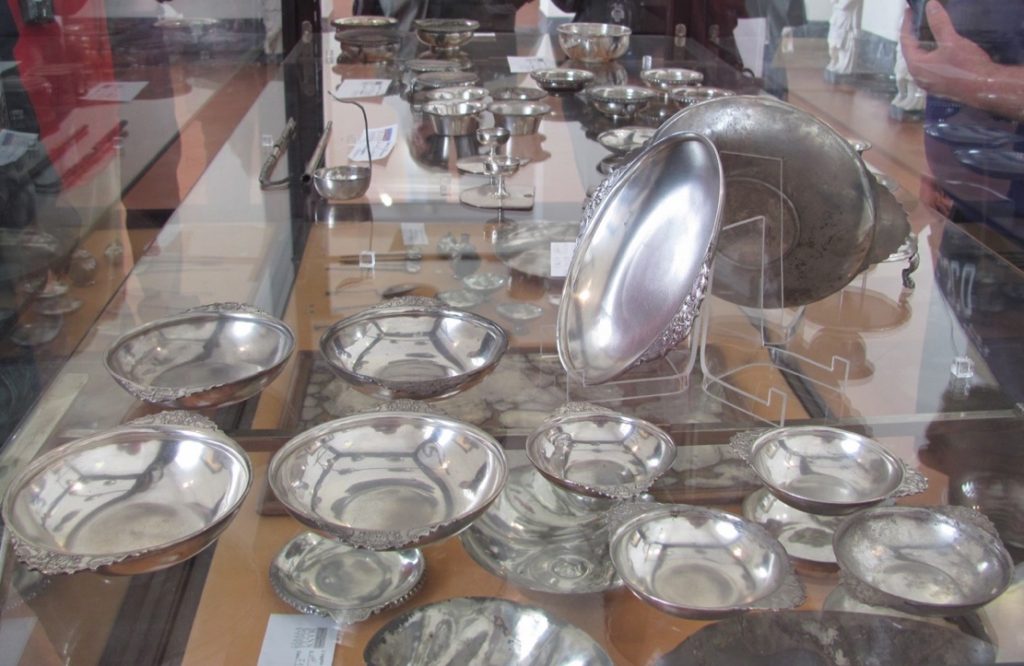
Silver dishes from Pompeii and Herculaneum, Naples Museum
The rich reclined on couches in the triclinium (the room ‘of the three couches’), while slaves served exotic food and wine with vessels of silver.The less wealthy sat at tables and used vessels of pottery and glass. Graffiti from Pompeii show monotonous diets of bread, oil, leeks, onions and cheese with fish and sausages as treats. But a drain in Herculaneum, serving both poor and rich houses, produced vegetables, including beans, olives and lentils, together with fruit and nuts such as fig, date, apple and grape and hazelnut.
Seafood included scallops, mussels and sea urchins alongside fish such as sardine, eel and anchovy. Chicken, sheep and pig bones were also found, as were seeds of dill, coriander, mint and black peppercorns (imported from India) – an echo of rich sauces.**
And in Roma Nova?
In the first three Roma Nova books set in the present, the characters eat a modern European diet with breakfast, light lunch and dinner in the early evening. When Karen meets Conrad in New York, they do what any couple does – they go out for dinner, even though they are being watched by the opposition.
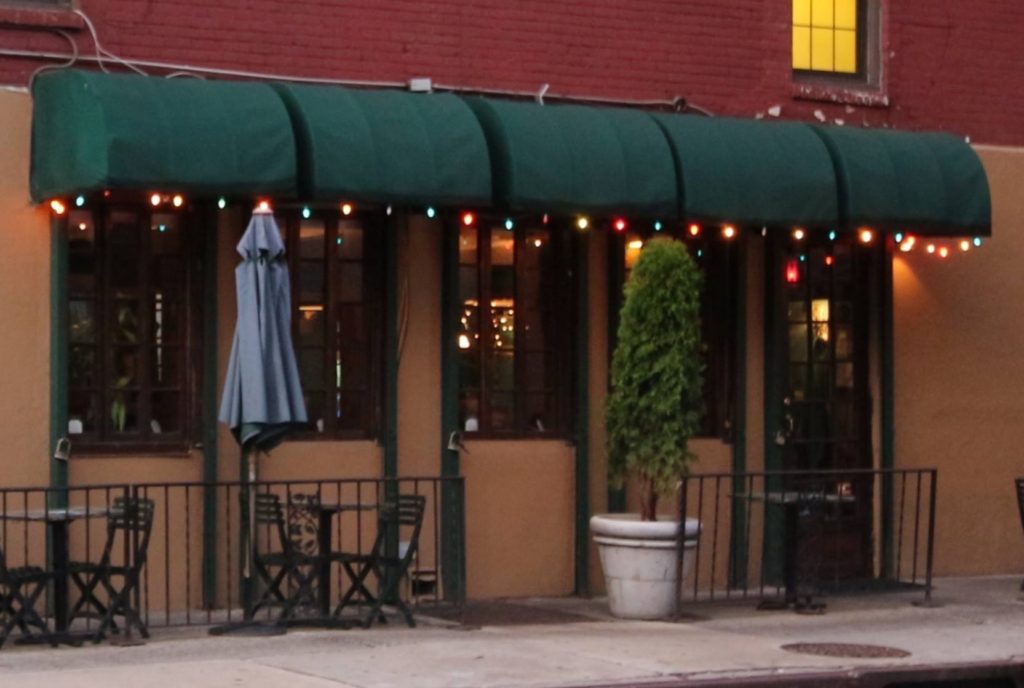
New York restaurant near 23rd Street
The taxi stopped outside a […] restaurant with a dark green awning curving over like a protective hood. Soft yellow lights shone through tinted glass. Inside, it was subdued, intimate and rich. Light music played and couples danced. I’d never been in such a place before.
One lunchtime, they eat informally:
The waitress approached. Conrad touched my hand and narrowed his eyes. After getting some beers, I ordered a salad and, like a tourist, he went for the cardiac-arrest-inducing house special burger and fries. He saw my look of disapproval and laughed.
Carina in 21st century Roma Nova eats meat, fish, pasta, olives, eggs, vegetables, fruit, honey and drinks a lot of coffee. In PERFIDITAS, her juniors in their early twenties only drink water and Carina senses they disapprove of her caffeine addiction. And she’s not averse to an alcoholic drink. On military exercise, she loves nothing better than a bacon and egg sandwich first thing in the morning. (Believe me, you need the calories when you’re running around doing soldier stuff.)
Beginning the day with a fresh egg and bacon roll – hot, salty bacon coupled with the rm liquid of a fried egg bursting in your mouth – in the quiet of a pine forest with the sun starting to shed its early light on you took some beating. The cook grinned at me, sensing an appreciative customer.
‘Like another one, ma’am?’
I swallowed the last piece and grinned back. ‘No. No, thanks. Nothing could better that.’
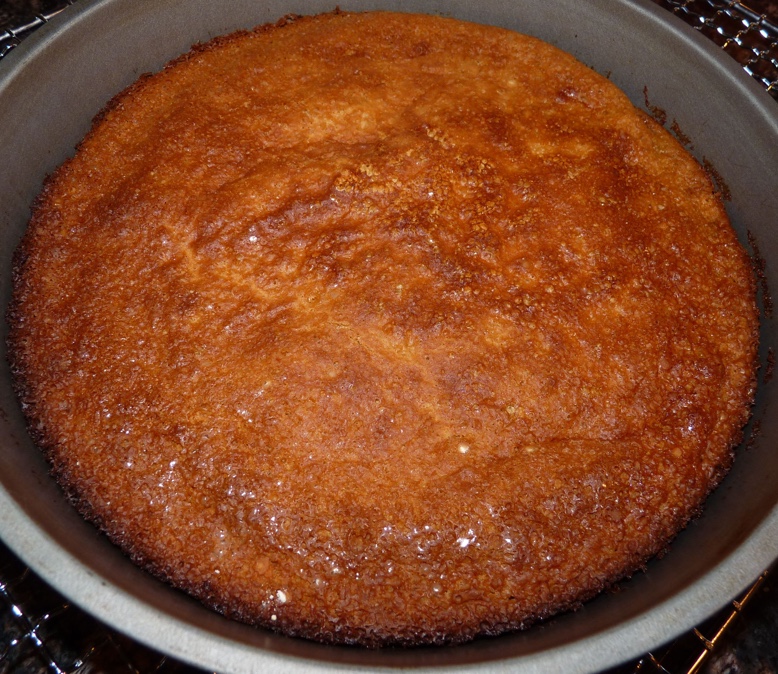
Honey cake!
Ancient Roman cooking used honey as a sweetener and honey cake is still a favourite in Roma Nova, as are honey drinks. Even in the police squad room they don’t eat chocolate digestives, but honey biscuits.
In the second trilogy we see Aurelia Mitela knock back her favourite French brandy in times of stress, a glimpse of something we saw in the first three books. As a blood and bone Roma Novan, she’s at home with managing her farm and in INSURRECTIO we see her attachment to the land and its produce:
I panned around with the binoculars. The Castra Lucilla estate complex covered a large area with the pars domenica – the main house – on the south side. The farm office and dormitories for the farmworkers occupied the next section and the fructuaria – the production area where they processed butter, cheese and yoghurt, and packed and bottled everything – lay beyond that. The vinery was at the far end. Barns, milking parlour and all the poultry runs stretched out on the other side. No sign of life from the house, but it was normally closed when none of us was there. Now, shutters hung open on the front.
‘Anything?’ Callixtus asked.
‘Nothing,’ I replied. ‘Not even a vehicle outside the farm office, no barn door open.’ I glanced at my watch. ‘It’s half-seven. People should be swarming all over the place. The fructuaria should be open and running – it’s market day tomorrow in Castra Lucilla and they need to pack all the produce today. We’ve still got wheat and spelt to cut. And then prep work for winter sowing.’ I swung the binoculars round to the fields. ‘And the cows should be in for milking.’
Food also defines other characters such as Miklós, Aurelia’a companion and lover:
‘Here, for energy,’ he said, and pushed an oval pastry into my hand. It resembled a panis focacius that the Italians called focaccia. It burst in my mouth at the rst bite, herbs and cheese delighting my senses.
‘Gods, what’s this?’ I said, almost forgetting my anger.
‘Pogača. Easy to bake in the fire and eat on the move.’
I stared at him. I could see him hiding up in some remote wood, biting through the crusts, the crumbs irrelevant as he flung himself on his horse and galloped off to avoid border guards or police.
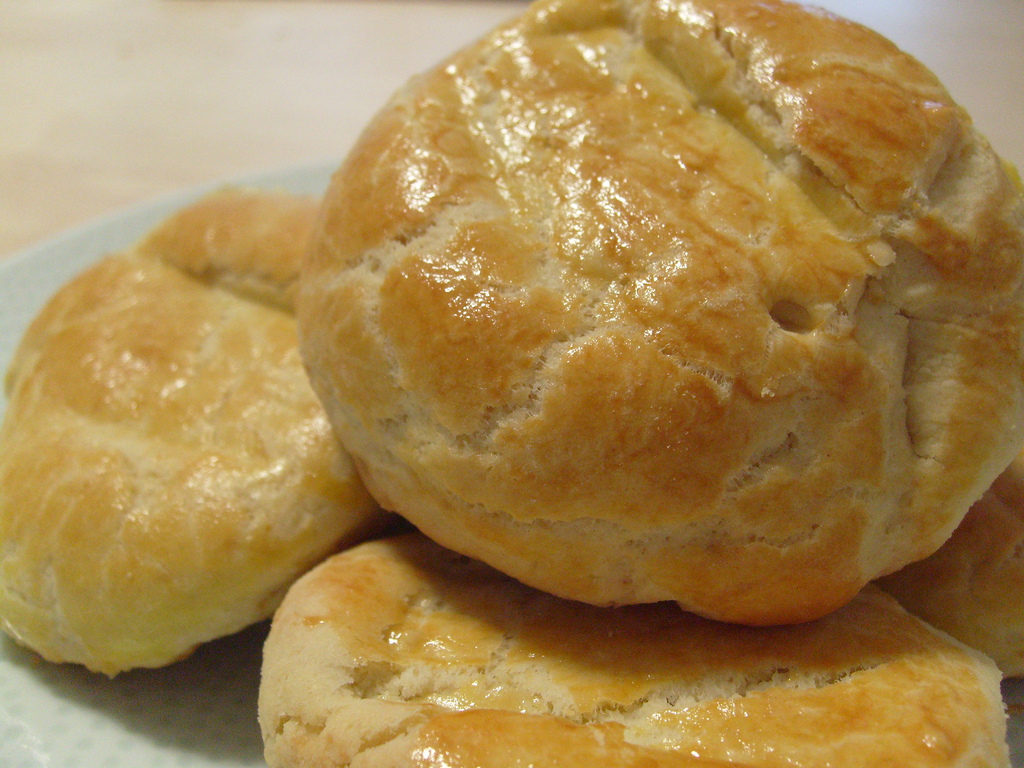
Hungarian pogácsa
Pogača is a favourite and centuries old ‘fast food’ in Hungary, Turkey, the Balkans so this shows us something about Miklós’s “fast moving’ life style and ethnic background.
And Saturnalia?
An advance glimpse into RETALIO…
This was the first year in my entire life I’d missed Saturnalia.
Ceding my place at the head of the Mitela tribe for a day to the princeps Saturnalicius was traditional. For a few hours, Domus Mitelarum would be overrun with noise, people, stupid but fun dares, overeating, games, theatricals and stand-up of dubious taste, arguments, falling in lust, laughter and progressive drunkenness. The under-steward would make sure the children were safe out of the way when the horseplay became too raunchy.
The atrium would blaze with light. Everywhere would be covered in ferns, spruce and pine. In the centre, there would be a large square table covered with linen, silverware, glasses, candles and the best china. Smells of roast pork, lemons and spices, everybody wearing over-colourful clothes, Miklós and I toasting each other and the assembled company with champagne from the Castra Lucilla estate, celebrating life…
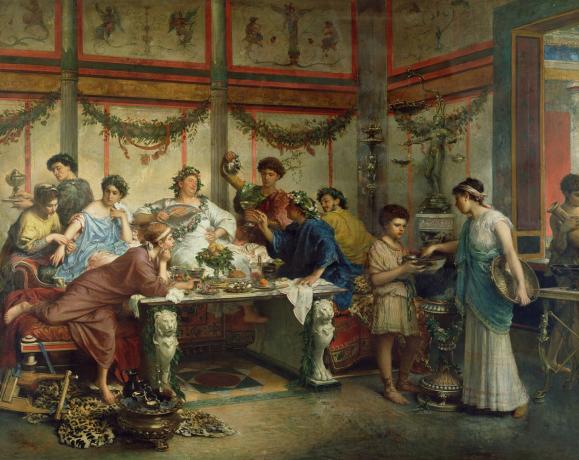
Roberto Bompiani “Il Parassita”, 1875
And garum, the (in)famous fish sauce of ancient Rome used as a seasoning, a condiment and a sauce? By the modern era in Roma Nova, it was available from specialist food retailers and only used for formal occasions. With modern food preservation and seasoning technology garum, unlike honey, had disappeared (without regret as far as Carina is concerned) from many modern Roma Novan tables.
Bene sapiat!
**My thanks to Paul Roberts, curator of a major exhibition on Pompeii and Herculaneum’s article ‘At Home with the Romans’, published in the April 2013 issue of BBC History Magazine.
Alison Morton is the author of Roma Nova thrillers – INCEPTIO, PERFIDITAS, SUCCESSIO, AURELIA, INSURRECTIO and RETALIO. CARINA, a novella, is available now. Audiobooks are available for the first four of the series.
Get INCEPTIO, the series starter, FREE as a thank you gift when you sign up to Alison’s monthly email newsletter. You’ll also be first to know about Roma Nova news and book progress before everybody else, and take part in giveaways.