Who were the Roman cops?

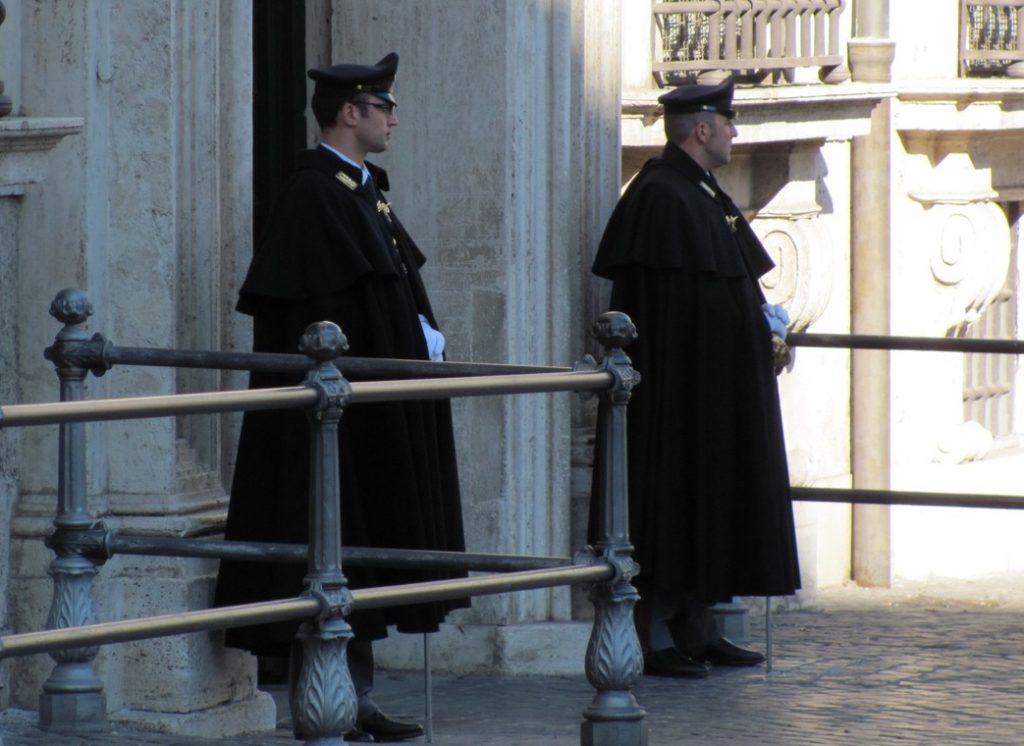
Modern Roman cops

Modern Roman cops – Carabinieri (Author photo)

Thinking about police, gendarmes and emergency services in the past few days brought me to the law enforcers of Ancient Rome.

Faced with terrorist attack (or riot, revolt and rebellion), they would have been robust in their attitude and actions. So who policed Rome?

Vigiles as a public service were founded by Augustus as a new firefighting force to replace the private, often haphazard, groups.

In AD 6, he levied a 4% tax on the sale of slaves to finance the service. They were commanded by the praefectus vigilum, who was of equestrian rank, and organised into seven cohorts of 500, later 1,000 men, each commanded by a tribune. A cohort would patrol two of the city’s fourteen administrative districts (regiones) from sub-stations throughout the city, plus detachments were stationed at Rome’s ports of Ostia and Portus.

Roman vigiles

Bas-relief of Ancient Rome vigiles by Carlo Sorgi (1941) at the Italian National Firefighters Training School

Vigiles were dual role: they also acted as a night watch, keeping an eye out for burglars, cut-throats and low-life, and hunting down runaway slaves. Sometimes, they were used to maintain order in the streets.

As well as the power to break into houses if they suspected an out-of-control fire inside, and demolish property to create firebreaks, vigiles could also check if householders had firefighting equipment and a ready reserve of water. If not, householders could be punished for negligence. So there was an element of preventative work as well as powers of investigation and enforcement…
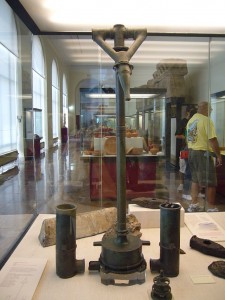
Portable Roman fire engine nozzle, Madrid Museum (Creative Commons)

Portable Roman fire engine nozzle, Madrid Museum (Creative Commons)


In their firefighting role, the vigiles had a variety of specialist troops such as sifonarii, who worked the pumps, uncinarii, men who used grappling hooks, aquarii who identified and supervised the supply of water. As with true military forces, the vigiles enjoyed the benefit of their own medical support with four doctors (medici) attached to each cohort. The ordinary firefighters were called milites (soldiers).

For firefighting, the vigiles used quilts or mats, (most likely soaked in water and used to smother flames), ladders, axes, fire buckets made of rope treated with pitch, poles and hooks to push and pull  over fire damaged walls. The height of sophistication was a sipho, a fire engine, pulled by horses and consisting of a large double-action pump that was partially submerged in a reservoir of water and fitted with a directional nozzle.

The Silver PigsRecruited from the lower levels of Roman society, often ex-slaves, vigiles were not as highly regarded as their other policing colleagues. But their job wasn’t easy…

I heartily recommend reading Lindsey Davis’ Falco series which features Petro (Lucius Petronius Longus), a vigiles watch captain in charge of a disparate lot and who helps main hero Falco investigate dastardly deeds in Ancient Rome.

Cohortes urbanae, also created by the ever busy Augustus, were formed to counterbalance the enormous power of the Praetorian Guard. The cohorts’primary role was to police Rome and to counteract the roaming mobs and gangs that so often haunted its streets during the Republic. These urban cohorts thus acted as a heavy duty police force, capable of riot control duties, while their contemporaries, the vigiles, had the day-to-day role of policing the streets and protecting against fires.
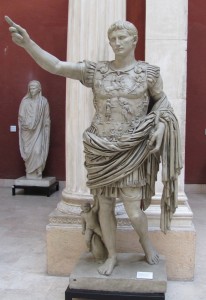
Augustus

Augustus

Originally, the cohortes urbanae were divided into three cohorts of around 500 men, each commanded by a tribune and six centurions. In the time of the Flavians (Vespasian, Titus and Domitian), this increased to four cohorts. Only free citizens, mainly of Italian origin, were eligible to serve in their ranks.

The man in charge of all the cohortes urbanae was the urban prefect (praefectus urbanus or praefectus urbi), a magistrate tasked with maintaining order in the city and within a hundred mile circumference.

He was also tasked with administering the emperor’s laws, superintending guilds and corporations (collegia), overseeing officials responsible for the drainage of the Tiber and the maintenance of the city’s sewers and water supply system, as well as its monuments.

Most importantly, he was ultimately responsible for the city’s provision with grain from overseas for the city’s large population; if the prefect failed to secure adequate supplies, riots usually broke out.

Urban cohorts were later created in both the Roman North African city of Carthage and the city of Lugdunum in Roman Gaul (modern Lyon).
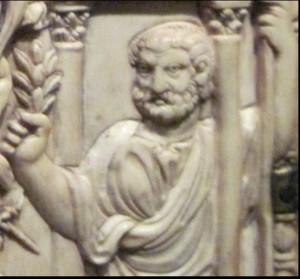
Symmachus

Symmachus

In Late Antiquity, when the imperial court moved from Rome itself, the office of urban prefect became more powerful, as it was no longer under the emperor’s direct supervision or even his eye. Interestingly, from the Roma Nova angle, the office was usually held by leading members of Italy’s still largely pagan senatorial aristocracy. In such a capacity, Symmachus played a prominent role in the controversy over the Altar of Victory in the late 4th century.

So there are some parallels and overlaps with modern day services. In the UK, police (regionally based), military, fire brigades and ambulance/paramedic services are separate. Here in France, there are two main police services –police nationale and gendarmerie nationale (paramilitary) plus the police municipale (local police). Ambulances are organised privately and publicly, but it’s a firefighter (sapeur-pompier) who is likely to arrive first at an accident and carry out paramedic services.
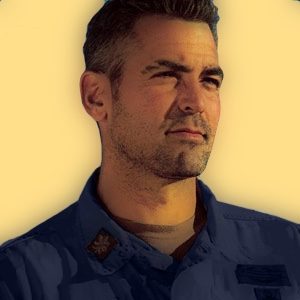
Lurio

And in Roma Nova?
When Aurelia was younger in the late sixties in AURELIA, and later in INSURRECTIO and RETALIO (early eighties), the police were still called vigiles and wore a maroon uniform, but after Roma Nova was liberated from Caius Tellus’s regime, a new force was formed called custodes; they wear a standard blue uniform we associate with most police forces today.

Those of you who have read Carina’s adventures in INCEPTIO, PERFIDITAS and SUCCESSIO will know the most fascinating and rather, er, robust custos is Inspector, later Commander, Aulus Cornelius Lurio with whom Carina has history. And he seems to be entangled in all her adventures.


Alison Morton is the author of Roma Nova thrillers –  INCEPTIO, CARINA (novella), PERFIDITAS, SUCCESSIO,  AURELIA, NEXUS (novella), INSURRECTIO  and RETALIO,  and ROMA NOVA EXTRA, a collection of short stories.  Audiobooks are available for four of the series. Double Identity, a contemporary conspiracy, starts a new series of thrillers. JULIA PRIMA,  Roma Nova story set in the late 4th century, starts the Foundation stories. The sequel, EXSILIUM, is now out.

Download ‘Welcome to Alison Morton’s Thriller Worlds’, a FREE eBook, as a thank you gift when you sign up to Alison’s monthly email update. You’ll also be among the first to know about news and book progress before everybody else, and take part in giveaways.

Roma Nova on Jo Frances Penn's Books and Travel podcast

Alison with Jo Frances Penn

Travel is a wide concept. It doesn’t just mean trotting up the steps to a plane or sitting back looking out of a train window, or even visiting entrancing and exotic places.

Travel can be in the mind, across hundreds or possibly thousands of years, into other realities and mentalities, even into an alternative time. So I was thrilled to be invited by Jo Frances Penn (also known as Joanna Penn of The Creative Penn) to be be interviewed for her Books and Travel podcast. You can read the transcript here and listen to our hugely enjoyable discussion:

  • The early genesis of an idea for books about an alternative history based on Ancient Rome
  • How the past and the present are connected by landscape
  • Places that have inspired aspects of the Roma Nova books
  • Bringing my personal military experience into fiction
  • Language and how it can impact appreciation of a place and culture
  • Recommended books about ancient Rome and some alt-history novels

Thank you so much, Joanna – it was 100% fun.
Podcast link: https://content.blubrry.com/booksandtravel/Podcast_BAT_AlisonMorton0320B.mp3


Alison Morton is the author of Roma Nova thrillers –  INCEPTIO, CARINA (novella), PERFIDITAS, SUCCESSIO,  AURELIA, NEXUS (novella), INSURRECTIO  and RETALIO,  and ROMA NOVA EXTRA, a collection of short stories.  Audiobooks are available for four of the series. Double Identity, a contemporary conspiracy, starts a new series of thrillers.

Download ‘Welcome to Alison Morton’s Thriller Worlds’, a FREE eBook, as a thank you gift when you sign up to Alison’s monthly email newsletter. You’ll also be among the first to know about news and book progress before everybody else, and take part in giveaways.

Taking the plunge - Roman baths

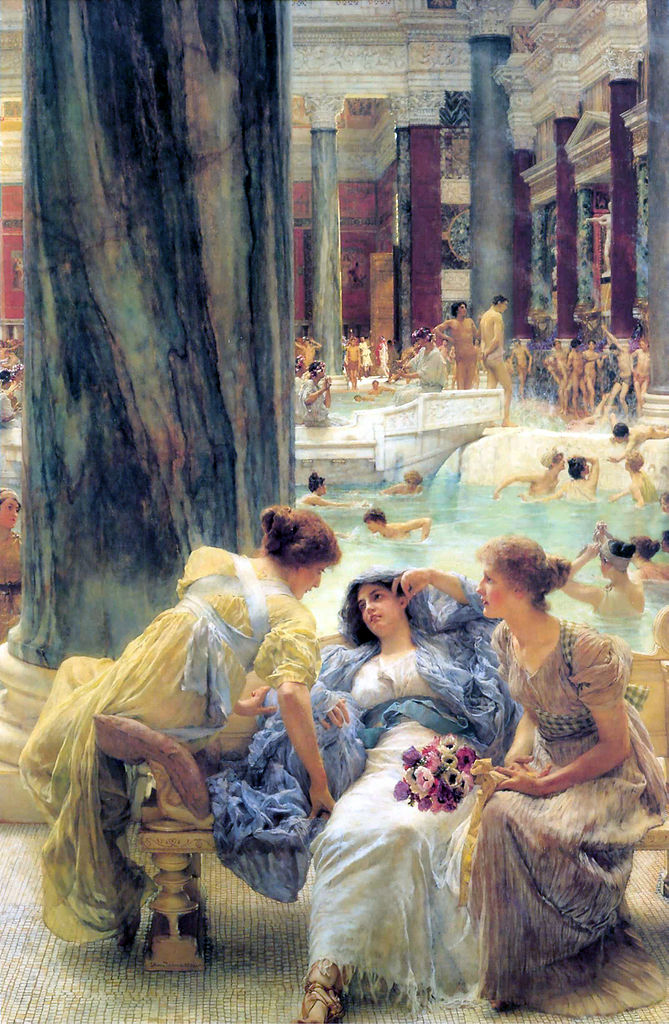
The Baths at Caracalla, Lawrence Alma-Tadema, 1899

Baths were such an intrinsic part of the Roman world that we can’t think of one without the other. Everybody went to the baths – everybody.

Today we see bathing as something we do privately in the home, but bathing in Rome was a communal, social activity. While wealthy Romans could afford to build bathing facilities in their homes or country villas, and bathhouses were provided for Roman legionaries at their forts throughout the empire, most people went to the communal baths which in some ways, resembled modern-day spas.

A catalogue of buildings in Rome from 354 AD documented 952 baths of varying sizes in the city alone (Boëthius, Axel; Ward-Perkins, J. B. (1970). Etruscan and Roman architecture). Large baths called thermae were owned by the state and often covered several city blocks;  the Baths of Diocletian could hold up to 3,000 bathers.

Generally open from lunchtime until dusk, baths were accessible to all, both rich and poor. In the reign of Diocletian, for example, the entrance fee was a mere two denarii. On occasions such as public holidays, the public baths were even free to enter. Small bathhouses, called balnea, often privately owned, but open to all for a fee.

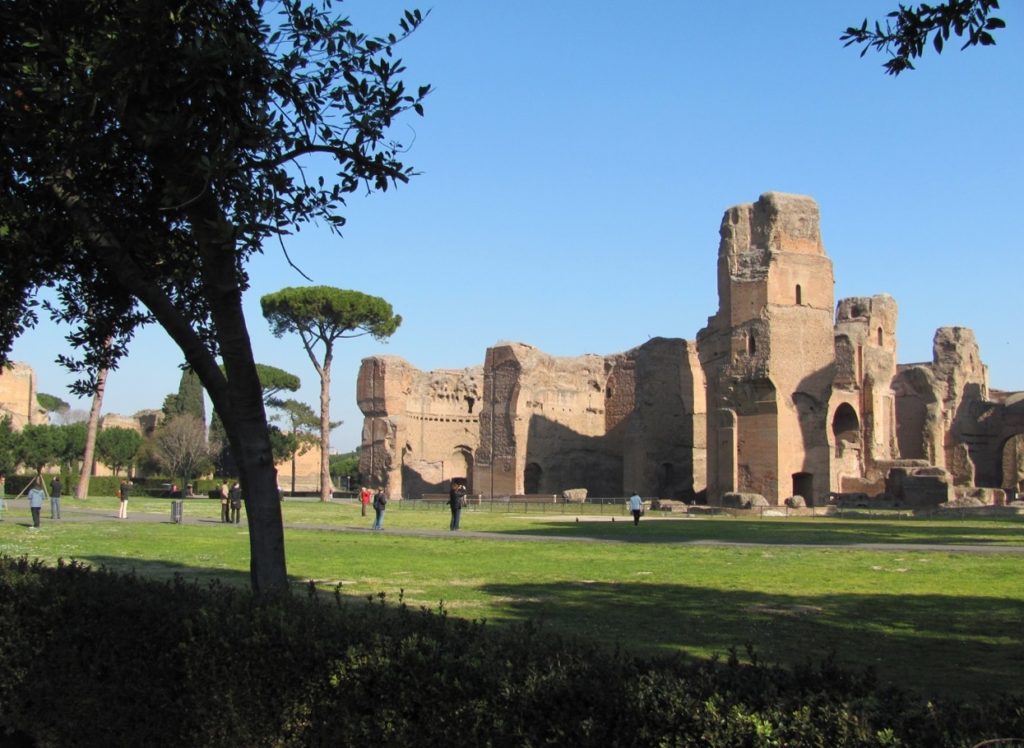
Public baths were a feature of ancient Greek towns but were usually limited to a series of hip-baths. Characteristically, the Romans took the idea and scaled it up to an art form. Baths became common in even the smaller towns of the Roman world – part of the process for ‘civilising the barbarians’ – and were often located centrally near the forum. However, in the large cities these complexes took on monumental proportions, literally, with vast colonnades, wide-spanning arches and domes, millions of fireproof terracotta bricks, fine mosaic floors, marble-covered walls, and decorative statues.

Baths of Caracalla, Rome today (Author photo)

Because wealthy Romans brought slaves to attend to their bathing needs, the bathhouse usually had three entrances: one for men, one for women, and one for slaves; the women’s area was usually smaller than the men’s because of fewer numbers of patrons. (Hm, same old excuse) Republican bathhouses often had separate bathing facilities for women and men, but by the 1st century AD mixed bathing was common and is a practice frequently referred to in Martial and Juvenal, as well as in Pliny and Quintilian. However, gender separation might have been restored by Emperor Hadrian (Women In Roman Baths, Roy Bowen Ward) but there is also evidence it wasn’t. The jury is out. For many Roman moralists, baths were the perfect sign of how far the Rome of their own day had fallen into decline; Cato the Elder publicly attacked Scipio Africanus for his frequent use of bathhouses.

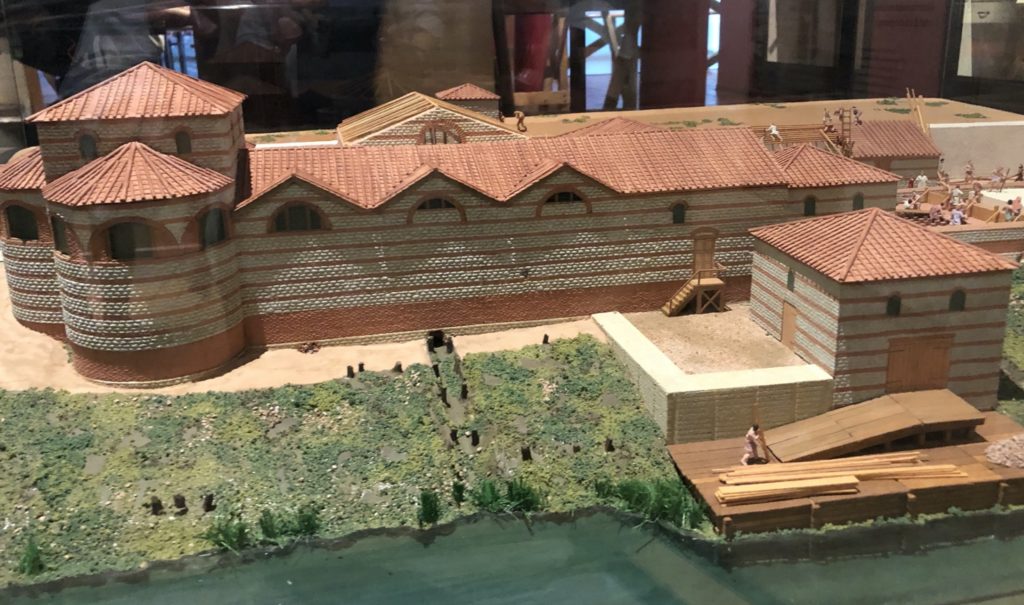
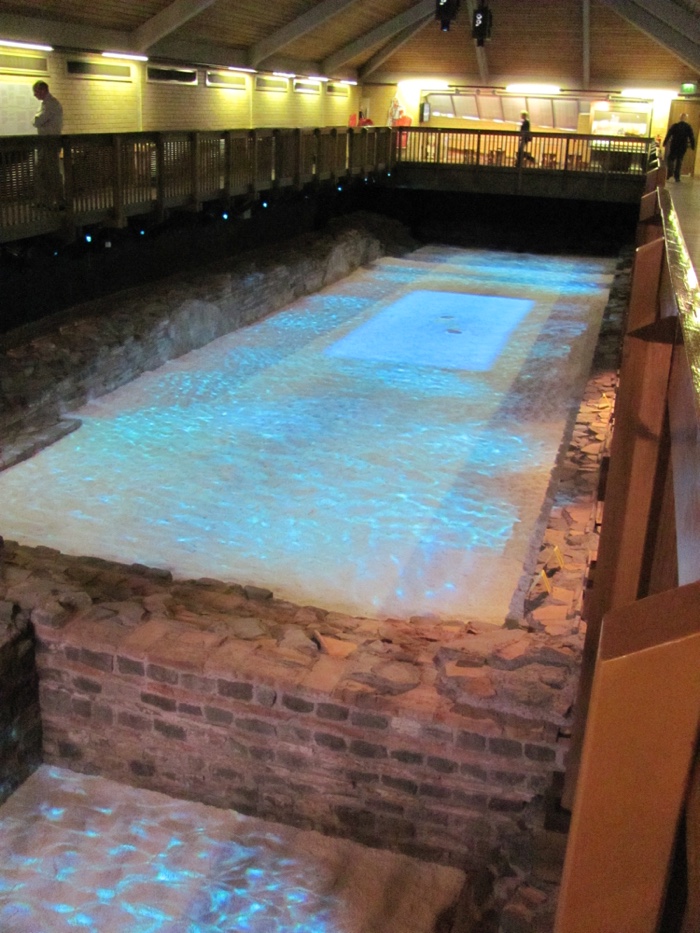
Model reconstruction of Londinium baths, Museum of London (Author photo)

What’s in a Roman bath?

They varied from simple to exceedingly elaborate structures, and by size, arrangement and decoration.Typical features were:

  • apodyterium – changing rooms.
  • palaestrae – exercise rooms.
  • natatio – open-air swimming pool.
  • laconica and sudatoria – superheated dry and wet sweating-rooms.
  • calidarium – hot room, heated and with a hot-water pool and a separate basin on a stand (labrum)
  • tepidarium – warm room, indirectly heated and with a tepid pool.
  • frigidarium – cool room, unheated and with a cold-water basin, often monumental in size and domed, it was the heart of the baths complex.
  • rooms for massage and other health treatments.

Additional facilities could include gymnasium, private baths, toilets, libraries, lecture halls, fountains, and outdoor gardens, not to mention food and perfume-selling booths, libraries, and reading rooms. Stages accommodated theatrical and musical performances. Plus, there was plenty of scope for “personal services”, paid, voluntary or provided as an inclusive service by private bathhouse owners.

Roman bathhouses often contained a courtyard, or palaestra, an open-air garden used for exercise. Adjacent stadia provided spaces for (serious) exercise and athletic competitions.

Reconstructed floor plan: 1=Caldarium 2=Tepidarium 3=Frigidarium 4=Natatio 5=Palaestra 6=main entrance 7=Exedra (seating area)

The bathing process

From the changing rooms, bathers would go to the gymnasium and exercise in the palaestra and from there to a sauna to induce an even greater sweat. Then the bather passed to the caldarium, after which the skin was scraped clean with a strigil, and to the tepidarium to cool off in the warm air and, finally, to the frigidarium for a bracing plunge in a cold bath – which was the regimen recommended by Galen himself. You could admire the sculpture, swim in the natatio, read at the libraries, walk the grounds, or as Trimalchio does in the Satyricon, be carried off in a litter to a dinner party.

The big heat
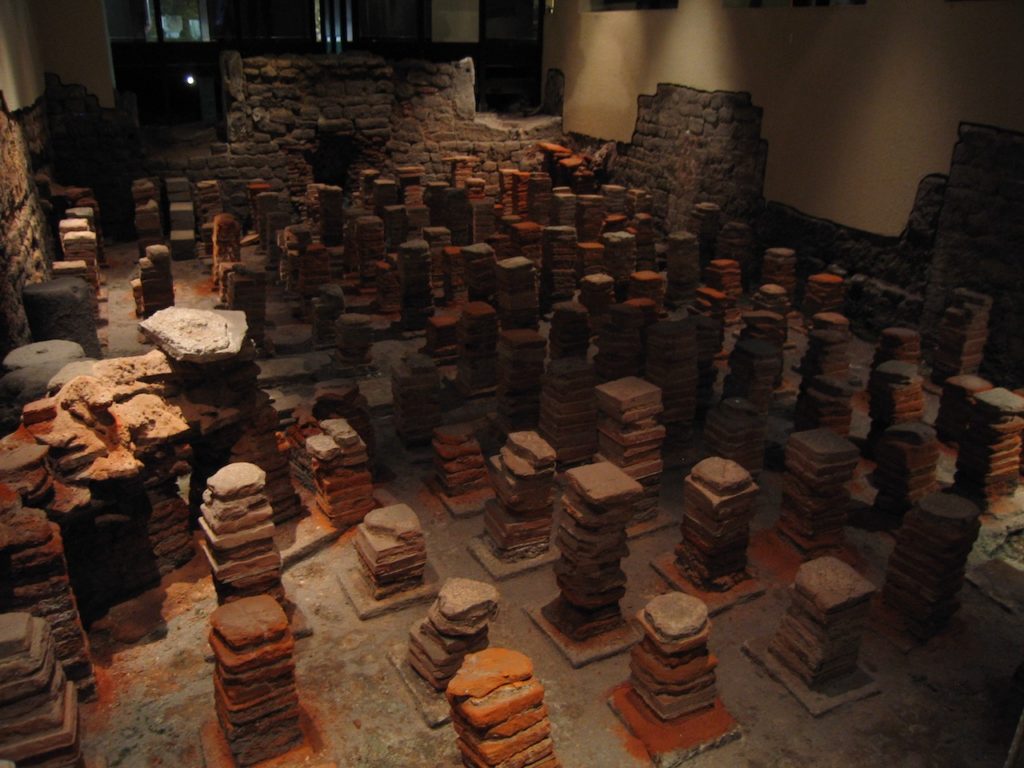
Early baths – a bit ramshackle in the very earliest of days – were heated using braziers, but from the 1st century BCE more sophisticated heating systems were used such as underfloor (hypocaustum) heating fuelled by wood-burning furnaces (prafurniae). Greek baths had employed such a system but, typical of the Romans, they took an idea and improved upon it for maximum efficiency. Huge fires from the furnaces sent warm air under the raised floor (suspensurae) which stood on narrow pillars (pilae) of solid stone, hollow cylinders, or polygonal or circular bricks. The floors were paved over with square tiles (bipedales) then covered in decorative mosaics.(Pity the poor slaves sweating away keeping the fires burning…)

Hypocaustum, Bath, UK (Author photo)

Water (indispensable!)

The vast amount of water needed for the larger baths was supplied by purpose built aqueducts and regulated by huge reservoirs in the bath complex. The Baths of Diocletian reservoir in Rome, for example, could hold 20,000 m³ of water. Water was heated in large lead boilers fitted over the furnaces and could be added (via lead pipes) to the heated pools using a bronze half-cylinder connected to the boilers. Once released into the pool the hot water circulated by convection.

Natatio (swimming pool), Roman barracks, Isca (Caerleon) (Author photo)

But were the baths completely good for you?

There’s not mistaking that Romans enjoyed their baths.

But…

Not even considering the large amount of lead involved in heating and pipework, we should bear in mind that the water was not always renewed as often as we might like it to be in the 21st century; remains of oil, sweat, dirt or even excrement were kept warm, providing a fabulous breeding ground for bacteria. Emperor Marcus Aurelius complained about the dirtiness. (Meditations, 8.24). Celsus, who wrote one of the best sources concerning medical knowledge in the Roman world, while commending bathing’s therapeutic virtues, warns not to go to the baths with a fresh wound, because of the risk of gangrene.The objections of the philosopher Seneca were more about the associated noise that interrupted his work when he lived above a bath (Epistulae morales ad Lucilium 56.1, 2).

However, I would think that like modern consumers, Romans would not have returned to the baths daily if those baths were that distasteful. Given the wide variety and sheer numbers of thermae and balnae available to them, they could always have taken their denarii elsewhere.

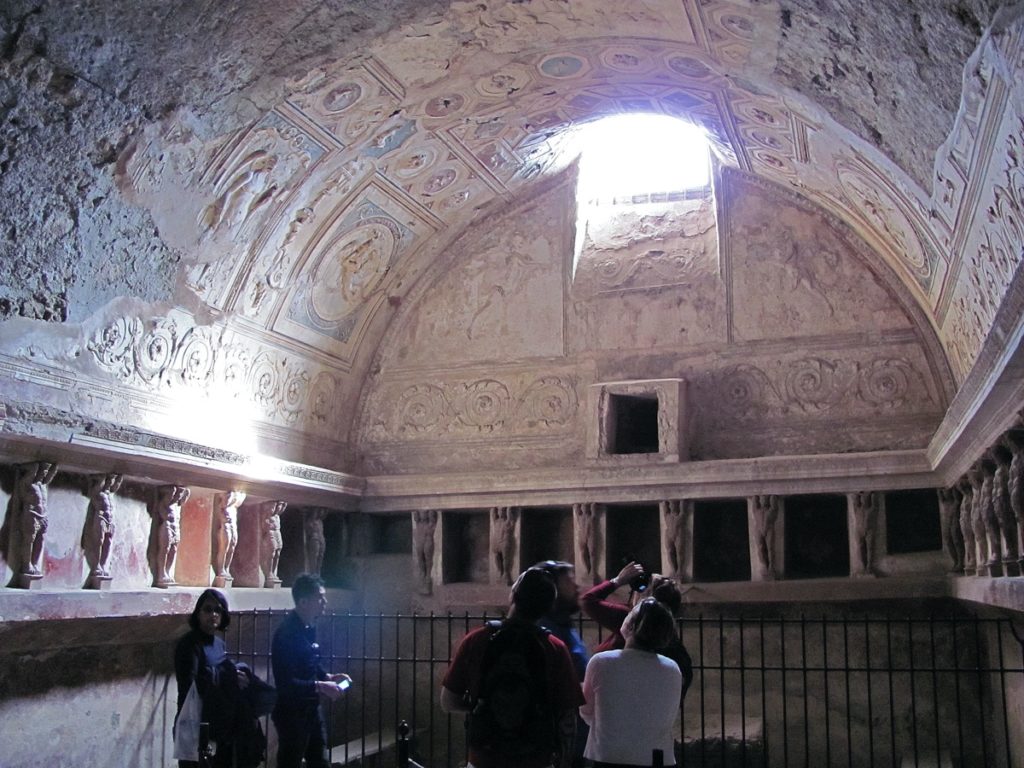
Tepidarium, forum baths, Pompeii (author photo)

An extra note in reply to a couple of comments here and social media about slaves using the baths…
(You do keep me working…;-) )

Epigraphic testimony for slaves at baths as customers is direct if sparse so it’s not always easy to work out determine how common and widespread the practice was.“(G. Fagan, ‘Interpreting the Evidence: Did Slaves Bathe at the Baths?,’ in D. E. Johnston and J. DeLaine (eds.), (1992))

The consensus among academics is that slaves could use public baths as customers rather than just attendants. For example, this from a blog from the University of Kent (https://blogs.kent.ac.uk/lucius-romans/2016/03/15/visiting-the-baths-in-ancient-rome/“The rich, who had no time constraints, could choose to bathe at the optimum time and therefore temperature, but labourers or slaves — who were not in control of their time — had to settle for a tepid bathing experience once their work was done.”

For primary sources, Fagan cites an inscription from Puteoli which prohibits the slaves who removed corpses in the town from using the baths before the first hour of night… (Garrett G. Fagan, ‘Bathing in Public in the Roman World’ (2002))

In the same book, Fagan also cites the lex Metalli Vipascensis which stipulates that “slaves and freedmen who were in the employ of the procurator in charge of the mine or who enjoyed other privileges could use the baths free of charge….the wording can be read to imply that slaves not in the employ of the imperial service would be charged, which in turn implies that slaves of any kind…had access to the baths as customers.” Also, an inscription in Coela, Thrace “…records the building of baths for ‘the people and the familia of our Caesar,’ that is, for the local inhabitants and the emperor’s slaves who served his estates in the region.”

Less reliable but probably worth mentioning is some literary evidence from works of fiction. For example, the anonymous Latin comedy Querolus: “Even if we are tempted to go by day, it is at night that we go to the baths. We bathe with the slave-girls and boys.” (Kyle Harper, ‘Slavery in the Late Roman World, AD 275–425’ (2011))

Another literary work, the Roman novel The Golden Ass or The Metamorphoses of Apuleius has characters who use the baths: two cooks who bathe every evening.

Anybody know any other sources?


Alison Morton is the author of Roma Nova thrillers –  INCEPTIO,  PERFIDITAS,  SUCCESSIO,  AURELIA,  INSURRECTIO  and RETALIO.  CARINA, a novella, and ROMA NOVA EXTRA, a collection of short stories, are now available.  Audiobooks are available for four of the series. NEXUS, an Aurelia Mitela novella, is now out.

Download ‘Welcome to Roma Nova’, a FREE eBook, as a thank you gift when you sign up to Alison’s monthly email newsletter. You’ll also be first to know about Roma Nova news and book progress before everybody else, and take part in giveaways.