It’s that exhibition that Roman enthusiasts are clamouring to see.
The British Museum is rather good at themed exhibitions; the Nero one was terrific as were those featuring Pompeii, the Celts and the World of Stonehenge. When ‘Legion – Life in the Roman Army’ was first announced in the members’ newsletter, I wept bitter tears as I had no plans to be in the UK in the first part of 2024 so I would miss it. But happily, a family occasion in the UK coincided and I insisted on a day trip to the museum during that week.
The museum is imposing in itself; you cannot hope to see a fraction of the exhibits, let alone the special exhibitions like this one in a single visit. I resolutely ignored the call of other fascinating exhibits and focused on striding through the Great Court and headed for the Sainsbury Room and life in the legion. Prime objective was to see the only surviving whole legionary scutum, the classic curved rectangular shield that we think of as ‘typically Roman’.
 Dura-Europos scutum The shield was made from layers of leather and wood strips, bound with bronze edging. Held like a suitcase handle, complete it likely weighed 5.5 kg but was stored without ever being fitted with a boss. While Roman auxiliaries mostly used flat oval shields, this semi-cylindrical profile helped legionaries interlock shields in battle manoeuvres. By the AD 250s, legionaries abandoned this shield type in favour of those common to other regiments.
Wood, leather and bronze Dura-Europos, Syria, early AD 200s, Yale University Art Gallery, Yale-French Excavations at Dura-Europos
 Back of scutum

Scene from Trajan’s column showing the testudo (tortoise) manoeuvre. Interlocking long shields aid this tank-like formation to advance under enemy fire – the soldier’s hobnails trample falling enemies underfoot. Troops could also run along the top to jump up onto walls. I wouldn’t like to be underneath when that happened!

This is the world’s most complete Roman legionary’s articulated cuirass, often referred to as the lorica segmentata by later historians. In AD 9, Arminius, a Roman citizen and cavalry commander of Germanic origin, treacherously teamed up with his native tribes and successfully ambushed three legions led by Publius Quinctilius Varus, the Roman governor of Germany. Varus and his entire army were destroyed in the Battle of the Teutoburg Forest. This cuirass was found on the battlefield. Analysis suggests the soldier died wearing it.
Iron, Kalkriese, Germany, AD 9,VARUSSCHLACHT im Osnabrücker Land Gmbh /Museum und Park Kalkriese
Despite the armour being commonly associated with the Romans, it was used by other civilisations before them; Parthians, possibly Dacians, Scythians, or Sarmatians. The segmented cuirass was possibly introduced into the Roman army after Crassus’s defeat at Carrhae in 53 BC.
Around the middle of the third century the lorica segmentata fell out of favour with the Roman army, although it did remain in use during the Late Roman Empire. Soldiers wearing the lorica segmentata were depicted on the Arch of Constantine, a monument erected in AD 315. However, it has been argued that these depictions are from an earlier monument by Marcus Aurelius, from which Constantine incorporated portions into his Arch. The latest known use of the armour was in the 4th century.
And Arminius? He evaded Roman retribution, ridding his homeland of Roman rule, but was ultimately murdered by opponents within his own tribe.
Marcus Caelius, a high-ranking centurion of the 18th legion, was killed when Arminius defeated Varus. The 17th and 19th legions were also destroyed.

This monument was raised for Caelius, then a high-ranking and highly decorated centurion of the 18th legion. He was 53 at the time of his death in Germany. As a senior centurion, he earned thirty times an ordinary legionary’s wages. Here Caelius wears a harness of medals, bracelets and torcs on his shoulders. His most significant military decoration is an oak wreath crown, awarded for saving the lives of his fellow Roman citizens. He’s flanked by his freedmen, Privatus and Thiaminus, enslaved men liberated by their wealthy master’s death and who are requesting that Caelius’s bones be buried if ever found.
Stone replica, Bonn, Germany, original: AD 9, replica: late 1800s – early 1900s, LVR-Landesmuseum Bonn

Under Augustus’s successors, non-citizens gained citizen rights after 25 to 26 years’ military service. Above is the earliest known example of a retirement ‘diploma’. It records Emperor Claudius’s grant of citizenship to Sparticus Dipscurtus, a Thracian (modern-day southeast Europe) who served far from home as a marine at Misenum, in the Bay of Naples, Italy. Citizenship of Rome extended to his wife and children.
Copper alloy, Castellammare di Stabia (near Naples), Italy, AD 52, MiC – Museo Archeologico Nazionale di Napoli
These are a few – a very few – of the exhibits in this outstanding exhibition. I’m not a professional photographer, but a mere smartphone user. However, I hope they give you a flavour of what you could see.
Alison Morton is the author of Roma Nova thrillers – INCEPTIO, CARINA (novella), PERFIDITAS, SUCCESSIO, AURELIA, NEXUS (novella), INSURRECTIO and RETALIO, and ROMA NOVA EXTRA, a collection of short stories. Audiobooks are available for four of the series. Double Identity, a contemporary conspiracy, starts a new series of thrillers. JULIA PRIMA, Roma Nova story set in the late 4th century, starts the Foundation stories. The sequel, EXSILIUM, is now out.
Download ‘Welcome to Alison Morton’s Thriller Worlds’, a FREE eBook, as a thank you gift when you sign up to Alison’s monthly email update. You’ll also be among the first to know about news and book progress before everybody else, and take part in giveaways.
If you enjoyed this post, do share it with your friends!
Could this be the first paragraph of Roma Nova’s Wikipedia entry?
Of course, it’s a spoof. Coming clean, I had to suddenly write it as an introduction to a recent guest post. But it was fun. Wikipedia has a particular style and not just the way it’s set out on the screen. Each article gives a summary in the first paragraph so that the reader knows whether they want to read on.
The idea’s similar to the synopsis of a book you find in articles, blurbs or even on the back cover of a book. The essential is to be succinct and provide enough bare information to guide a potential reader.
I’d conceived the idea of Roma Nova over many decades before, but it became part of a backstory to my first modern thriller INCEPTIO when that novel was published in 2013. Since then I’ve elaborated the idea and eventually my readers/fans asked me to write the story of Roma Nova’s origins in the late 4th century, which is why I wrote JULIA PRIMA and EXSILIUM.
More about how I built that world (two posts):
https://www.alison-morton.com/2024/01/13/roma-nova-world-building/
https://www.alison-morton.com/2024/01/13/roma-nova-world-building-2/
More about how the Roma Nova story develops through history:
https://www.alison-morton.com/roma-nova/roma-nova-history/
Alison Morton is the author of Roma Nova thrillers – INCEPTIO, CARINA (novella), PERFIDITAS, SUCCESSIO, AURELIA, NEXUS (novella), INSURRECTIO and RETALIO, and ROMA NOVA EXTRA, a collection of short stories. Audiobooks are available for four of the series. Double Identity, a contemporary conspiracy, starts a new series of thrillers. JULIA PRIMA, Roma Nova story set in the late 4th century, starts the Foundation stories. The sequel, EXSILIUM, is now out.
Download ‘Welcome to Alison Morton’s Thriller Worlds’, a FREE eBook, as a thank you gift when you sign up to Alison’s monthly email update. You’ll also be among the first to know about news and book progress before everybody else, and take part in giveaways.
If you enjoyed this post, do share it with your friends!
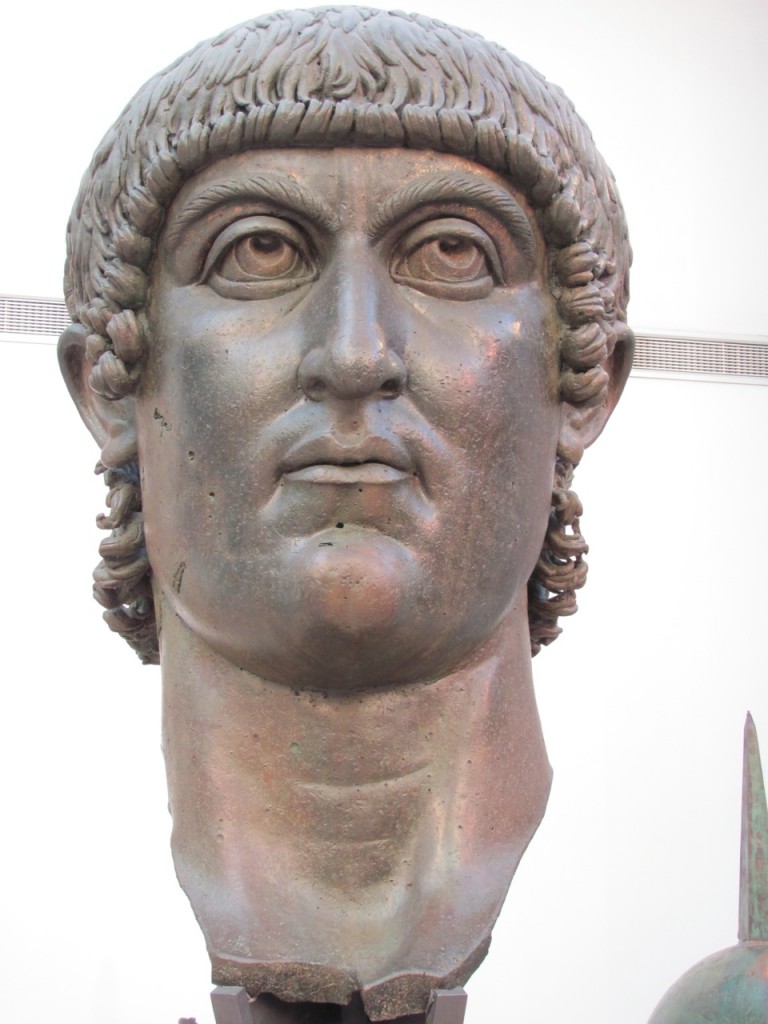 Bronze of Constantine’s head, Capitoline Museum, Rome. (Author photo) In my last two books, JULIA PRIMA and EXSILIUM, I’ve taken a risk. A big risk. I’ve highlighted a very different side to the early Christians, one which many people may not have heard of. The late 4th century was a massive turning point, yet it’s pretty well ignored, even hidden. And it’s very unfashionable amongst publishers who commission Roman historical fiction. They can’t get enough of G. Julius Caesar, Mark Anthony, Hannibal and Vespasian. Vesuvius and the destruction of Pompeii are pretty popular as well along with ‘bad boys’ Nero, Caligula and Elagabalus.
I love all these stories, especially when they are written by some of my dear and much respected writing friends and colleagues. Most are an automatic buy as I know they will tell me an engaging and well-written story.
But… (You knew that was coming…)
Vast areas of the Roman period are neglected
From the founding (allegedly) by a pair of scruffs called Romulus and Remus on the official date of 21 April 753 BC until the last titular Roman emperor, a young boy called Romulus Augustulus, knelt before the barbarian warlord Odoacer in 476 AD, there were 1229 years of Ancient Rome. Surely other things happened during that period?
Of course, there are honourable exceptions such as Ursula K LeGuin’s Lavinia where Aeneas, the last hero of Troy, alights on the Italian coast supposedly in the 12th century BC, and Elisabeth Storrs‘ A Tale of Ancient Rome trilogy starting in 406 BC. I must mention Gordon Doherty’s gritty hero, Pavo, fighting his way through the late 4th century AD in a whole series of novels.
So what am I uncovering?
Up until recently, the conventional story of Christianity was the beastly Romans persecuting the poor Christians, but due to the grace of the new eastern religion centred on a humble but charismatic carpenter, the Christian religion ‘won’. The Roman Empire became officially Christianised, starting with Emperor Constantine, and put the whole weight of the Roman state behind that decision. This narrative has been the accepted one as Christianity became the default, sometimes compulsory, religion in the West until the late 20th century. As Christianity spread rapidly in the 4th century, supported as the sole official state religion of the empire, all other religions were suppressed by the Roman authorities, violently where necessary.
The enforcement of Christianity
Edicts were issued during the 390s forbidding ‘pagan’ sacrifice – even a pinch of incense dropped on a private altar – and any worship of ‘pagan’ idols. Traditional temples were closed, the Vestal Virgins’ fire – a symbol for a thousand years – extinguished and their order disbanded. Denunciation of pagans was encouraged, temples destroyed and mob violence against people, statues of the gods and former religious buildings broke out in many places, especially in the eastern provinces.
No person could hope for advancement in any public office, civil or military, unless they were demonstrably Christian. But not everybody wanted to accept the new, exclusive religion. We can deduce this from the repeated issuing of edicts against paganism throughout the following decades in response to people still worshipping other gods rather than the Christian one.
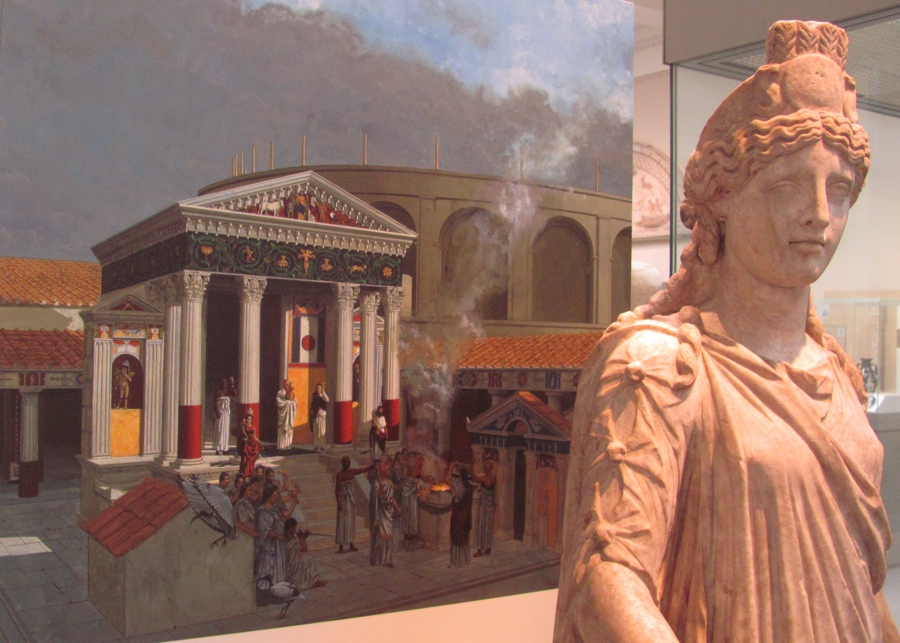 Traditional Roman religion (Author photo in British Museum) Previously in Rome…
In the past, Rome had absorbed most other religions such as the cults of Isis and Mithras as well as local centres of worship even at the edges of empire with the proviso that the Roman state was not disrespected. When Roman emperors were deified, then a small reverence to them was expected; most worshippers of other cults and religions had complied. The problem had arisen during the first to third centuries when other religions such as Judaism and Christianity required absolute exclusivity. This brought them into direct confrontation with the Roman state on the basis of treason. But from Constantine’s reign, the situation was reversed.
A complex and neglected part of history
This reversal and the enforcement of conversion, whether physical or societal, is well-enough documented, but was probably not a story that previous centuries’ church authorities would liked to have highlighted in any way. The norm was to be a Christian and unthinkable not to be. And different forms within the religion – Arian, Donatist, Coptic, Orthodox, Catholic, Protestant, not to mention countless sects – polarised continents, countries and families. Internal wars of religion, coupled with politics, racked Europe for centuries.
So the story of state ordered compulsory Christianity at the end of the 4th century slipped out of notice and became ‘hidden history’ for the majority of people. Peter Heather’s wonderful book Christendom: The Triumph of a Religion, AD 300-1300 and The Darkening Age: The Christian Destruction of the Classical World by Catherine Nixey are the two texts to read to discover all about it.
Alison Morton is the author of Roma Nova thrillers – INCEPTIO, CARINA (novella), PERFIDITAS, SUCCESSIO, AURELIA, NEXUS (novella), INSURRECTIO and RETALIO, and ROMA NOVA EXTRA, a collection of short stories. Audiobooks are available for four of the series. Double Identity, a contemporary conspiracy, starts a new series of thrillers. JULIA PRIMA, Roma Nova story set in the late 4th century, starts the Foundation stories. The sequel, EXSILIUM, is now out.
Download ‘Welcome to Alison Morton’s Thriller Worlds’, a FREE eBook, as a thank you gift when you sign up to Alison’s monthly email update. You’ll also be among the first to know about news and book progress before everybody else, and take part in giveaways.
If you enjoyed this post, do share it with your friends!
|
Subscribe to Blog via Email
Join 37 other subscribers.
Buy AURELIA from Apple!
UK

US
|