Pleb or patrician?

plebIn the past year in the UK, there has been a lot of talk on the news about “plebs”. I’m not offering any comment on that, but listening to media reports and reading social media gossip, I started to wonder if people knew where the terms came from. Ah! It’s those pesky Romans again.

So here’s a blaggers guide…
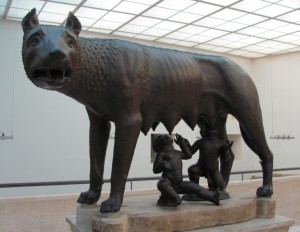
Capitoline - 23_smllrFirst, the caveat: “Rome” lasted 1229 years and the roles, power, responsibilities, ranks and privileges fluctuated over that long period which ran from the Regal era, Republic, Principate, Dominate and into Late Antiquity, so this guide is a general one.

Basically, there were two main classes of free citizens in ancient Rome – 
the patricians (aristocrats) and the plebeians (everybody else). Equites, often called knights, formed a band of mid-level aristocrats ranking below the patricians.

Patricians: upper class, the nobility and wealthy land owners, often senators (law-makers), governors, senior magistrates, advisors to the emperor. Augustus introduced n a new rule that senators had to have property worth 1,000,000 sesterces. Senators were also not allowed to become directly involved in business – particularly shipping or government contracts where there might be a conflict of interest. Given they were also unpaid, this meant that only a small percentage of the population could afford to become deeply involved in politics.
Naples Museum - 54_sm

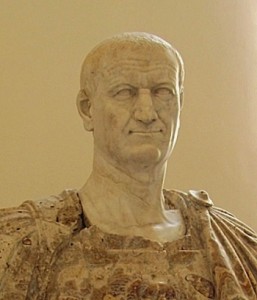
Vespasian

Equites: middle-ranking, provided senior administrative and military officers and came to dominate mining, shipping, manufacturing industry and tax farming. Later, they included leading non-Italian families who rose to prominence, such as emperor Vespasian.

Plebeians: everyone else in ancient Rome from well-to-do tradesmen all the way down to the very poor. Shopkeepers, crafts people, merchants and skilled or unskilled workers might be plebeian. From the 4th century BC or earlier, some of the most prominent and wealthy Roman families, as identified by their gens name (nomen), were of plebeian status.

Literary references to the plebs, however, usually mean the ordinary citizens of Rome as a collective, as distinguished from the elite. In the very earliest days of Rome, plebeians were any tribe without advisers to the king. In time, the word came to mean the common people.

Plebeians were excluded from becoming magistrates or entering religious colleges, and they were not permitted to know the laws by which they were governed. Plebeians served in the army, but rarely became military leaders.
Secessio_plebis

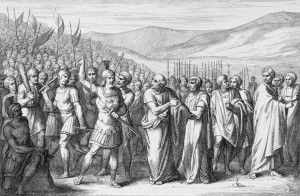
The Secession of the People to the Mons Sacer, engraved by B. Barloccini, 1849

Dissatisfaction with the status quo occasionally mounted to the point that the plebeians engaged in a sort of general strike, a secessio plebis, during which they would withdraw from Rome, refusing to fight and leave the patricians to face the enemy by themselves.

From 494 to 287 BC, five such actions during this “Conflict of the Orders” resulted in the establishment of plebeian offices (the tribunes and plebeian aediles), the publication of the laws (Twelve Tables), the establishment of the right of plebeian-patrician intermarriage (Lex Canuleia), the opening of the highest offices of government and some state priesthoods to the plebeians, and legislation (Lex Hortensia) that made resolutions passed by the assembly of plebeians, the concilium plebis, binding on all citizens.
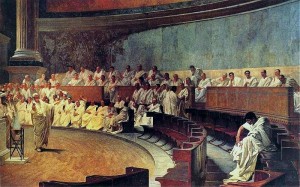
800px-Maccari-Cicero

Cicero Denounces Catiline, fresco by Cesare Maccari, 1882–88

Social mobility
During the Second Samnite War (326–304 BC), plebeians who had risen to power through these social reforms began to acquire the aura of nobilitas, “nobility”, marking the creation of a ruling elite of nobiles that allied the interests of patricians and noble plebeians. From the mid-4th century to the early 3rd century BC, several plebeian-patrician “tickets” for the consulship suggests political cooperation between the classes.

Although nobilitas was not a formal social rank during the Republican era, a plebeian who had attained the consulship was regarded as having brought nobility to his family. Such a man was a novus homo, a “new man” or self-made noble, and his sons and descendants were nobiles. Marius and Cicero are notable examples of novi homines in the late Republic, when many of Rome’s richest and most powerful men—such as Lucullus, Crassus, and Pompey—were plebeian nobles.
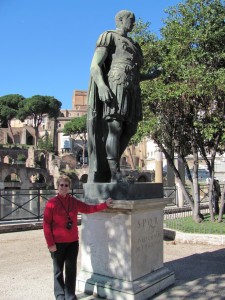
Me and G.J.Caesar

Me and G.J.Caesar

Some or perhaps many noble plebeians, including Cicero and Lucullus, aligned their political interests with the faction of optimates, conservatives who sought to preserve senatorial prerogatives. By contrast, the populares or “people’s party”, which sought to champion the plebs in the sense of “common people”, were sometimes led by patricians such as G.Julius Caesar and Clodius Pulcher.

Straightforward, isn’t it? But I hope I’ve shed some light on the origin of plebs and patricians.


Updated 2022: Alison Morton is the author of Roma Nova thrillers –  INCEPTIO, CARINA (novella), PERFIDITAS, SUCCESSIO,  AURELIA, NEXUS (novella), INSURRECTIO  and RETALIO,  and ROMA NOVA EXTRA, a collection of short stories.  Audiobooks are available for four of the series. Double Identity, a contemporary conspiracy, starts a new series of thrillers. JULIA PRIMA, a new Roma Nova story set in the late 4th century, is now out.

Download ‘Welcome to Alison Morton’s Thriller Worlds’, a FREE eBook, as a thank you gift when you sign up to Alison’s monthly email update. You’ll also be among the first to know about news and book progress before everybody else, and take part in giveaways.

Meet Geri Clouston of IndieBRAG

Geri CloustonToday, I’m delighted to welcome Geraldine Clouston, founder and president of IndieBRAG, an organisation whose mission is “to recognize quality on the part of authors who self-publish both print and digital books.”

One fearsome, but in a way reassuring, statistic is that IndieBRAG rejects 90% of books that it considers. Not quite two years old, it already has an excellent reputation as a serious “Guardian at the Gate”. At the recent Self-Published Book Expo in New York, IndieBRAG presented an authoritative report on self-publishing and was the only panel out of 17 filmed by C-SPAN’s Book TV.

Welcome to Roma Nova, Geri.
Thank you so much for letting me tell you about my passion – indieBRAG!

Brag logoWhat is the background to you starting IndieBRAG?
Several years ago my husband and I attended the Self-Publishing Book Expo in New York City for the first time. We were, of course, not surprised to find many self-published authors at the Expo who were looking for help. However, we were surprised to discover that after these authors had published their books very few of them knew what to do next. We quickly realized that with the explosion of self-publishing, it is very hard for an indie author to get any attention for their book. And more to the point, given that much of what is self-published is not worth a reader’s time or money, it is a major challenge for a good self-published book to rise above the rest.

Tell us about your process for evaluating self-published work.
After a book is nominated through our website it is subjected to a rigorous selection process. This entails an initial screening to ensure that the author’s work meets certain minimum standards of quality and content. If it passes this preliminary assessment it is then read by members drawn from our reader group. We have over 150 readers in 11 countries who regularly read self-published books for us. They judge the merits of the book based on a comprehensive list of criteria, the most important of which is whether or not they would recommend it to their best friend. If a book meets our high standards, we award it our B.R.A.G. Medallion and present it on our website.

There are two important things to note about our process- First, we are not agents, literary experts, or publishers. We are simply ordinary people who are passionate about reading books; the same people who buy books. And second, we do not permit any contact between our readers and authors, or other readers. This gives the reader an opportunity to make a decision without any undue influence from anyone.

At the SPBE in New York, you gave a major presentation called “THE GOOD, THE BAD, AND THE UGLY” of self-published books. I understand this was based on surveys and interviews with your readers and BRAG Medallion authors. What were your main findings?
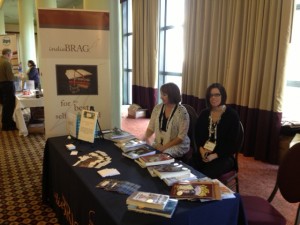
At SPBE, New YorkYes, in September we conducted surveys among both our readers and Medallion authors, the key findings of which were presented at the Expo. The results covered a broad range of topics, but perhaps the most significant finding was that while good editing won’t make a book successful, bad editing will almost certainly kill it. The adage that you rarely get a second chance for a first impression holds especially true in self-publishing!

We also found that over 70% of readers download a free sample of a book, or peruse it in a book store, before they buy it. Importantly, most will only read a few pages before they decide to buy it so it is critical to grab their attention right away. A significant finding from our authors was that over 80% use social media to promote their books, and most believe the degree to which this helps them is directly proportional to the effort they put into it.

More of our results can be found in my blog on our website.
(Read through all of Geri’s posts from the SPBE – well worth it!)

Should self-published books be priced at rock-bottom to encourage readers or would this give a false message?
Pricing has been a major topic of conversation lately in the self-publishing industry and we addressed this issue in our surveys. Again I would suggest that you check out our blog for more details. The most striking finding was that many authors are pricing their books too low. We learned that most readers are willing to pay at least $5.00 for an eBook and up to $15.00 for a trade paperback. Moreover, a price of $.99 often red flags a book as being self-published. Although this is becoming less of a negative, an author should want their book to be judged by the quality of the writing not how it was published, and such a low price may give the wrong impression. Also offering it a higher price gives an author greater flexibility in running reduced price promotions.

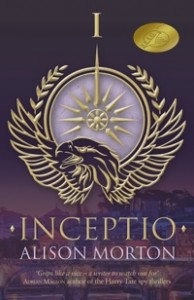
INCEPTIO with BRAG stickerWhat is the chief benefit of B.R.A.G. MedallionTM books for the reader?
The B.R.A.G.Medallion is quickly becoming recognized as a sign of quality in self-published books. It attests to the fact that a reader can be confident that a book bearing the B.R.A.G.Medallion will not be a waste of their time or money!

How do you think readers are going to find books in the future with more digital books and fewer physical bookshops? And with ever more books coming on the market each year?
I believe this speaks to how the B.R.A.G.Medallion best serves the reading audience. Instead of perusing the thousands of books online, a reader can go to our website, pick a genre and find a book other readers recommend highly. Or, when they are shopping elsewhere, such as at amazon.com or barnesandnoble.com, a reader who sees the B.R.A.G.Medallion will know that this is a book worthy of consideration.

And how will you be spreading the message about IndieBRAG in 2014?
We will continue to actively promote our B.R.A.G.Medallion books, as well as indieBRAG itself, on social media, and by attending book events and expos. We also encourage bloggers like you to continue to help us get the word out. We are optimistic that 2014 will be a big year for indieBRAG and we are currently working on several new and exciting ideas to help deserving self-published books rise to the top!

Thank you for being my guest today, Geri, and have a successful 2014

I’m very proud INCEPTIO is a B.R.A.G. MedallionTM honoree. You can find more excellent books on the IndieBRAG website.


Alison Morton is the author of Roma Nova thrillers, INCEPTIO, and PERFIDITAS. Third in series, SUCCESSIO, is out early summer 2014.

INCEPTIO - Amazon bestseller!

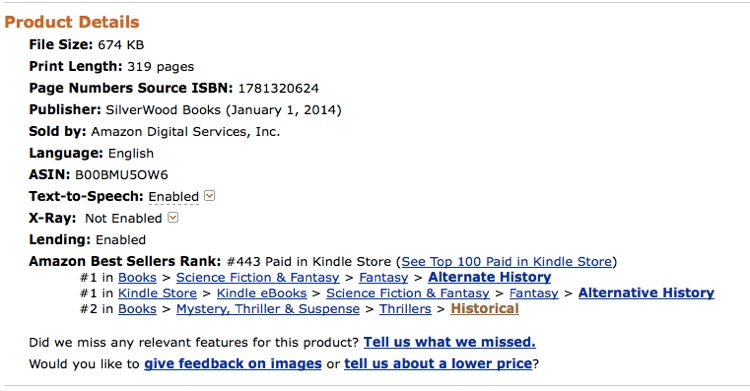
This last weekend, something very exciting happened. INCEPTIO reached bestseller ranking on Amazon.com, #1 in the Alternate History and Alternative History categories and #2 in Historical Thrillers. At this stage, I had even knocked Stephen King off first place!
AmazonUS3Jan14(7)

 So I did this…

IMG_4645_sm


Alison Morton is the author of Roma Nova thrillers, INCEPTIO, and PERFIDITAS. Third in series, SUCCESSIO, is out early summer 2014.