 The Roman Empire didn’t ‘fall’ in a cataclysmic event as the movies and TV would have you believe – it localised and eventually dissolved like chain mail fragmenting into separate links, giving way to rump states, local city states and petty kingdoms. New, dynamic and often warring nations emerged – Goths, Franks, Alamans and Burgundians. The Roman Empire didn’t ‘fall’ in a cataclysmic event as the movies and TV would have you believe – it localised and eventually dissolved like chain mail fragmenting into separate links, giving way to rump states, local city states and petty kingdoms. New, dynamic and often warring nations emerged – Goths, Franks, Alamans and Burgundians.
But one part of the Roman empire hung on in Gaul – the intriguing Domain of Soissons.
Officially, the last Roman emperor in the West reigned until AD 475 (Julius Nepos) or AD 476 (Romulus Augustulus) – take your pick of the two available contenders. But the last really effective Roman emperor, Majorian, had died in AD 461. Before he did, he’d appointed Aegidius in AD 457 to command all military forces in Gaul as magister militum (master of soldiers).
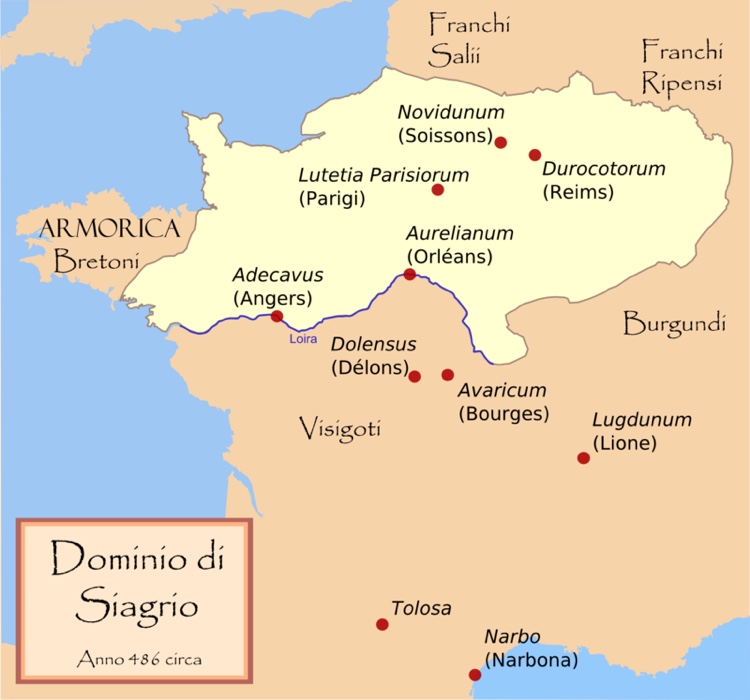
Soissons in the north-west was the only remaining Roman territory in Gaul by then and included Angers, Orleans, Reims, Paris and much of modern day Normandy up to the Channel coast. A corridor to Italy was annexed by the Germanic tribes occupying Gaul, cutting off Aegidius and his citizens from the empire.
Aegidius managed to rule in much of his province, but died in AD 464 or AD 465 and after a brief rule by Paulus, a Roman official, his son Syagrius succeeded him as ruler. Although Syagrius was sometimes called Rex Romanorum (King of the Romans), probably by the barbarians settled on Soissons’ borders, the citizens living there didn’t consider themselves as anything other than inhabitants of a separated province of the Western Roman empire. They perpetuated Roman rule and core structures for nearly thirty years despite being cut off from the Italian homeland (which was also pretty chaotic at this time).
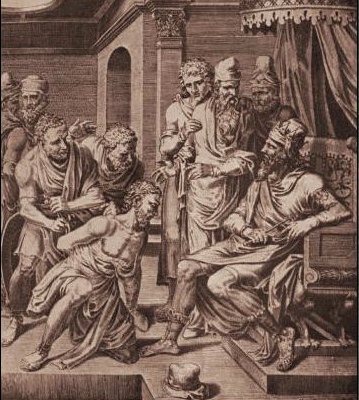 Syriagrus brought before Alaric Unfortunately for Syagrius, in AD 486 he came up against the most dynamic and ruthless leader of the new Europe, the Frankish king Clovis, and lost the Battle of Soissons.
Syagrius sought sanctuary with Alaric, king of the Visigoths, but when Clovis threatened war, he handed Syagrius over to Clovis for execution.
The Gallo-Roman enclave was absorbed into the Frankish kingdom, a step that established the Franks as the major regional power and laid the foundations of a later nation-state, France.
Even though it’s a footnote of history, Romans carrying on a Roman life – social, economic, legal – surrounded by barbarians does have a tinge of the romantic, of a people stranded in time…
Alison Morton is the author of Roma Nova thrillers – INCEPTIO, CARINA (novella), PERFIDITAS, SUCCESSIO, AURELIA, NEXUS (novella), INSURRECTIO and RETALIO, and ROMA NOVA EXTRA, a collection of short stories. Audiobooks are available for four of the series. Double Identity, a contemporary conspiracy, starts a new series of thrillers. Double Pursuit, the sequel, is now out!
Download ‘Welcome to Alison Morton’s Thriller Worlds’, a FREE eBook, as a thank you gift when you sign up to Alison’s monthly email update. You’ll also be among the first to know about news and book progress before everybody else, and take part in giveaways.
If you enjoyed this post, do share it with your friends!
 How do you make a decision? Whether it’s buying a new pair of shoes, going to law or plunging into a new life in a different country and culture, it’s a complicated question. How do you make a decision? Whether it’s buying a new pair of shoes, going to law or plunging into a new life in a different country and culture, it’s a complicated question.
First of all, there’s an instinctive reaction to the decision: you see, you want, you say yes. Then your brain kicks in: do I have the money, will I have the time, will this change my life, will I look better, will I enjoy it, do I want all that upheaval?
Basically, it boils down to the hassle of pushing yourself to change from where you are versus the pleasure you will gain or threat you’ll avoid once you’ve made the decision.
Most people love the status quo – it’s familiar, the pluses and minuses are there to be seen (And I’m not talking about the rock band!). The original Latin in statu quo res erant ante bellum (in the state in which things were before the war), meant all troops were withdrawn and boundaries back where they were before the war. These days status quo generally means the ways things are set up at the moment. Status quo can also refer to a situation that nobody likes but the result of changing it seems too risky.
Here you have two choices: wait and see, or take a risk to change it.
Human beings tend to be irrationally loss averse. In other words, we sometimes prefer to avoid the risk of loss even at the cost of a better than fair prospect. This isn’t us being wimpish; our propensity to protect what is already in hand is hard-wired into our brains. For most of human evolution, our biological ancestors lived in an environment where resources were scarce. If you wanted to feed your family, you had to hunt or gather. If there were natural impediments such as extreme weather, or unfriendly wildlife like sabre-tooth tigers, you might not survive. Over countless generations, this developed a biological basis to loss aversion.
So, taking a decision means overcoming an instinctive dislike of risk. For most people it’s “Shall I buy those shoes?”, “Can I get into that parking space?”, “Which type of pasta shall we have for supper?”. For your hero or heroine, it’s “Shall I turn my back on this?”, “Shall I put myself in danger?”, “Can I trust him/her?”, “Why would I leave my safe but boring life and risk an uncertain but wealthy life with strangers?”.
Writers have the power of pushing characters to that decision point by introducing a crushing threat. Readers love seeing characters struggling with these decisions, it makes delicious tension. But writers must chart how their characters deal with conflict and come to make decisions or they’ll look unbearably smart and a bit wooden.
Of course, it’s a heroic virtue to be able to make a good decision under pressure, but even the most decisive character has to have a wobble from time to time…
References: Kahneman & Tversky’s Prospect theory (http://en.wikipedia.org/wiki/Prospect_theory) and Pearlman’s Loss aversion, evolution and Risk complacency (http://philpearlman.com/2009/02/03/75319882/)
If you enjoyed this post, do share it with your friends!
 Agents are busy people – we know that – so when I read this (handwritten) note, I was strangely pleased: Agents are busy people – we know that – so when I read this (handwritten) note, I was strangely pleased:
“Please forgive my incredibly slow response, but I liked your writing and had put it aside to get back to. It’s not right for my list, but I’m sure you will find an agent to suit.”
The cynical may say it’s pretty standard, but this was a personal note added after the formal printed text. Me, I regard it as a near miss.
The last few replies from agents have said nice things about my writing: “well-written”, “intelligent”, “your work is good”, so I’m happy that the quality of my work is at publishable level.
It’s the list thing. Publishing is at an uncertain place and I can understand that companies are opting for the safe and known. I write thrillers with an alternative history setting, which is probably speculative in all senses of the word.
But I have faith, but hopefully not hubris, that my books will be published.
If you enjoyed this post, do share it with your friends!
|
Subscribe to Blog via Email
Join 37 other subscribers.
Buy AURELIA from Apple!
UK

US
|