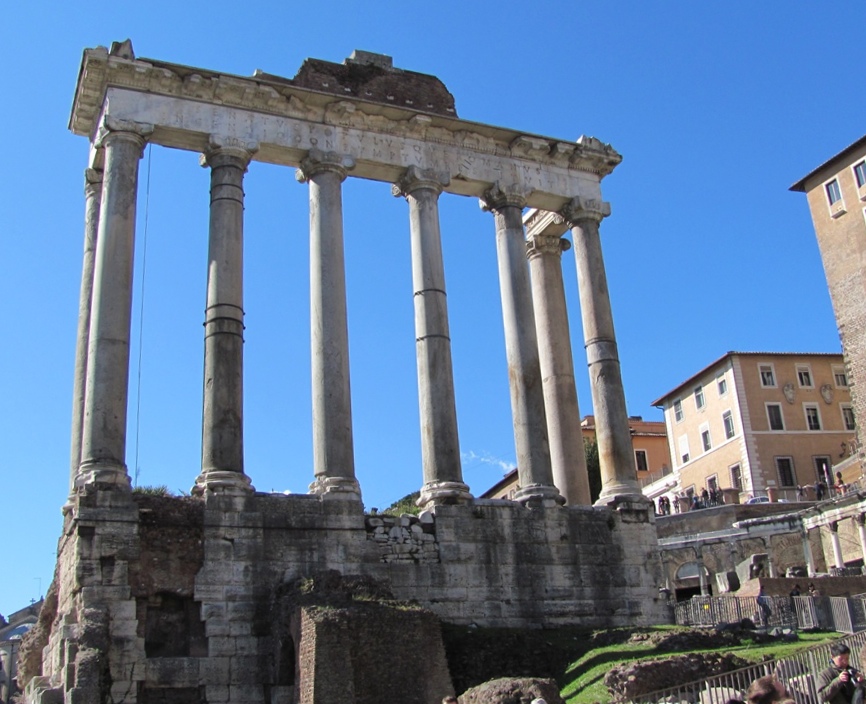
Saturnalia was THE most important Roman festival. Heavy on feasting, fun and gifts, it was originally celebrated in Ancient Rome for only a day around 17 December (today!), but it was so popular it expanded into a week or even longer, despite Augustus’ efforts to reduce it to three days, and Caligula’s, to five. Like today’s Christmas, this holy day (feriae publicae) had a serious origin: to honour the god of sowing, Saturn. But also like modern Christmas, it was a festival day (dies festus). After sacrifice at the temple, there was a public banquet, which Livy says was introduced in 217 BC. Afterwards, according to the poet Macrobius, the celebrants shouted ‘Io, Saturnalia‘ at a riotous feast in the temple.
Modern mid-winter habits echo Roman conspicuous eating and drinking, and visiting friends and giving gifts, particularly of wax candles (cerei), and earthenware figurines (sigillaria). Masters served meals to their slaves who were permitted the unaccustomed luxuries of leisure and gambling. A member of the familia (family plus slaves) was appointed Saturnalicius princeps, roughly equivalent to the Lord of Misrule.
The poet Catullus describes Saturnalia as ‘the best of days’ while Seneca complains that the ‘whole mob has let itself go in pleasures’. Pliny the Younger writes that he retired to his room while the rest of the household celebrated. Sound familiar?
Macrobius described a banquet of pagan literary celebrities in Rome which classicists date to between 383 and 430 AD. So Saturnalia was alive and well under Christian emperors, but no longer as an official religious holiday.
But alongside ran the Dies Natalis Solis Invicti (the birthday of the ‘unconquerable sun’), a festival celebrating the renewal of light and the coming of the new year and which took place on 25 December. By the middle of the fourth century AD, the dominant Christian religion had integrated the Dies Natalis into their celebration of Christmas. So it seems that Saturnalia wasn’t the official ancestor of Christmas after all. Never mind.
Io Saturnalia!
Read ‘Saturnalia surprise‘ about how the Mitelae were celebrating one year…
Alison Morton is the author of Roma Nova thrillers, INCEPTIO, and PERFIDITAS. Third in series, SUCCESSIO, is now out.
Find out about Roma Nova news, writing tips and info by signing up for my free monthly email newsletter.
If you enjoyed this post, do share it with your friends!
 I’m reading a book at the moment full of “prithee, varlet” language. It’s as irritating as Hades, but maybe that’s just me. The atmosphere of fear is building, the characters are forming and the plot slowly emerging. I’m reading a book at the moment full of “prithee, varlet” language. It’s as irritating as Hades, but maybe that’s just me. The atmosphere of fear is building, the characters are forming and the plot slowly emerging.
But despite the over-elaborate language, the author’s grammar is spot on. And that’s what saves it.
Writing is a form of communication and when we structure writing correctly then our message is unambiguous, even in “prithee” language. The reader reads what we intended them to read. Even in a very minimalist-styled book such as any of Lee Child’s Jack Reacher thrillers, the accuracy and clarity of the writing enables the reader to see exactly what the author is saying.
If we don’t write clearly, then the poor reader has to re-read sentences and pause to work out what he or she thinks we meant. After a few jolts to continuity, it’s inevitable that the reader’s pleasure diminishes. And after too many, the reader chucks the book on the floor.
Editors can, and do, do a wonderful job, but even they get to the hair-tearing stage in the face of relentless sloppiness. If they have the choice of working on a well-written manuscript and one weighed down with mistakes, guess which one they’ll prioritise?
Poor grammar and spelling are the things that irritate readers of self-published books most, and most quickly, even in a free book. We have so much choice these days, why would we spend precious life-hours reading something that is written in a careless and sub-standard way?
However fabulous the plot, characters and narrative thrust of the story, good grammar and spelling matter.
Horrors to avoid (Any one of these makes me chuck the book on the floor.)
your/you’re
Can you say ‘you are’ instead? If so, then it’s ‘you’re’. ‘Your’ is to indicate something belonging to ‘you’, e.g. your book.
it’s/its
Can you say ‘it is’? Then it’s ‘it’s’. 😉 As with ‘your’, when used to show something that belongs to ‘it’, ‘its’ doesn’t have the abused apostrophe, e.g. “Gorgeous book. I love its cover.”
There/their
Can you say ‘here’ instead of ‘there’. e.g. ‘there are /here are’? There you are, then. Remember, ‘their’ is very possessive…
Affect/effect
‘Affect’ is an active verb. ‘Effect’ is the outcome, e.g. cause and effect. A quick way of remembering is that A comes before E, i.e. you have to affect something before you can see the effect.
‘Bored of’ or ‘bored with’?
Please don’t start me on this one. I hope you know the correct version. See me in the comments if you don’t.
If you enjoyed this post, do share it with your friends!
 One of the first things we notice in the mornings is the weather. How many of those first tweets go something like this: One of the first things we notice in the mornings is the weather. How many of those first tweets go something like this:
‘Brrr – cold as I crawl out of bed – not LOL’
‘The sun. At last. Damn, I have to go to work.’
‘DH now in garden shed building an ark. Blasted rain!’
We even report average weather:
‘Nice and sunny here, a bit overcast but OK. What are you up to today?’
Some primeval instinct drives us to orientate ourselves in the day the minute we’re awake. Cave man asked whether it was a good day for hunting, gathering or beating the crap out of the neighbouring tribe. Today, we look out of the window and wonder whether the car will start in the damp, if the heatwave will continue or the delivery person won’t appear because the snow’s too deep.
We need weather to frame our lives. And so do our characters, but not in a nice way. They need disruption.
Firstly, a writer can use weather to add weight, obstacles and trouble to a character’s dilemma. Weather can change the plot: snow falling might stop planes flying, bring down power lines, prevent a vital meeting or elopement. Prolonged, heavy rain may cause flooding, damage to vital papers, trapping a character in a cave or cellar or a beloved pet drowning.
Weather can affect a character’s mood: sun generally cheers people up and rain depresses them. Wind is well-known for, er, winding people up. Any teacher will confirm that kids become more jittery and argumentative if there’s a gale blowing outside.
And thirdly, using weather to reflect inner turmoil adds a layer to the story: character C is waiting for character D and the meeting is going to be difficult, C paces around, fidgets, keeps looking out of the window, his stomach is queasy. The wind outside is blowing rubbish down the street and the sky is getting blacker by the minute…
How to write weather
The key is to integrate weather into the story as it affects the character at that point. I write thrillers and the reason I might describe weak winter sunlight, or perish the thought, a sunset, is that the horizontal light gets into the hero’s eyes and blinds him when he’s taking a vital shot.
Some less extreme ways to introduce environmental conflict into a scene could be:
- If teenagers are meeting anywhere outside on a first date, make it rain;
- If a woman takes her young grandson sailing, a squall blows in;
- If a man is afraid of the dark, make it a moonless night, preferably in the country, either windy or raining. Possibly both.
While weather is a vital ingredient, you only need to mention it once and the reader will set the scene themselves:
- We ate quickly, ignoring the rising heat from the afternoon sun.
- Next morning, it was still snowing and she’d left her boots in the car.
- I wasn’t surprised to see him an hour later. He came in through the service entrance, shaking rain from his umbrella.
The reader can then take their experience of rain/snow/scorching heat and use it to ‘see’ the scene in the book. If it’s rain, some readers will imagine heavy rain, others a drizzle, but it doesn’t matter. The precise nature of the rain isn’t important – all you need to do is mention the wet stuff and the reader’s imagination will do the rest.
If you enjoyed this post, do share it with your friends!
|
Subscribe to Blog via Email
Join 37 other subscribers.
Buy AURELIA from Apple!
UK

US
|