What? What?
When I first started this blog on World Book Day not quite three years ago (4 March 2010) I had just signed my indentures as a mad newbie writer, so the title Write a Novel? I must be mad! was an appropriate one. While I will never give up learning – no human being, let alone no writer ever should – I feel that it’s time for refreshment. And we’re not talking about a cup of tea.
My first book, INCEPTIO, comes out on 1 March this year. I have survived the initial mad phase and am passing into the institutionalised one where I hope to produce novels on a reasonably regular basis. Perhaps I will never be released from this obsession of writing…
I write thrillers with a strong heroine. She gets into scrapes: treason, death threats, kidnappings, betrayals, let alone organised crime, and comes near to losing her life and her love several times in the course of the novels. She has a temper, but tends to let it out only when she thinks she’s being treated unfairly. But she matures and learns valuable, if not always palatable, lessons about herself.
But her biggest challenge is the world she lives in, mainly because she wasn’t born there. Roma Nova, lying somewhere between the Northern Confederation of Italy and New Austria was founded sixteen centuries ago by a group of Romans fleeing persecution by the Christian Emperor Theodosius in AD 395. And they’ve managed to tough it out until the 21st century.
Welcome to the world of Roma Nova.
If you enjoyed this post, do share it with your friends!Like this:Like Loading...
 A butterfly in the Amazon jungle makes that little extra flutter of its wings and a few weeks later there’s a storm or even a hurricane in the Caribbean that wrecks cities. That’s a little crudely put, but this is the idea behind Edward Lorenz’s chaos theory. In reality, the butterfly’s flapping wing is just as likely to prevent that storm with an equal number of changes both ways. The random nature of the ‘butterfly effect’ makes it impossible to predict which way at any given time. A butterfly in the Amazon jungle makes that little extra flutter of its wings and a few weeks later there’s a storm or even a hurricane in the Caribbean that wrecks cities. That’s a little crudely put, but this is the idea behind Edward Lorenz’s chaos theory. In reality, the butterfly’s flapping wing is just as likely to prevent that storm with an equal number of changes both ways. The random nature of the ‘butterfly effect’ makes it impossible to predict which way at any given time.
This equalising idea is a bit boring, so writers tend to opt for the doom scenario, ladling all sorts of dreadful consequences over the butterfly’s head. Closely related is the ‘For the want of a nail’ theory when one tiny missing thing leads to world-changing events. And they’re always bad ones. Erik Durschmied’s The Hinge Factor – How Chance and Stupidity Have Changed History illustrates this point perfectly.
In alternate history, writers can play with these types of ideas to introduce a point of divergence to bring about full-blown complex political, economic and social change. In Ray Bradbury’s A Sound of Thunder, a butterfly is crushed in the time of the dinosaurs by a time-traveller which has the consequence in the ‘present’ of electing a fascist leader instead of a moderate one. Alternatively, in a film like Sliding Doors, dealing with a purely personal story, missing a train splits the heroine’s life into two possible timelines, one transforming and the other fatal.
If you’re fascinated by the butterfly of doom as a story device visit TV Tropes.
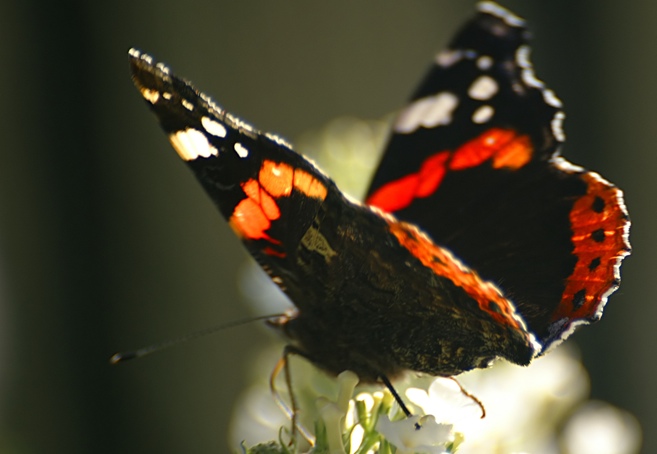 In our timelime, or OTL as alternate historians abbreviate it, the poor Red Admiral is known as the butterfly of doom. Writer and lepidopterist, Vladimir Nabokov, mentioned it in his work. The Red Admiral was especially abundant in Russia in one year in the late 19th century; the markings on the underside of its two hind wings seem to read ’1881′. That year, the Russian Tsar Alexander II was assassinated. In our timelime, or OTL as alternate historians abbreviate it, the poor Red Admiral is known as the butterfly of doom. Writer and lepidopterist, Vladimir Nabokov, mentioned it in his work. The Red Admiral was especially abundant in Russia in one year in the late 19th century; the markings on the underside of its two hind wings seem to read ’1881′. That year, the Russian Tsar Alexander II was assassinated.
Everybody has potential points of divergence in their lives when they make choices. But the butterfly, or missing nail, can make those choices for you.
Alison Morton is the author of Roma Nova thrillers – INCEPTIO, CARINA (novella), PERFIDITAS, SUCCESSIO, AURELIA, NEXUS (novella), INSURRECTIO and RETALIO, and ROMA NOVA EXTRA, a collection of short stories. Audiobooks are available for four of the series. Double Identity, a contemporary conspiracy, starts a new series of thrillers. JULIA PRIMA, a new Roma Nova story set in the late 4th century, is now out.
Download ‘Welcome to Alison Morton’s Thriller Worlds’, a FREE eBook, as a thank you gift when you sign up to Alison’s monthly email update. You’ll also be among the first to know about news and book progress before everybody else, and take part in giveaways.
If you enjoyed this post, do share it with your friends!Like this:Like Loading...
 A round robin Oh, the sneering! Oh, the superiority! Even Lynne Truss (Eats, Shoots and Leaves) is on BBC Radio4 broadcasting a series of witty ripostes to round-robins (RRs).
Now some RRs are painful: long-winded, which goes hand-in-hand with boring; poorly composed and/or typed; with scattered blurry photos; and produced with tight margins in tiny, coloured or weird fonts. But some gems are witty, near professional offerings, mostly photos with hilarious captions leaving you wanting more. The best ones make you grab the ‘phone or start bashing out an email to the sender immediately after reading.
In time-strapped, intense lives, the RR can reach many more people without the sender getting RSI, paying a fortune for individually printed photos or dying from exhaustion and insanity repeating the same stuff up to, and possibly beyond, a hundred times. How are RRs different from all the blog posts we chuck out indiscriminately into the digiverse?
But, like trying to avoid the slush-pile that many writers end up on, how do you write an RR that’s entertaining, informative and has that spark of something special? I’ve been sending them out for over twenty-five years, well before the time they became fashionable, so I’ve got some experience.
Keep these key points in front of you:
- The recipient may only have a quick minute to scan your letter, so keep it snappy
- Include lots of photos, but interesting, non-forced ones. Do not reduce them down to such a low resolution that they look like a blurry mess.
- Do not witter on about Jemima’s first day at school. Most people have been to school, so have their children – we know. Just say J has started school and add a photo of her in her too large uniform.
- Yes, a mention of holidays, but not a detailed description of the sangria night when you all got trollied. As above, we know this experience.
- Achievements – careful does here. Of course, say that Jemima bagged a first in Icelandic or her sister passed her hairdressing apprenticeship and has secured a stylist job in a top London salon – these are great things. But don’t go on about it (Even I was reasonably restrained about the publication of my debut novel INCEPTIO on 1 March 2013. 😉 ).
- What people in the family are doing now – as in the point above. A brief sentence or two is enough.
- Try to inject some wit, but don’t force it.
- And guess what? Edit it! An RR is like any other piece of writing and if you are sending it to recipients who are your friends and relations, they deserve the same courtesy as the rest of the reading public.
- Lastly, make sure you leave a space at the end for a short, personal, handwritten message and signature.
Do you write or receive RRs? Go on, now, tell me your thoughts…
If you enjoyed this post, do share it with your friends!Like this:Like Loading...
|
Subscribe to Blog via Email
Join 37 other subscribers.
Buy AURELIA from Apple!
UK

US
|