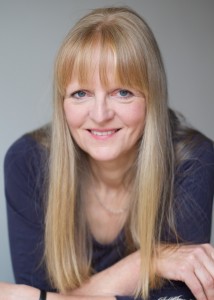
 Ruth Downie read too much Jane Austen at university, emerged with an English degree and a plan to get married and live happily ever after. As a backup she learned typing and shorthand, in the mistaken beliefs that people would always need secretaries and that she might be quite good at it. Finally escaping into fiction, she won the Fay Weldon section of the BBC’s End of Story competition in 2004.
The first book in her crime series featuring Roman Army medic Ruso and his British partner, Tilla, was a New York Times bestseller under the title ‘Medicus’. It was published as ‘Ruso and the Disappearing Dancing Girls,’ in the UK, where The Times recommended it as one of their ‘Seven best thrillers for Christmas’. The sixth in the series, ‘Tabula Rasa,’ is published this year. She is currently working on the next book and also spends several weeks every summer wielding an archaeological trowel in search of inspiration.
Welcome Ruth! We first met on Helen Hollick’s ‘The Wonder of Rome‘ blog hop last year. You wrote a great post called ‘First drown your ape‘ about Roman doctors. I love your grumpy hero, Ruso. Tell us more about him…
On arrival in Britannia, Gaius Petreius Ruso’s needs are simple. All he wants
1. is to get on with his job as a medic in Rome’s Twentieth Legion, and thus
2. clear a few family debts.
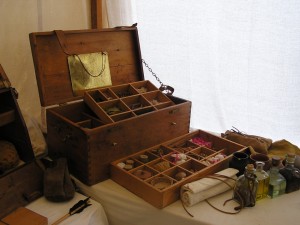
Roman Medical chest (Reconstruction)
He doesn’t need – or want –
1. an injured British slave girl with a name he can’t pronounce
2. her opinions
3. anyone else’s opinions
4. any unexplained dead bodies, because it certainly isn’t his job to pursue whoever killed them.
Unfortunately, the Roman Empire is a violent place, and the gods don’t care what Ruso wants. They have more interesting plans…
Do you think historical accuracy matters in a historical novel? And connected to that, do you think fiction does anything to help us understand the past, or is it purely entertainment?
I’m sure historical accuracy is important, but I’ve lived long enough to learn that “truth” is a slippery word. Today’s accepted facts can be swept aside by tomorrow’s shiny new theory, and if you think ‘history’ is done, dusted and settled, then you and I haven’t been reading the same books.
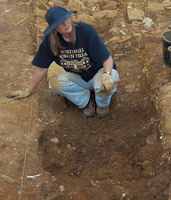
In the trenches
Archaeology, you’d think, should be safe. After all, you can see it, touch it and photograph it. However, I’m mightily glad I never wrote that short story about the poignant ceremony where the soldiers of Maryport buried their stone altars and then marched away, never to return. The area has been re-examined since I visited, and we now know that the altars weren’t reverently buried at all. They were dumped in foundation pits as hard core.
Written evidence is tricky too. Even if we have the ‘facts’ straight, we all naturally choose to record the parts of a story that strike us as important. That’s why we know so much about the lives and opinions of wealthy men in the classical world, and so little about their slaves, or about the many women who neither married a famous man nor murdered one.
Meanwhile, the ancient Britons steadfastly refused to write anything down, so all we have is the opinions and inventions of their conquerors. And archaeology, of course. Which is, as we know, open to interpretation.
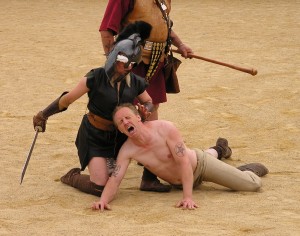
Violence as entertainment – Chester Roman Festival, 2011
Strangely, attitudes are easier to pin down. I don’t know anyone who would dispute that, under the Roman empire, slavery was normal, women were generally deemed to be less intelligent than men, and violence was frequently entertaining.
Of course, some writers will deliberately choose to be “inaccurate” – altering and augmenting the stories most of us believe about our past. Others – and I’m one of them – would rather work within the currently accepted facts about our chosen period. Certainly, the scarcity of information about Britain in the early second century is such that it leaves plenty of room for invention. We know that Roman soldiers were allowed to form partnerships with local women, and we know there was some sort of rebellion in the early years of Hadrian’s reign, but we have no details. Only in fiction can we feel the torn loyalties of a soldier’s girlfriend, or the mistrust between the occupying forces and the locals.

A source for a remedy?
Imagination aside, there’s marvellous material from beyond these shores to decorate the gaps between the evidence. Ruso regularly refers to genuine medical recipes from the ancient world. Constrained by accuracy, I’ve never yet written any scorpions into Britannia. If one ever appears, I shall instantly write a pile of dried donkey manure, drop some into a cup of wine and stir well before offering this authentic remedy to its unlucky victim.
I think the best we writers can do (and heaven knows, most of us aren’t historians, so we’re constantly playing catch-up) is to love our chosen era enough to immerse ourselves in the research and try to create something that seems authentic at the time. Something that, crucially, we ourselves believe in. We’re bound to get some things wrong. For that, we apologise. It’s only fiction, after all.
Thank you, Ruth. I don’t think I’ll be going near any scorpions in the near future…
Find out more about Ruth: www.ruthdownie.com
Twitter: @ruthsdownie
Facebook: Ruth Downie Ruso and Tilla
Ruth’s latest book, Tabula Rasa is officially out today! (23 October)
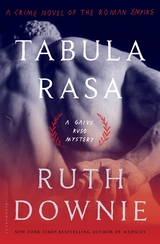 Ruso and his wife Tilla are stationed in the borderlands of Britannia, helping to tend the builders of Hadrian’s Great Wall.
Having been forced to move off their land, the Britons are distinctly on edge, and are still smarting from the failure of a recent rebellion that claimed many lives. Then Ruso’s recently arrived clerk, Candidus, goes missing. A native boy thinks he sees a body being hidden inside the wall’s half-finished stonework, and a worrying rumour begins to spread.
When the soldiers ransack the nearby farms looking for Candidus, Tilla’s tentative friendship with a local family turns to anger and disappointment – and then a child vanishes in the company of a lone, unidentified solder.
As tensions rise between the Britons and the Romans, Ruso must find the missing boy before it’s too late.
Alison Morton is the author of Roma Nova thrillers, INCEPTIO, and PERFIDITAS. Third in series, SUCCESSIO, is now out.
Find out about Roma Nova news, writing tips and info by signing up for my free monthly email newsletter.