


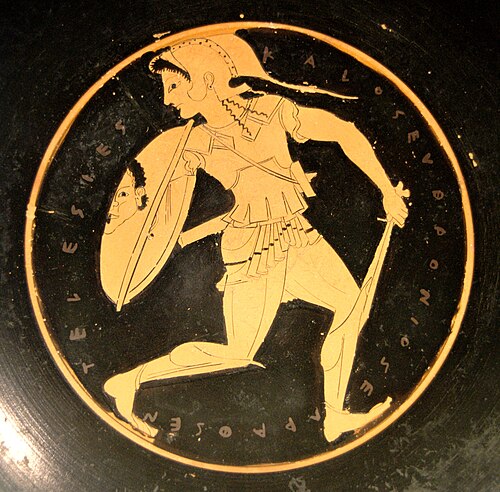
Armed Amazon, her shield decorates a Gorgon head; Tondo of Attic red-figure kylix, c. 500 BCE, Staatliche Antikensammlungen, Berlin (Public domain)
The Amazons stride through ancient myth with spears, bows, and a reputation that unsettled the ancient world. These warrior women, said to live beyond the edges of the known Greek world near the Black Sea, were described as superb horse-archers, fiercely independent, and stubbornly resistant to male control.
Whether they really existed as a distinct people is debated, but archaeology from the Eurasian steppe has uncovered graves of armed women among Scythian and Sarmatian cultures—enough to suggest that the legend may have grown from encounters with societies where women did, at times, ride and fight. We all know how the rumour mill works and I’m sure it was the same in the ancient world.
To the Greeks, Amazons were both fascination and warning: a mirror held up to their own gender order. To the Romans, who inherited Greek myth along with so much else, Amazons were something more complicated – a symbol of chaos, exoticism, courage and a distinct challenge to Roman assumptions about power, family and citizenship.
Romans and Amazons
Diving deeper… Romans encountered Amazons first through Greek art and literature, then through their own retellings. In the epics and histories circulating in the Roman world, Amazons appear at pivotal moments. The Amazon queen Penthesilea fights at Troy and falls to Achilles – a scene beloved by artists for its tragic intensity. The hero Heracles must seize the belt of the Amazon queen Hippolyta as one of his labours. These stories circulated widely in Roman mosaics, frescoes, and carved sarcophagi.
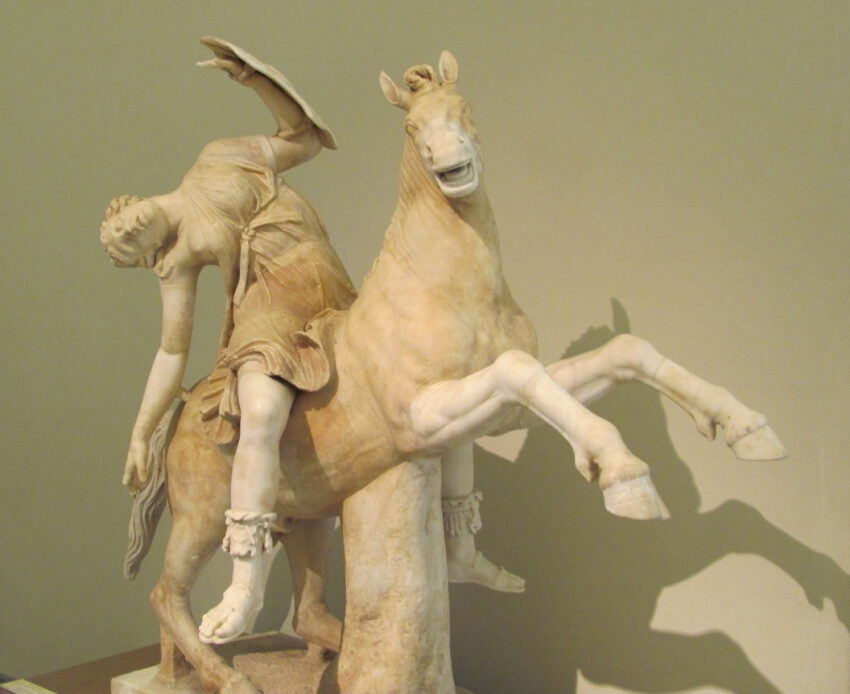
The Dying Amazon, 2nd century AD copy of a Greek original of the 2nd century BC. National Archaeological Museum, Naples (Author photo)
Roman writers such as Virgil included Amazon figures in their works. In the Aeneid, the warrior maiden Camilla is not an Amazon by name, but she is unmistakably cast in their image – swift, deadly, devoted to martial life but ultimately doomed. Camilla is admired, even honoured, but she cannot be allowed to survive into the orderly Roman future Virgil is constructing. She belongs to a wild, heroic past.
That is telling about ancient Roman attitude.
Romans admired courage wherever they found it; it’s deep-rooted in their culture. However, they were deeply invested in a social order in which women’s power was expressed through family, lineage and influence behind the scenes – not on the battlefield. We have many stories about that influence and about Roman women taking a courageous stand or demonstrating incredible fortitude.
But the Amazon was an altogether different type of woman. She fought openly, rejected male authority and lived outside the social and civic structures that Romans believed defined civilisation. To a Roman mind, that placed her somewhere between noble savage and existential threat.
Yet there was also respect. The Amazon was not mocked. She was formidable. Roman art often depicts Amazons as dignified, athletic, and beautifully equipped. They are enemies worthy of heroes. The very care taken in their portrayal suggests a grudging admiration for their martial skill.
In short: the Romans did not dismiss the Amazons. They contained them—by placing them in myth, in the distant past, or on the far edges of the world.
Why did the idea trouble them?
Because Ancient Rome itself had a complicated relationship with women and power. Roman matrons could own property, run households, influence politics, and shape dynasties. Women like Livia, Agrippina, and Julia Domna exerted enormous influence. But it was influence within a framework. The Amazon suggested what might happen if that framework vanished.
The Amazon was a thought experiment: What if women did not accept the roles assigned to them? What if they claimed the spear as well as the spindle?
The answer, in Roman storytelling, was usually tragedy.
A Roma Novan perspective on Amazons
Now imagine a modern, Roman-descended society such as Roma Nova where the society evolved differently over the centuries. Women have, out of the practical needs for survival and then thriving, held formal authority, commanded troops, and shaped state policy not from behind curtains but from the centre of power.
To Roma Novans, Amazons would not be aberrations. They would be ancestors of the imagination.
A Roma Novan historian might smile at the old Roman discomfort. Of course, women can fight. Of course, they can command. Of course, courage and discipline are not gendered traits. The real question, from a Roma Novan perspective, would not be why Amazons existed, but why other societies found them so unsettling.
Roma Nova would likely interpret Amazon legends not as fantasy, but as distorted memory – garbled reports of cultures that organised themselves differently from Greece and Rome. Where Romans saw myth, Roma Novans might see early evidence that martial ability among women is neither new nor unnatural – merely suppressed or ignored in certain traditions.
And they would probably have a certain dry amusement at Virgil’s Camilla; admired, but conveniently removed by death before she could in any way complicate the Roman future.
In Roma Nova, she would have been promoted.
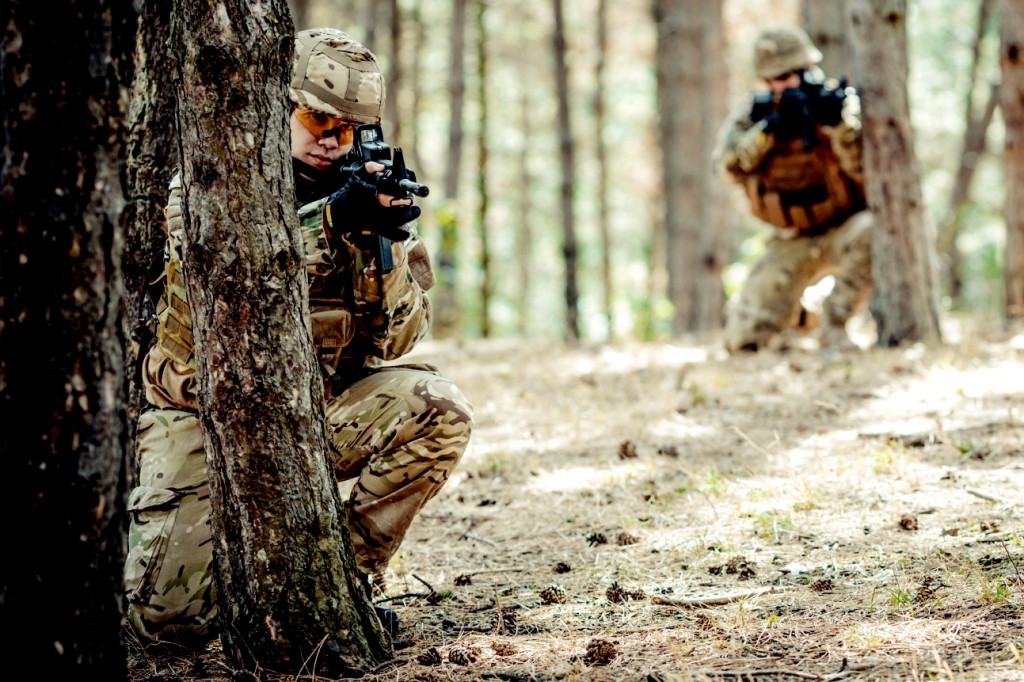
What women in warrior roles bring to the fight
Beyond myth and fiction, the modern world has demonstrated something the Amazons hinted at: when women serve in military roles, they bring distinct strengths alongside shared human qualities of courage, endurance, and skill. I can endorse this from my own six years in uniform.
1. Adaptability and problem-solving
Women entering historically male spaces often develop acute situational awareness and adaptive thinking. This translates well to asymmetric warfare, intelligence work, and complex operational environments.
2. Cohesion and communication
Mixed units frequently report improved communication and team cohesion. Women are often trained – socially, culturally and professionally – to read group dynamics closely, a valuable trait under stress.
3. De-escalation and cultural access
In modern conflict zones, female soldiers can interact with local women in societies where male soldiers cannot. This provides intelligence, builds trust and reduces friction with civilian populations.
4. Psychological resilience
Those who have had to prove themselves repeatedly tend to develop formidable mental resilience. The need to earn one’s place can forge exceptional discipline and commitment. (Nothing new under the sun about that, I hear you say.)
5. A broader leadership model
Women leaders often employ collaborative leadership styles alongside decisiveness, broadening the tactical and strategic options available to a unit.
None of this suggests women fight like Amazons of myth. Rather, it shows that capability in war is human, not male.
The enduring power of the Amazon idea
The Amazon endures because she represents a possibility that societies have alternately feared, admired, suppressed and rediscovered something very powerful: that women can be visible, effective agents of force. For the Romans, she had to remain safely in legend. For Roma Novans, she would be a familiar concept – less a mythic outsider than a symbolic foremother.
And for us, she remains a reminder that history is not only what happened, but what people believed could not happen.
Alison Morton is the author of Roma Nova thrillers – INCEPTIO, CARINA (novella), PERFIDITAS, SUCCESSIO, AURELIA, NEXUS (novella), INSURRECTIO and RETALIO, and ROMA NOVA EXTRA, a collection of short stories. JULIA PRIMA and EXSILIUM, set in the late 4th century, tell the story of Roma Nova’s foundation. Audiobooks are available for four of the series. Double Identity and Double Pursuit start a new contemporary thriller series. The third, Double Stakes is now out.
Download ‘Welcome to Alison Morton’s Thriller Worlds’, a FREE eBook, as a thank you gift when you sign up to Alison’s monthly email update. As a result, you’ll be among the first to know about news and book progress before everybody else, and take part in giveaways.







Leave a Reply