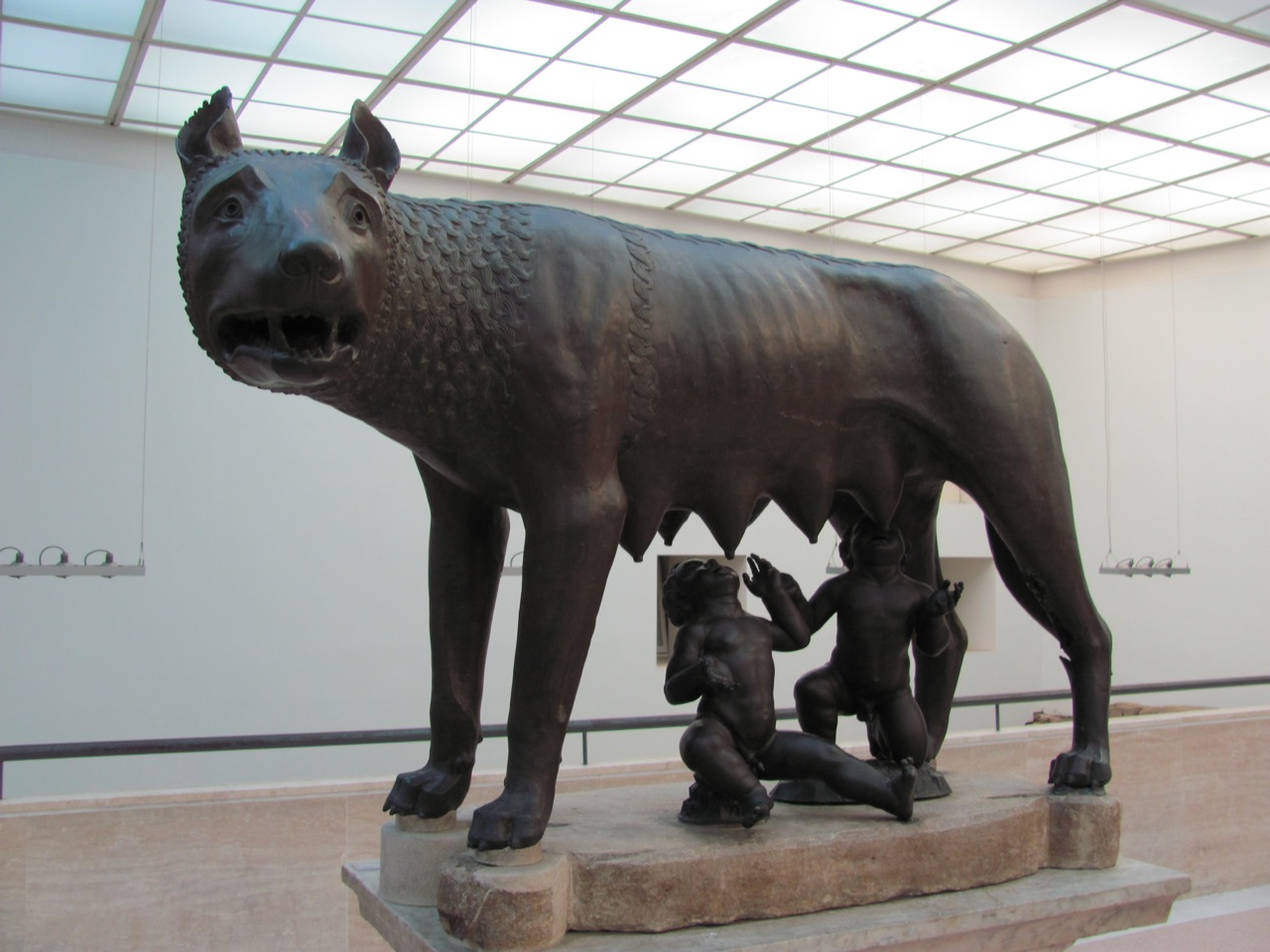
 The shocking news that the icon of Rome’s foundation, a life-size bronze statue of a she-wolf with two human infants suckling her, is about 1,700 years younger than its city hit the headlines this summer. The shocking news that the icon of Rome’s foundation, a life-size bronze statue of a she-wolf with two human infants suckling her, is about 1,700 years younger than its city hit the headlines this summer.
Scholars had long established that the bronze figures of Romulus and Remus feeding from their adopted wolf mother were added in the Renaissance. But the main sculpture’s link to antiquity, traditionally to the Etruscan period 5th century BC, wasn’t seriously questioned until the 1997 restoration.
The she-wolf was found to have been cast as a single unit, a technique typically used in the Middle Ages.
Ancient bronzes were cast in separate parts and then soldered together. First used by the Greeks and then adopted by Etruscan and Roman artists, the technique basically consisted of brazing the separate joints using bronze as welding material.
After much discussion, Rome’s officials decided to carry more in-depth tests to clear any doubt. Radio carbon testing has given the new dating range between 1021 and 1153 AD.
Oops!
So what about the wolf and Rome? The wolf – lupa – is a strong theme throughout the Roman period. Lupercalia was a very ancient, possibly pre-Roman (pre-753 BC) fairly raunchy pastoral festival, held in February to avert evil spirits, purify the city and promote health and fertility. But it was an excuse for a lot of rampant youth to run through the streets whipping women with wolfskin thongs – more here. By the 5th century AD, when the public performance of pagan rites had been outlawed, a nominally Christian Roman populace still clung to the Lupercalia in the time of Pope Gelasius I (494–96). So over a thousand years of the wolf.
Lupa was also a slang Latin word for prostitute, hence the famous lupercal in Pompeii. Is there a meretricious element here, both in the wolf and the festival?
The moral of the story? Whatever the historic background – and a thousand plus years is considerable background – never take history for granted and look out for the medieval wolf in Etruscan clothing.
Alison Morton is the author of Roma Nova thrillers – INCEPTIO, CARINA (novella), PERFIDITAS, SUCCESSIO, AURELIA, NEXUS (novella), INSURRECTIO and RETALIO, and ROMA NOVA EXTRA, a collection of short stories. Audiobooks are available for four of the series. Double Identity, a contemporary conspiracy, starts a new series of thrillers. Double Pursuit, the sequel, is now out!
Download ‘Welcome to Alison Morton’s Thriller Worlds’, a FREE eBook, as a thank you gift when you sign up to Alison’s monthly email newsletter. You’ll also be among the first to know about news and book progress before everybody else, and take part in giveaways.
If you enjoyed this post, do share it with your friends!Like this:Like Loading...
 Publishing services have come a long way since the old vanity publishers. In fact, the best of the providers aren’t even on the same ruler, let alone somewhere along the scale. Simply put, it’s effectively a cross between traditional publishing and self-publishing. Publishing services have come a long way since the old vanity publishers. In fact, the best of the providers aren’t even on the same ruler, let alone somewhere along the scale. Simply put, it’s effectively a cross between traditional publishing and self-publishing.
Worth noting – publishing services providers (PSPs) should not be confused with subsidy publishing. For the most part, subsidy publishers will take anything as long as you are willing to pay and after the basic design, production, print and submission to online booksellers, anything more is an additional paid add-on. Subsidy publishers only differ from vanity publishers in that they are usually upfront about what they are offering.
There are good PSPs and there are bad PSPs. The good ones act like traditional publishers in that they won’t accept every author who comes to them waving a manuscript. As a filter, many PSPs stipulate a manuscript assessment before providing a quotation. How to find a good company? Ask other authors and search reputable forums. I heartily recommend consulting The Independent Publishing Magazine which scrutinises and scores all types of self and independent publishing support. But talk to other writers and research the books published by these providers: what is the quality of the paper, is the print inside readable? Is the text tiny or squashed on to the page with no margins? Is the cover chucked together or properly designed? Can you read the back cover blurb? Are the fonts on the cover easy on the eye, but clear?
How does it work with a publishing services provider?
The company publishes the book, just like a traditional publisher does. But instead of paying the author for the rights to his work the author retains all his/her rights and pays the publisher to publish the book. Effectively, the author shares the cost with the publisher. And a sign of a good provider is that they highlight the author as the copyright holder. This is extremely important. On no account should you cede any rights. You are granting the publisher a non-exclusive licence to publish your book. Anything else compromises your position.
A good PSP will expect you to have your book professionally edited. A better one will offer it alongside their publishing package which should include book design – typesetting, interior layout, cover – CIP registration, legal deposits, proofing, that all important ISBN number with barcode without which you cannot get your books into a bookstore, Nielsen Bookdata entry, and these days, ebook conversion. Most importantly, a good PSP will have a well-designed website featuring its books on the front page and an online shop. It should set up warehousing and distribution so that bookshop orders are fulfilled via major wholesalers. The two main book distributors in the US are Ingram and Baker & Taylor, and Gardeners, Bertrams in the UK. Make sure your chosen company uses at least one.
There are some disadvantages with PSPs. You, the author, are paying and often quite a hefty amount. It’s an investment in yourself and your work. So it’s up to you to scrutinise any contract or agreement to check exactly what you are getting. It’s worth joining the Society of Authors for their contract vetting service alone!
Even though your books are distributed it can be difficult to get the major bookstores to carry them. This is something to investigate with your chosen PSP; some have accounts with the major stores plus position their books across a wide range of online outlets. For bricks and mortar shops, you may have better luck with independent booksellers. Amazon, however, is the great equaliser. But as with a traditional publication deal, it’s ultimately up to you, the author, to market and promote your book.
Although you have control over decisions – you’re paying for the services – it’s comforting to get advice and moral support from an experienced team who are equally invested in your project.
Every author has to make the decision that feels right for them and their situation. If we’ve learned anything from the explosion of self-publishing, it’s that there isn’t just one way to do things anymore. That’s what makes this such an exciting time in publishing.
Updated 2020:
Alison Morton is the author of Roma Nova thrillers – INCEPTIO, PERFIDITAS, SUCCESSIO, AURELIA, INSURRECTIO and RETALIO. CARINA, a novella, and ROMA NOVA EXTRA, a collection of short stories, are now available. Audiobooks are available for four of the series. NEXUS, an Aurelia Mitela novella, is now out.
Download ‘Welcome to Roma Nova’, a FREE eBook, as a thank you gift when you sign up to Alison’s monthly email newsletter. You’ll also be first to know about Roma Nova news and book progress before everybody else, and take part in giveaways.
If you enjoyed this post, do share it with your friends!Like this:Like Loading...
Last Wednesday I was tagged by the marvellous writer Victoria Lamb for The Next Big Thing. This week, it’s my turn to answer the following questions and tag a few other writers in my turn.
What is the title of your next book?
INCEPTIO
Where did the idea for the book come from?
INCEPTIO is the first of the Roma Nova series set in the present day but in an alternate world, where women rule a European country founded by Romans sixteen centuries before. My heroine, living alone in New York, doesn’t have a clue about how strong her connection is to the mysterious Roma Nova until she meets a spy in disguise and a government enforcer who kidnaps and tries to kill her. And then it gets personal…
My memory of me as a eleven year old, walking amongst the mosaic floors in Ampurias (Spain), listening to my father explaining about Romans still lives in my mind. I asked him, ‘What would it have been like if women were in charge?’ He stopped and looked at me. ‘Well, what do you think it would have been like?’ And the thought germinated and grew. Very, very slowly.
What genre does your book fall under?
Alternate history thriller
What actors would you choose to play the part of your characters in a movie rendition?
A while ago, Meg Ryan and Val Kilmer, with Judi Dench and Alexander Siddig. Today, probably Bryce Dallas Howard and Orlando Bloom, with Meryl Streep and Ben Barnes.
Will your book be self-published or represented by an agency?
It will be published though SilverWood Books, based in Bristol, a publishing services company. It will be out in early March 2013.
How long did it take you to write the first draft of the manuscript?
Ninety days, and it was rubbish! I self-edited with the help of my critique partner and did about four runs through. I like to bash the plot out, then refine and layer the story and finally go through it line by line to make each word and sentence earn their keep. Then I seek professional help, as they say…
What other books would you compare this story to within your genre?
I don’t know any other books like the ones I write! Not exactly like them, anyway. First of all, they’re spy thrillers with plenty of action, conspiracy and betrayal. And this first one, INCEPTIO, has a cracking, complex villain. Next, my heroine (mostly) overcomes culture change and evolves into an identity which she realises is a natural fit for her, a world away from her previous unsatisfactory existence. And of course there’s romance and heartbreak. But running through are tough Roman values and the “fight or die” imperative feeding into the “what if?” alternate history.
So, to answer the question, a mix of Lindsey Davis’ Falco series, J.D Robb’s Eve Dallas Death series and Robert Harris’ Fatherland.
Who or what inspired you to write this book?
An itch to get the story out there! Bubbling away since I was eleven, the story burst out from the gooey mess beneath during the visit to the cinema when my husband and I were watching a dire film.
‘I could do better that that,’ I whispered in the darkened cinema.
‘So why don’t you?’ came his reply.
Three months later, I had completed the first draft.
What else about your book might pique the reader’s interest?
We seem to have an endless fascination for things Roman, but I didn’t want to write a swords and sandals epic – there’s far too much competition. Nor did I want to impose 21st century values, ideas or roles on to women in Republican, Principate or Dominate Roman societies. There were some remarkable women’s actions and voices recorded, but they are very, very few. So projecting forward to the 21st century where I could have a feminist switch was too tempting to resist. I think that piques!
INCEPTIO will be out on 1 March 2013.
I’d like to tag, in my turn, these writers:
Matt Mitrovich who as well as editing the wonderful Alternate History Weekly Update site, writes and blogs at Matt Mitrovich, Author
Paula Lofting, author of Sons of the Wolf and blogger at Paula Lofting, Historical Fiction Writer
If you enjoyed this post, do share it with your friends!Like this:Like Loading...
|
Subscribe to Blog via Email
Join 37 other subscribers.
Buy AURELIA from Apple!
UK

US
|