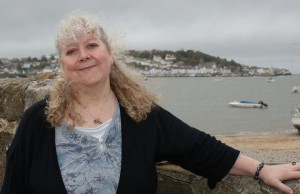
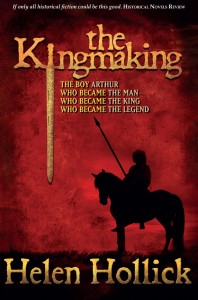
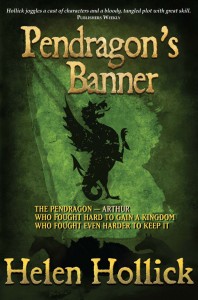
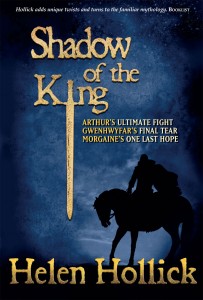
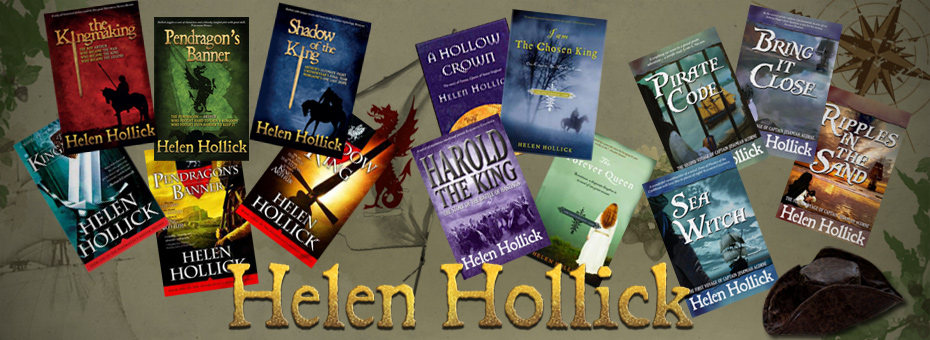
 My first special guest this spring is Helen Hollick, author of The Pendragon’s Banner trilogy (The Kingmaking, Pendragon’s Banner, Shadow of the King), a re-telling of the King Arthur legend where Arthur Pendragon is a post-Roman battle-hardened warlord. Before that, she wrote The Saxon Series (Harold the King (US – I Am the Chosen King) and A Hollow Crown (US – The Forever Queen). Now she’s into pirates, especially Captain Jesamiah Acorne, in her Sea Witch historical fantasy series for adults. So let’s find out why…
Welcome Helen!
The question I’ve been longing to ask you – why Arthur?
 More than thirty years ago I worked in a public library. My passion was for science fiction and fantasy, with unfinished scribbled stories written on scraps of paper. I stumbled upon Mary Stewart’s The Hollow Hills and The Crystal Cave, and loved them. Here was a blend of believable fantasy entwined within an historical novel, and the author’s note mentioned that if Arthur had existed it would have been in that Dark Age period between the going of the Romans and the coming of the Anglo-Saxons, the late fifth, early sixth century.
I had never been drawn to the traditional Arthurian tales of knights in armour, courtly love or the search for the Holy Grail. Guinevere always annoyed me and I couldn’t stand Lancelot. These stories mirrored the post-Norman Conquest world, the Crusades, Henry and Eleanor and Richard I, where, to my mind, there was no place for Arthur. They did not feel right, but Arthur as a post-Roman warlord? Ah! That was intriguing!
 I devoured non-fiction to develop my own ideas, and thirsted for novels. One of the most notable was Sword At Sunset by Rosemary Sutcliff (I still have my somewhat worn edition). Another was The Mists of Avalon by Marion Zimmer Bradley. A good story but there were errors of historical detail, and Guinevere drove me to screaming point! Why was the character so weak? So stupid? Frankly, I saw her as a spoilt madam.
 I cast the novel aside and decided to write the story as I saw Gwenhwyfar (my spelling of her name). The several false starts were frustrating, page after page ended up scrunched into a ball and tossed into the bin – then I realised that telling it from her point of view was not going to work. I needed to get into Arthur’s skin, not hers.
The result, after ten years of stop-start writing was a draft manuscript of what became The Kingmaking and Pendragon’s Banner followed by a publishing contract with William Heinemann.
So in 2006 you switched periods and subject – why pirates?
After finishing my Arthurian trilogy with the third book, Shadow of the King, I went on to write about the Battle of Hastings from the English point of view (Harold the King UK title and I am the Chosen King US title). That was followed by a prequel about the Saxon Queen, Emma and her two husbands, Æthleread and King Cnut (Canute). Unfortunately, interest in historical fiction had taken a tumble and my publisher lost interest in my books.
 My agent suggested I go back to fantasy, which appealed as I had become interested in the Golden Age of Piracy (early seventeenth century) after falling for Johnny Depp’s character Jack Sparrow. Pirates meant swashbuckling adventure and tongue-in-cheek fun. I wanted to read books that were like The Curse of The Black Pearl, the first Pirates of the Caribbean movie, but beyond children’s stories I could find nothing in print. There were many seafaring novels: Patrick O’Brian, C.S. Forrester, Julian Stockwin… all good reads, but serious Royal Navy adventures set during the Napoleonic Wars. Where was the sexy hero with gold earring and cutlass, swigging rum and eyeing the wenches in a local tavern? Where was the fun of make-believe? I gave up the search and wrote Sea Witch.
My lead character is Captain Jesamiah Acorne, his girlfriend is Tiola Oldstagh, a midwife, healer – and a white witch. I describe Jesamiah as a cross between Jack Aubrey, Jack Sparrow, James Bond, Richard Sharpe (Bernard Cornwell’s hero played on TV by Sean Bean) and Indiana Jones.
The only problem, my agent regarded pirate stories as children’s books and Sea Witch was very firmly adult. She told me to re-write it for teenage boys. I refused. It looked like Sea Witch was to be scuppered before she even set sail as the manuscript was returned to me with red lines across fifty pages with sarcastic comments scrawled in the margin. Soon after came a telephone call informing me that Heinemann had dropped me, so as I no longer needed an agent: goodbye.
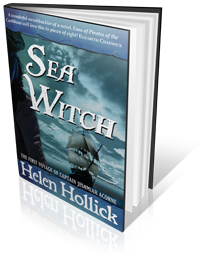 I was gutted but I was not going to abandon my pirate. I believed in him too much. My option was to self-publish my backlist, but depressingly, I received rejects from publishers for Sea Witch on the grounds that, although well-written and exciting, adults were not interested in reading pirate adventures. Had these people not heard of Jack Sparrow or the adult following that had burst like a cannon blast upon the world of entertainment? Forums and social media sites were crammed with adults – men and women – talking about pirates, re-enacting pirates, craving pirates….
So I self-published Sea Witch as well. Best decision I ever made.
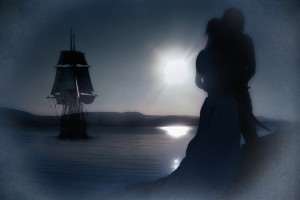 Jesamiah has a massive fan base and I have started his fifth Voyage: On The Account. Once again he finds himself in trouble with various characters who are up to no good, excise men who want him hanged, colony governors who need his ‘experienced’ help, and black-hearted pirates who don’t. There are seductive women who want his other experienced charms, and a wife who is annoyed because of them!
My Sea Witch Voyages are fun to write and read; they are not meant to be taken seriously but as adult escapism, which is why exciting stories about charismatic pirates, despite what publishers and ex-agents think, are popular with adult readers!
Well, I loved Sea Witch, the first in the series. The others are on my TBR pile singing a siren song enticing me away from my own writing. Or maybe it’s Tiola…
More about Helen here: Let us Talk of Many Things; of Books and Queens and Pirates, of History and Kings…And Helen’s books here: Helen Hollick’s World of Books
Alison Morton is the author of Roma Nova thrillers, INCEPTIO, and PERFIDITAS. Third in series, SUCCESSIO, is out early summer 2014.